
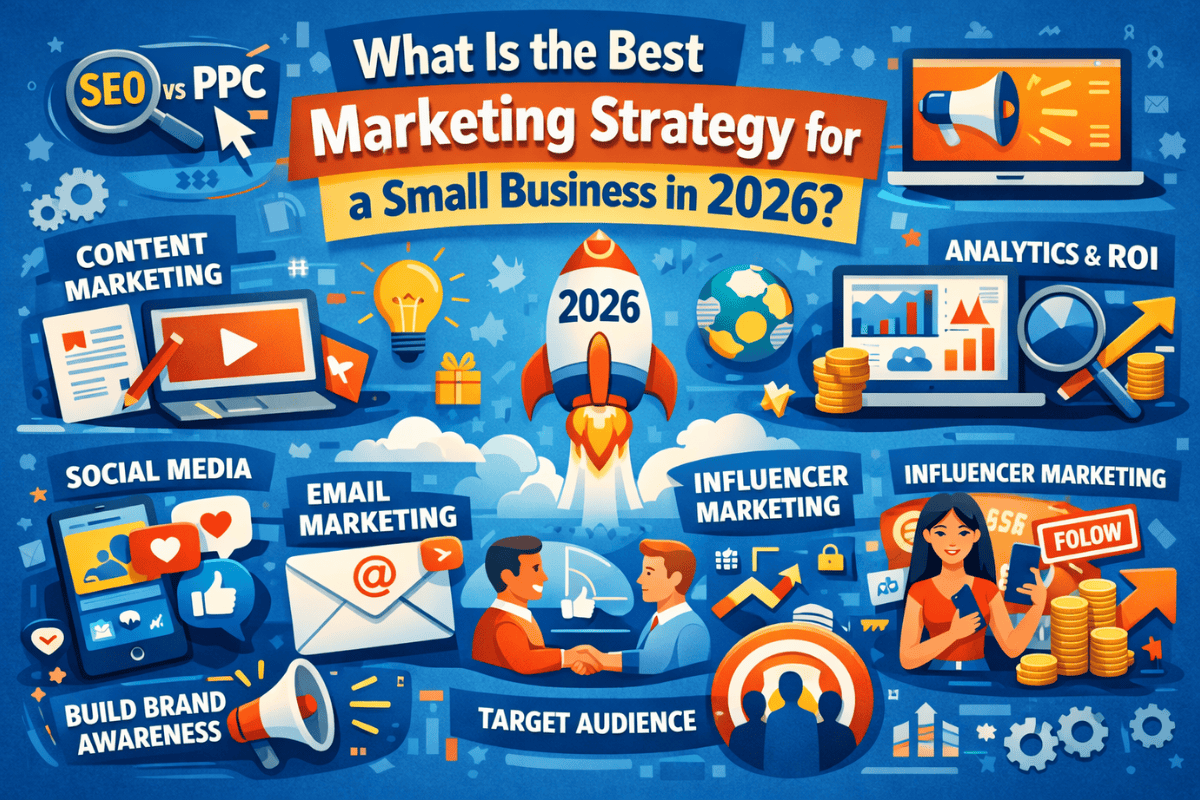
A 2026 marketing strategy can’t look like a 2022 checklist. Small businesses are competing in a world where customers discover brands through AI-powered search results, short-form video feeds, local listings, and review platforms — often without ever clicking a traditional “blue link.” At the same time, digital advertising has become more competitive, customer trust is harder to earn, and “being everywhere” is now the fastest way to burn time and budget.
So, what is the best marketing strategy for small business growth in 2026? It’s the strategy that creates predictable leads and sales while staying realistic for a small team: a focused small business marketing plan built on (1) strong owned assets, (2) one primary growth channel, (3) one supporting channel, and (4) consistent measurement and optimization.
This guide is designed for small business owners, startups, and lean teams who want marketing that produces results — not just activity. We’ll cover the most effective marketing strategies for small businesses, including digital marketing, content marketing, email marketing, social media marketing, referral marketing and word-of-mouth marketing. We’ll also break down the ongoing debate of ppc vs seo and show you how to choose the best approach for your marketing budget and business goals.
If you want to build brand awareness, drive sales, and improve return on investment, you’re in the right place. Let’s build your 2026 marketing strategy for small business growth — step by step.
Key Takeaways: Best Marketing Strategy for Small Business in 2026
- Focus wins in 2026. Pick one primary marketing channel (SEO, PPC, email, partnerships) and one support channel. Doing five channels “okay” usually loses to doing two channels exceptionally well.
- Owned assets beat rented attention. Your business website, email list, and Google Business Profile (for local businesses) are marketing assets you control, even if social algorithms change.
- SEO compounds; PPC accelerates. SEO and content marketing build long-term momentum. PPC creates quick lead flow — but needs tight targeting and conversion tracking to protect ROI.
- Retention is a growth strategy. Email marketing, referral systems, and review generation can lower customer acquisition cost and increase lifetime value.
- Measure what matters. A 2026 marketing strategy for small business should track leads, booked calls, revenue, and customer lifetime value — not vanity metrics.
What “Best” Really Means in a 2026 Marketing Strategy
In 2026, the “best” marketing strategy is not a single tactic like “post on social daily” or “run Google Ads.” It’s a system that helps you reach the right target audience, communicate your value, and convert potential customers at a sustainable cost.
For a small business owner, “best” usually means:
- Predictability: You can estimate lead volume and sales with reasonable confidence.
- Efficiency: Your marketing efforts fit your marketing budget and time constraints.
- Durability: Your results don’t disappear the moment you stop spending money or posting.
- Scalability: The strategy supports business growth as you add capacity.
That “best” strategy depends on your business model:
- Local services: Local SEO, Google Business Profile, reviews, and community partnerships often outperform trendy channels.
- Ecommerce: Paid social, search ads, creator/influencer marketing, and email flows are often the highest ROI marketing activities.
- B2B or high-ticket services: Content marketing, search engine optimization, and email marketing nurture are typically the most effective strategy mix.
- Startups/new business: PPC and short-cycle experiments help validate messaging and offers quickly.
Whatever you sell — product or service — the goal is the same: choose marketing strategies that match how your customers buy. The SBA marketing and sales guide is a helpful reminder that effective marketing starts with understanding your customer, clarifying your message, and building a plan you can execute consistently.
The 2026 Small Business Marketing Plan Framework (Step-by-Step)
Step 1: Start With Market Research (Not Guesswork)
Market research doesn’t need to be complicated. For a small business, it’s about getting real-world clarity on your target market and competitors so you don’t waste your marketing budget. Use a simple approach:
- Customer interviews: Ask 10 customers why they chose you, what they feared, and what nearly stopped them from buying.
- Review mining: Read reviews of your business and your competitors. Note repeated pain points and “desired outcomes.”
- Search research: Look at what people type into a search engine (and what questions show up in “People also ask”).
- Offer comparison: Identify what competitors bundle, their pricing signals, guarantees, and messaging.
The output of research is not a report — it’s a sharper marketing message. When your marketing speaks directly to the customer’s problem, your campaign performance improves across every marketing channel.
Step 2: Define Your Positioning and Your “No-Brainer” Offer
Positioning is how customers understand what you do and why you’re different. Your offer is how you package the value into something people can say “yes” to. In 2026, clarity wins because attention is expensive.
Strong positioning answers:
- Who you help (target audience)
- What outcome you deliver
- How you deliver it differently
- Why you’re credible (proof, experience, results)
A strong offer reduces friction. It might be a clear package, a first-time customer bundle, a service tier, or a consult + roadmap. The best marketing strategy for small business becomes much easier when your offer is easy to understand and easy to choose.
Step 3: Pick One Primary Channel and One Supporting Channel
Many small businesses stall because they spread effort across too many marketing strategies: a little SEO, a little PPC, a little social, a little email, a little “maybe influencers”… and nothing gets enough repetition to work.
Instead, choose:
- Primary channel: the main growth engine (example: SEO, PPC, partnerships, outbound, local listings)
- Support channel: the amplifier (example: email marketing, social distribution, referral marketing, retargeting)
This is how you turn scattered marketing initiatives into a coherent small business marketing plan.
Step 4: Set a Realistic Marketing Budget (Money + Time)
A marketing budget is not only dollars — it’s time, energy, and consistency. If you have $500/month but no time, you may rely more on digital advertising and automation. If you have time but limited cash, content marketing and SEO may be your best route.
Practical budgeting rules for small businesses:
- Protect your baseline: fund the channel that already produces leads before chasing new channels.
- Reserve a test budget: 10–20% of your marketing costs for experiments.
- Commit long enough: SEO/content typically needs months; PPC can show data in days, but still needs optimization cycles.
Step 5: Define KPIs That Map to Business Goals
In 2026, measurement separates effective marketing from expensive noise. Track metrics that match your business plan:
- Top of funnel: traffic, impressions, reach (useful, but not the goal)
- Mid funnel: leads, calls, form submissions, email subscribers
- Bottom funnel: booked appointments, purchases, proposals sent
- Revenue metrics: conversion rate, customer acquisition cost, lifetime value, return on investment
If you can’t track conversions, you can’t optimize — and “optimize” is where small business marketing becomes profitable.

Your Owned Assets Foundation (Website, Tracking, and Google Business Profile)
Your Business Website: The Home Base for Marketing
Your business website is not a brochure. In a strong digital marketing strategy, it’s your conversion engine. Whether your campaign is SEO, PPC, referral, or social media marketing, most journeys end at your site. In 2026, the best marketing strategy for small business owners includes a website built to convert.
High-impact website elements:
- Clear headline and offer: state who you help and what outcome you deliver.
- Strong proof: testimonials, reviews, case studies, before/after, certifications.
- Conversion paths: calls, booking, forms, lead magnets, and a clear next step.
- Service/product clarity: dedicated pages for each major offering (great for search engine optimization).
- Speed and mobile experience: most small business traffic is mobile-first.
Tracking: The Minimum Viable Measurement Stack
You don’t need an enterprise toolset to track ROI. You need consistent attribution and a simple reporting rhythm.
- Analytics: basic website analytics to understand traffic and engagement.
- Conversion tracking: forms, calls, bookings, purchases.
- CRM or pipeline: track lead status so you know what became revenue.
- Reporting cadence: weekly check-in, monthly deep dive.
Google Business Profile: A Must for Local Small Business Marketing
If you serve a local area, your Google Business Profile is one of the highest-leverage marketing tools available. It powers local pack visibility, maps results, and review-driven trust. In many industries, customers decide who to contact before they ever reach your website.
Google Business Profile optimization checklist:
- Correct categories and services
- High-quality photos and short videos
- Consistent business info (name, address, phone)
- Weekly updates/posts (when relevant)
- A review generation system that runs every week
For local businesses, this is often the fastest path to building brand awareness and driving leads — especially when paired with SEO and referral marketing.
Digital Marketing in 2026: The Core Channel Stack That Works for Most Small Businesses
Most small businesses don’t need 12 marketing channels. They need a digital marketing strategy that uses a few channels with tight execution. In 2026, the most reliable stack looks like this:
- Content marketing to build trust and visibility
- SEO to capture high-intent demand
- Email marketing to monetize and retain customers
- Social media marketing to distribute and reinforce (not to replace everything)
- Referral and word-of-mouth marketing to reduce acquisition cost
Content Marketing: The Compounding Asset
Content marketing is still one of the most effective marketing strategies for small businesses because it compounds. A good piece of content can generate leads for months or years. In contrast, a paid campaign stops the moment you stop paying.
In 2026, content that performs best is:
- High-intent: answers “buying” questions (pricing, comparisons, best options, “near me,” problem/solution)
- Outcome-focused: speaks to results, not features
- Structured: scannable headings, short paragraphs, lists, and clear answers
- Credible: uses proof, examples, and expert framing
High-performing content types for small business marketing:
- Service pages: one page per core service, optimized for search engine intent
- Comparison pages: “ppc vs seo,” “option A vs option B,” “best tool for X”
- Local pages: service + city/area pages when appropriate (avoid spam; make them genuinely helpful)
- FAQ clusters: groups of questions that customers ask before buying
- Video marketing: short explainers that can be repurposed across channels
Need a practical refresher on small business marketing basics? The NerdWallet small business marketing guide is a solid overview of channels and planning considerations.
SEO in 2026: Traditional Search + AI-Driven Discovery
Search engine optimization is still worth it in 2026 — but “SEO” now includes more than ranking for a keyword. Customers discover businesses through local packs, review snippets, video results, AI summaries, and “zero-click” answers. That means a modern 2026 marketing strategy for small business should optimize for:
- Entity clarity: make it easy for search systems to understand who you are, what you do, and where you operate.
- Trust signals: consistent brand info, reviews, testimonials, credentials, and real-world proof.
- Helpful structure: direct answers, scannable formatting, and clean internal linking.
- Local strength: GBP optimization, review velocity, and location relevance.
Simple SEO priorities that help small businesses compete:
- Fix the basics: site speed, mobile usability, indexable pages, clear navigation.
- Build high-intent pages: create pages around services, problems solved, and buyer questions.
- Earn trust: collect reviews, showcase expertise, and publish content that demonstrates experience.
- Use internal links: connect related pages so your website becomes a topical hub.
- Optimize for conversions: traffic is not the goal; leads and sales are.

Email Marketing: The Profit Multiplier
Email marketing remains one of the highest ROI marketing channels because it lets you follow up with people who already showed interest. For small business owners, email is also a defense against unpredictable algorithms on social media and rising ad costs.
Foundational email marketing flows for a small business marketing plan:
- Welcome sequence: 3–5 emails that introduce your brand, clarify your offer, and guide the next step.
- Nurture newsletter: consistent, helpful updates that keep you top-of-mind.
- Post-purchase follow-up: increase retention, reviews, and referrals.
- Reactivation campaign: bring back past customers with a timely offer.
If your marketing campaign brings in leads but you don’t follow up well, your ROI collapses. Email fixes that.
Social Media Marketing: Distribution, Not the Whole Plan
Social media marketing can be powerful, but it’s often misunderstood. Social is best used as a distribution and trust channel — a way to amplify your content marketing, show proof, and stay visible to your target audience. It is rarely the best standalone growth strategy for small businesses unless you have a creator-driven brand or a highly visual product.
What a smart social media strategy looks like in 2026:
- Pick one platform: where your customers actually spend time.
- Use repeatable content themes: FAQs, behind-the-scenes, customer results, quick tips, myths vs facts.
- Repurpose content: one blog post can become 5–10 short posts, a video script, and an email.
- Build trust: show your process, your standards, and your proof.
Referral + Word-of-Mouth Marketing: Systematize What Already Works
Word-of-mouth is often the #1 growth driver for small businesses — but most businesses treat it like luck. Turn it into a system.
Referral marketing ideas that help small businesses:
- Ask at the right moment: immediately after delivering a win for the customer.
- Create a simple incentive: account credit, gift card, upgrade, or exclusive bonus.
- Partner with complementary businesses: trade referrals with businesses that serve the same target market without competing.
- Make it easy: provide a link, a one-sentence referral message, or a simple “share this” page.
When you combine referrals with email marketing and reviews, your marketing costs drop and your brand awareness increases faster.
PPC vs SEO in 2026: Which One Should a Small Business Prioritize?
The ppc vs seo question is one of the most common decisions in a 2026 marketing strategy for small business. Both channels work — but they work differently.
| Factor | PPC (Pay-Per-Click) | SEO (Search Engine Optimization) |
|---|---|---|
| Time to results | Fast (days to weeks) | Slower (months) |
| Cost structure | Pay per click/lead; costs can rise | Upfront time/content investment; lower marginal cost over time |
| Best for | Immediate lead flow, seasonal promos, offer testing | Long-term demand capture, authority, predictable inbound leads |
| Compounding effect | Low (stops when spend stops) | High (content and rankings can compound) |
| Risk | Wasted spend without tracking and conversion optimization | Slow ramp; requires consistency |
When PPC Wins for Small Businesses
PPC is often the best channel when you need speed or certainty. It can be the right choice if:
- You’re a new business and need leads now
- You have a proven offer and want to scale quickly
- You’re in a seasonal industry and need short-term boosts
- You want to test messaging, pricing, and landing pages
But PPC requires discipline: tight targeting, clear landing pages, conversion tracking, and ongoing optimization. Otherwise, marketing and advertising becomes a leak.
When SEO Wins for Small Businesses
SEO is often the best marketing strategy for small business owners who want sustainable growth. It can be the right choice if:
- Your market searches for your service regularly
- You want lower marketing costs long term
- You have expertise you can turn into content
- You serve a local area and want to dominate local search
The Best Answer in 2026: A Hybrid Strategy
For many small businesses, the best strategy is hybrid:
- Use PPC to capture demand now (high intent searches, retargeting, offer testing).
- Build SEO + content marketing to compound visibility and reduce reliance on paid spend.
If you’re looking for additional practical business growth guidance related to marketing strategy, The Hartford’s small business marketing tips is another useful non-competitive resource.
Marketing Automation and AI Tools for Small Businesses in 2026
Marketing automation is no longer “nice to have.” In 2026, it’s how small teams compete. The goal is not to automate everything — it’s to automate the repetitive parts so you can spend human time where it matters: strategy, relationships, creative, and service delivery.
What to Automate First (Highest ROI)
- Lead capture: forms, booking links, and automated confirmations
- Speed-to-lead follow-up: instant response emails + text reminders where appropriate
- Email sequences: welcome, nurture, post-purchase, reactivation
- Review requests: a consistent system for Google reviews and testimonials
- Reporting dashboards: basic KPI snapshots so you can optimize faster
Smart AI Uses That Don’t Break Trust
AI can help small businesses create content faster and improve marketing efforts — but it works best as an assistant, not a replacement for expertise.
- Content support: outlines, repurposing, summarizing long pieces into social snippets
- Ad iteration: variations of headlines and descriptions for testing
- SEO support: topic clustering ideas, FAQ expansion, schema drafts (human-reviewed)
- Customer insights: categorizing objections from calls, emails, and reviews
Guardrails matter: keep claims accurate, review everything, and ensure your brand voice stays human.
A 90-Day Implementation Plan for the Best Marketing Strategy for Small Business in 2026
Execution is where most small business marketing plans fail — not because people aren’t trying, but because the plan is too complicated. Here’s a 90-day plan that keeps your strategy focused and measurable.
Weeks 1–2: Foundation and Clarity
- Confirm your target market and top 3 customer pain points
- Refine your positioning statement and main offer
- Audit your business website for clarity and conversion paths
- Set up tracking: key conversions, call tracking if relevant, and a simple CRM pipeline
- For local businesses: optimize Google Business Profile and create a review request process
Deliverables: messaging doc, offer page (or service page), tracking checklist, baseline KPI snapshot.
Weeks 3–6: Build the Core Growth Assets
This is where your content marketing and SEO foundation becomes real. Build assets that continue to perform.
- Create 3–6 high-intent pages (service pages, “best for” pages, comparison pages)
- Create one lead magnet that fits your buyers (checklist, guide, quote builder, assessment)
- Build an email welcome sequence (3–5 emails)
- Create a simple “proof” system: testimonials, case studies, before/after, or a results page
Deliverables: content pages live, lead magnet live, email automation active, proof elements added to site.
Weeks 7–10: Launch and Promote (Choose Your Primary Channel)
Now you push your primary channel.
- If SEO is primary: publish one high-intent content piece per week, build internal links, and strengthen local signals
- If PPC is primary: launch 1–2 tightly focused campaigns with conversion tracking and a dedicated landing page
- If social is support: repurpose weekly content into 3–5 posts and 1–2 short videos
- If email is support: send a weekly or biweekly newsletter to drive repeat visits and conversions
Deliverables: campaign live, weekly publishing rhythm, distribution checklist, weekly KPI review.
Weeks 11–12: Optimize, Double Down, and Systematize
- Identify the highest-performing pages/ads
- Improve conversion rates (headlines, CTAs, proof, offers)
- Cut what doesn’t work and reallocate budget/time
- Systematize referrals and review generation
- Create your next 90-day content and campaign calendar
Deliverables: optimization log, updated budget allocation, next-quarter plan, and a repeatable marketing system.
Common Mistakes That Kill Small Business Marketing ROI in 2026
1) Doing Too Many Marketing Strategies at Once
When you try to run SEO, PPC, social media marketing, influencer marketing, and email marketing simultaneously — with a small team — everything becomes inconsistent. The best marketing strategy for small business is often simpler than expected: fewer channels, better execution.
2) No Clear Offer (Or Too Many Offers)
If your website and messaging don’t quickly answer “What do you do, who is it for, and what should I do next?” your marketing efforts will struggle. Offer clarity is conversion clarity.
3) Chasing Vanity Metrics
Likes and views can support brand awareness, but they’re not a business plan. Track metrics that map to revenue: leads, booked calls, purchases, customer acquisition cost, and lifetime value.
4) Ignoring Retention and Word-of-Mouth
Retention is often the most profitable growth strategy. Email marketing, referral marketing, and review systems increase ROI without increasing ad spend.
5) Not Optimizing
Marketing is not “set it and forget it.” Every campaign should run through a cycle: launch → measure → optimize → scale.
Ready to Build Your 2026 Marketing Strategy for Small Business?
If you’re tired of random marketing activities and want a small business marketing plan that drives real leads and sales, Innovative Flare can help you build a focused strategy and execute it with clarity.
Whether you need a digital marketing strategy, a content marketing plan, or a smarter approach to ppc vs seo, we’ll help you prioritize the right marketing channel, optimize your funnel, and improve ROI.
Book your strategy call with Innovative Flare:
call.innovativeflare.com
2026 Marketing Strategy for Small Business FAQs
1) What is the best marketing strategy for a small business in 2026?
The best marketing strategy for small business in 2026 is a focused system: strong owned assets (website, email list, local listings), one primary growth channel (SEO or PPC for most), one supporting channel (email, social distribution, referrals), and consistent optimization based on ROI.
2) What should be included in a small business marketing plan?
A strong small business marketing plan includes your target audience definition, positioning, offers, chosen marketing channels, budget, KPIs, content plan, campaign calendar, and a process to measure and optimize performance.
3) How much should small businesses spend on marketing in 2026?
There isn’t one perfect number, but many small business owners plan a percentage of revenue plus a test budget for growth initiatives. The key is to tie spend to measurable outcomes and protect ROI through tracking and conversion optimization.
4) Is SEO still worth it in 2026 with AI search?
Yes. SEO is still one of the most effective marketing strategies because it captures high-intent demand and compounds over time. In 2026, SEO success also includes strong local signals, structured content, and credibility (reviews, proof, expertise).
5) PPC vs SEO: which is better for fast growth?
PPC is better for fast growth because it can generate leads quickly. SEO is better for sustainable growth. Many businesses use a hybrid: PPC for immediate demand capture and SEO/content marketing for long-term momentum.
6) What’s the best digital marketing channel for local businesses?
For many local businesses, the best channel mix is Google Business Profile + reviews + local SEO, supported by referral marketing and email follow-up. This combination builds trust and drives high-intent calls.
7) How long does content marketing take to work?
Content marketing is typically a medium-to-long-term strategy. Some pieces can generate quick wins, but compounding results usually come from consistent publishing and optimization over months.
8) What are low-cost marketing tactics that work in 2026?
Low-cost marketing tactics include referral marketing, word-of-mouth systems, email marketing, SEO, and partnerships with complementary businesses. These tactics often improve ROI because they leverage trust and existing relationships.
9) How do I measure marketing ROI as a small business owner?
Measure ROI by tracking leads and sales back to the marketing channel that generated them. At minimum, track cost per lead, conversion rate, customer acquisition cost, and revenue generated. Without conversion tracking, you can’t reliably optimize.
10) Do I need social media marketing to grow my business in 2026?
Not always. Social media marketing can help build brand awareness and trust, but it works best as a supporting channel that distributes your content and proof. Many small businesses grow faster by prioritizing SEO, PPC, email marketing, and referrals.
Conclusion: The Best 2026 Marketing Strategy Is Focus + Systems
The best marketing strategy for small business in 2026 is not about doing everything. It’s about choosing the right growth channel, building owned assets that compound, and optimizing your marketing efforts around real business outcomes. If you start with clarity, commit to consistent execution, and measure ROI, you can build a marketing system that drives sustainable business growth.
Pick one primary channel. Add one support channel. Build your content and follow-up systems. Then optimize. That’s how small businesses win in 2026.