seolounge
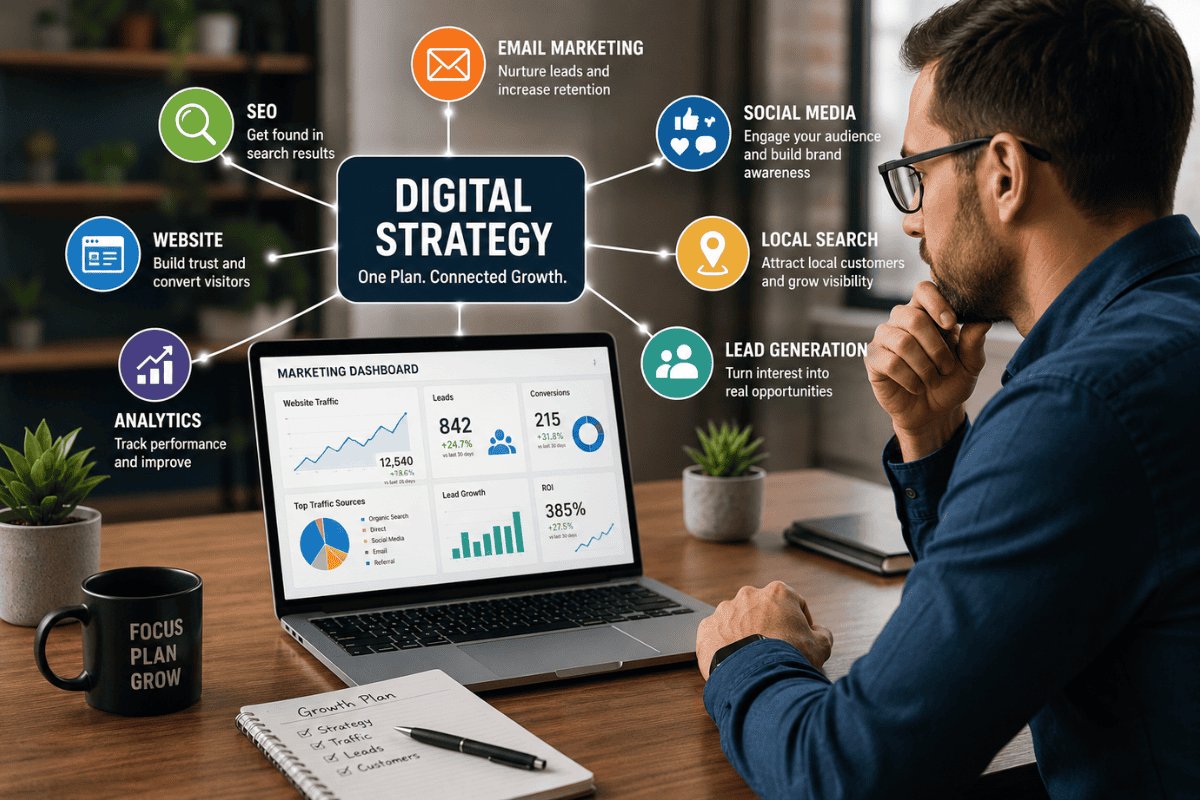
Many small business owners are working harder than ever on marketing, yet their digital presence still feels scattered. They post on social media, update their website, send emails, try SEO, and maybe run ads, but the results do not always match the effort.
The problem is rarely a lack of ambition. Most small businesses struggle because their marketing activities are disconnected from a clear business strategy. Without a unified plan, every channel competes for attention instead of supporting the same growth goal.
A strong small business digital strategy brings order to the chaos. It connects SEO, content creation, social media marketing, email marketing, website development, analytics, and lead generation into one system. When those pieces work together, your online presence becomes easier to manage, measure, and optimize for long-term business growth.
Key Takeaways
- Most small businesses do not fail from lack of effort: They struggle because their digital marketing efforts are often disconnected from a clear marketing strategy and measurable business goals.
- Tactics are not the same as strategy: Posting on social media, writing blogs, running ads, or improving SEO can help, but each activity must support a larger online growth strategy.
- Every small business needs a connected digital system: Your website, content marketing, search engine optimization, email marketing, social media presence, Google Business Profile, and analytics should work together.
- Budget problems are often strategy problems: A limited marketing budget becomes more effective when small business owners prioritize the right marketing channels instead of spreading resources too thin.
- Measurement matters: Analytics, website traffic, lead generation, conversion rates, and ROI help businesses understand what is working and where to optimize.
- Growth comes from alignment: A strong small business digital strategy connects marketing activities to customer needs, business goals, and long-term digital transformation.
What Is a Small Business Digital Strategy?
A small business digital strategy is a clear plan for how your business uses online marketing channels to attract, educate, convert, and retain customers. It is not one campaign, one platform, or one marketing activity. It is the system that connects your website, SEO, content marketing, social media platforms, email marketing, local search, paid campaigns, analytics, and conversion goals.
For example, a local business might use search engine optimization to increase website traffic, blog content creation to answer customer questions, social media engagement to build trust, and email marketing to follow up with leads. When these channels support the same business goals, the digital presence becomes stronger and easier to measure.
Many small businesses face marketing challenges because they skip the planning stage. They try digital tools without first identifying their target audience, business needs, budget, message, and desired ROI. A strong digital marketing strategy gives your business direction, helping every marketing effort support online growth instead of creating more noise.
Signs Your Business Has a Strategy Problem
A strategy problem usually shows up before a sales problem. Many small businesses often blame the platform, the algorithm, or the marketing budget, but the real issue is that their marketing efforts are not connected to a clear plan.
One sign is inconsistent results. You may get website traffic but few leads, social media engagement but no inquiries, or email marketing clicks that never turn into sales. Another warning sign is channel confusion. If your business is posting on LinkedIn, updating a Google Business Profile, running ads, and publishing content without knowing how each activity supports lead generation, your digital marketing strategy needs structure.
Small business owners may also notice that every campaign feels like starting over. There is no reusable content strategy, no defined target audience, no consistent message, and no analytics process to measure ROI. This creates wasted time and unclear priorities.
A strong small business digital strategy fixes this by giving every marketing activity a purpose. Instead of guessing, your business can focus on the channels, content, and digital tools most likely to support growth.
The Difference Between Marketing Tactics and Marketing Strategy
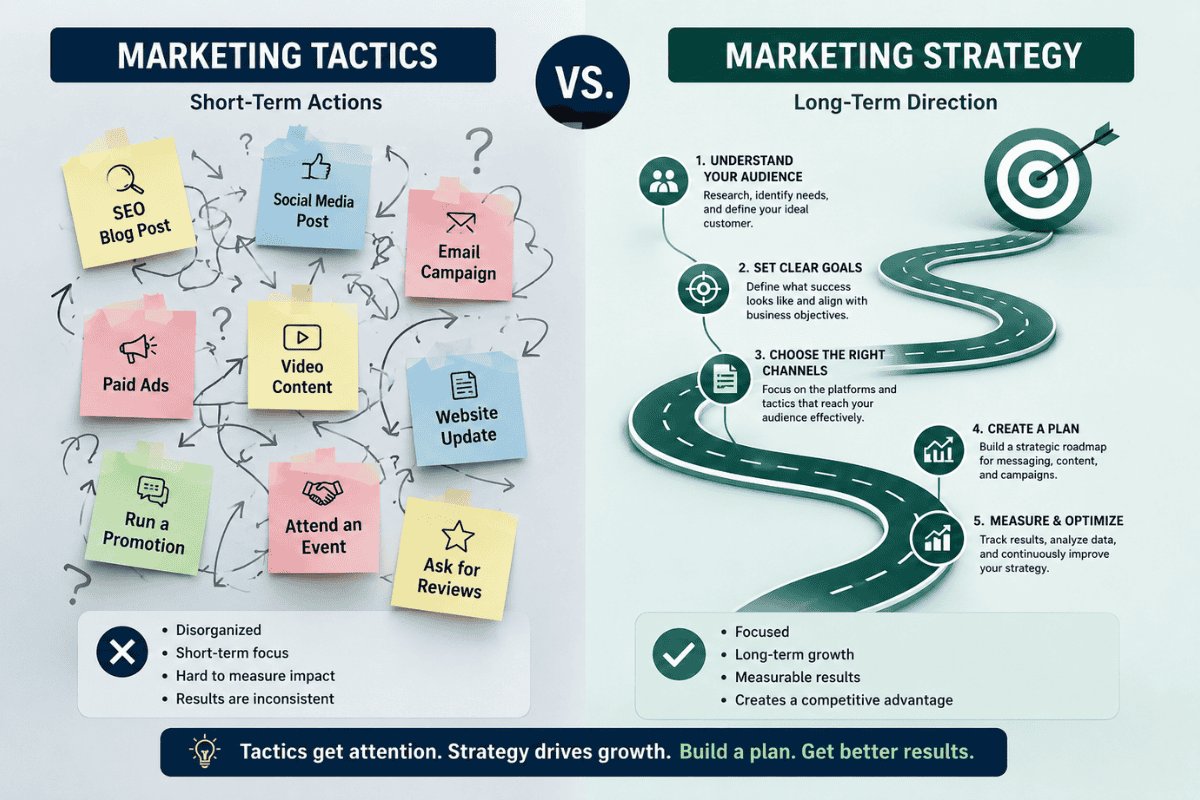
One of the biggest reasons many small businesses struggle online is that they confuse tactics with strategy. A tactic is a single action, such as posting on social media, writing a blog post, sending an email, improving SEO, or running a paid ad. A marketing strategy explains why those actions matter, who they are meant to reach, and how they support business growth.
For example, posting three times a week on social media platforms is a tactic. Creating content that resonates with a defined target audience, drives website traffic, supports lead generation, and moves people toward a consultation is strategy. The same applies to search engine optimization. Adding keywords to a page is a tactic. Building an online presence around customer intent, local search, content quality, and conversion paths is a digital marketing strategy.
Small businesses often still struggle because they collect tactics without connecting them. They try SEO, LinkedIn, email marketing, content creation, and ads separately, then wonder why ROI is unclear. A good digital marketing plan turns individual marketing activities into a system. Every channel has a purpose, every message supports the same business goals, and every result can be measured and optimized.
Why Small Businesses Often Struggle Online
Small businesses often struggle online because digital marketing feels urgent, but strategy feels optional. When sales slow down, many small business owners react quickly by posting more, boosting ads, changing website copy, or trying a new marketing channel. Those actions may create activity, but they do not always create momentum.
The deeper issue is usually misalignment. A business may have a website that does not clearly explain its offer, social media content that attracts the wrong audience, SEO pages that do not match search intent, and email marketing that only appears during promotions. Each piece exists, but the digital presence does not guide customers through a clear journey.
Budget pressure makes this harder. Running a small business means every dollar matters, so owners often choose low-cost tactics without knowing whether they fit the larger marketing plan. This can lead to inconsistent branding, weak lead generation, and unclear ROI.
To thrive in the digital landscape, small businesses must stop treating marketing as separate tasks. A stronger approach connects customer needs, business goals, digital tools, and marketing best practices into one practical online growth strategy.
Common Digital Marketing Challenges Small Businesses Face
Many small businesses face the same digital marketing challenges, even when they serve different industries. The first challenge is limited clarity. Business owners know they need marketing, but they may not know which marketing channels matter most for their target audience, budget, and business goals.
The second challenge is inconsistency. A business may post on social media for two weeks, send one email campaign, update its Google Business Profile, then stop when daily operations become busy. Running a small business requires constant attention, so marketing often becomes reactive instead of planned.
The third challenge is weak measurement. Without analytics, it is difficult to know whether website traffic, search results, social media engagement, or email marketing are producing real ROI. This makes it harder to optimize campaigns or justify a marketing budget.
Another common issue is disconnected messaging. A customer might see one offer on LinkedIn, another on the website, and a different message in an email. Effective marketing for small businesses requires consistency across every digital touchpoint. When the message, offer, audience, and follow-up process align, digital marketing efforts become easier to manage and more likely to support business growth.
How Limited Budgets Affect Marketing Decisions
A limited marketing budget does not have to stop growth, but it can create problems when small business owners spend without a clear plan. Many small businesses try to do everything at once: SEO, paid ads, social media marketing, email marketing, website updates, content creation, and local search. When the budget is spread too thin, no channel gets enough focus to perform well.
The smarter approach is prioritization. A local business with weak search visibility may need to focus first on search engine optimization, Google Business Profile improvements, and website development. A service-based business with steady website traffic but few inquiries may need conversion optimization, stronger calls to action, and better lead generation follow-up.
Budget also affects consistency. Small businesses often pause marketing campaigns too early because they do not see immediate ROI. But good digital marketing strategies usually need time, testing, and analytics to improve. Cost-effective strategies are not random cheap tactics. They are focused choices based on business needs, customer behavior, and measurable goals.
When every dollar has a purpose, even a modest marketing budget can help small businesses create a stronger online presence and grow your business sustainably.
Why Understanding Your Target Audience Comes First
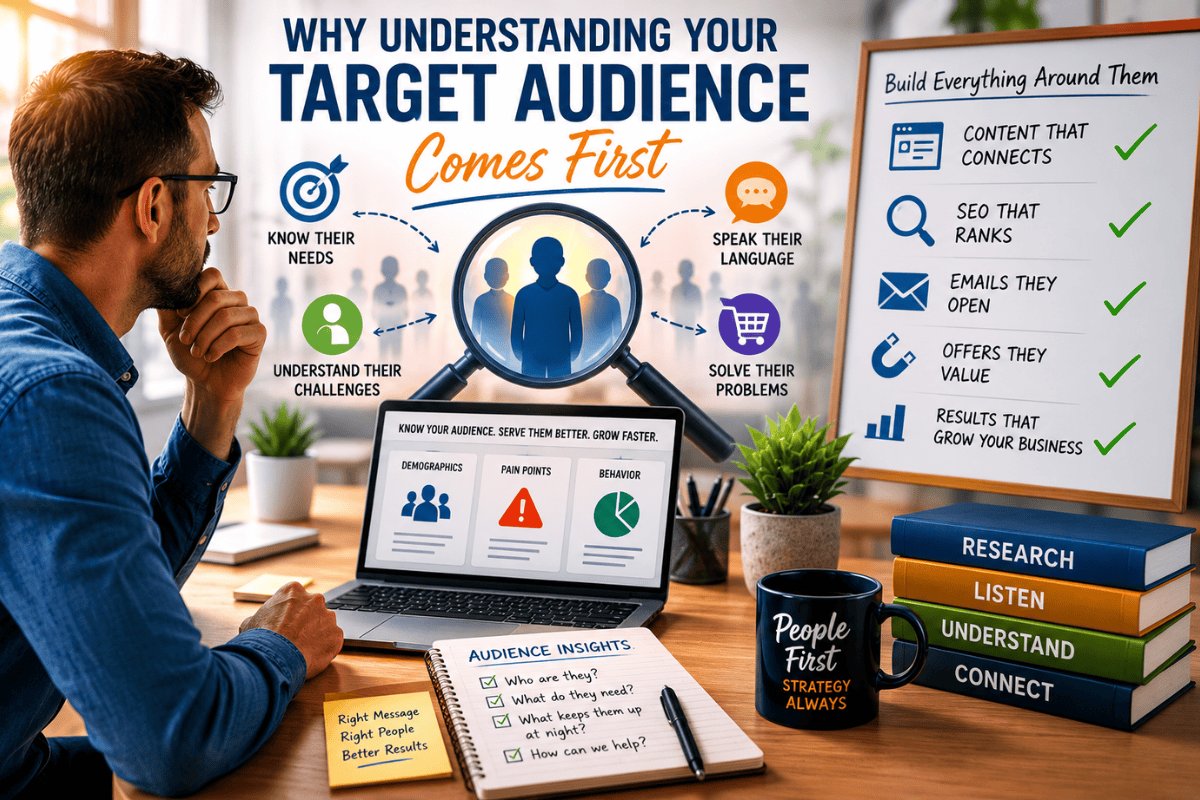
Every effective small business digital strategy starts with the target audience. Before choosing marketing channels, writing content, improving SEO, or running campaigns, a business needs to know who it is trying to reach and what those customers actually need.
Many small businesses struggle because they market from their own perspective instead of the customer’s. They describe services, features, or credentials, but they do not clearly answer the questions buyers are asking: Can this solve my problem? Do I trust this business? Is this the right fit for my budget, timeline, and goals?
Understanding the audience improves every part of digital marketing. It helps shape website development, content strategy, social media marketing, email marketing, local search optimization, and lead generation. A contractor, consultant, restaurant, medical office, or professional service firm may all need an online presence, but each audience responds to different messages, platforms, and offers.
When small businesses create content that resonates, marketing becomes more focused. Your business can choose better keywords, speak to real pain points, build stronger social media engagement, and optimize campaigns based on customer behavior instead of assumptions.
The Essential Components of a Digital Strategy
A strong digital marketing strategy is built from connected components, not isolated tasks. Every small business needs a clear offer, a defined target audience, a useful website, search visibility, content creation, social media presence, email follow-up, local search optimization, analytics, and a conversion path.
Your website is the foundation because it gives your business online credibility and turns traffic into leads. SEO and search engine optimization help customers find you in search results when they are already looking for solutions. Content marketing builds trust by answering questions, explaining services, and creating content that resonates with buyers.
Social media platforms support awareness and relationship building, while email marketing helps retain attention after someone visits your site or joins your list. A Google Business Profile strengthens local search visibility, especially for a local business that depends on nearby customers.
Analytics connects everything by showing which marketing activities produce website traffic, leads, sales, and ROI. When these components work together, small businesses create a digital presence that supports business growth instead of relying on disconnected marketing campaigns.
Marketing Channel Comparison
Not every marketing channel serves the same purpose. A small business digital strategy works best when each channel has a defined role in the customer journey instead of being judged by the same metric.
- SEO: Best for long-term visibility, search results, website traffic, and customers actively looking for solutions.
- Content marketing: Best for education, trust building, content creation, and answering questions before buyers contact your business.
- Social media marketing: Best for awareness, social media engagement, community building, and keeping your business visible between buying moments.
- Email marketing: Best for lead nurturing, customer retention, promotions, and staying connected with people who already know your business.
- Google Business Profile: Best for local search, map visibility, reviews, and helping nearby customers choose a local business.
- Paid advertising: Best for faster traffic, testing offers, and supporting campaigns when the marketing budget allows.
The mistake many small businesses make is expecting every channel to generate immediate sales. Good digital marketing strategies assign each channel a job. When SEO, content, email, social media, local search, and ads support the same business goals, your marketing becomes easier to measure and optimize.
How SEO Supports Long-Term Visibility
SEO is one of the most important parts of a small business digital strategy because it helps customers find your business when they are already searching for answers, services, or local solutions. Unlike a social media post that may disappear quickly, search engine optimization can support website traffic for months or years when pages are planned, written, and optimized correctly.
For many small businesses, SEO begins with understanding search intent. A potential customer searching for “emergency plumber near me,” “best accountant for small business,” or “digital marketing services for local businesses” has a specific need. Your website must match that intent with clear service pages, helpful content, strong page structure, and trustworthy information.
SEO also supports other marketing channels. Blog content can answer common questions, social media can promote that content, email marketing can reuse helpful insights, and analytics can show which search results produce leads. The key is not treating SEO as a one-time checklist. It should be part of an ongoing online growth strategy that helps small businesses improve visibility, attract qualified traffic, and build trust over time.
Why Content Marketing Builds Authority and Trust
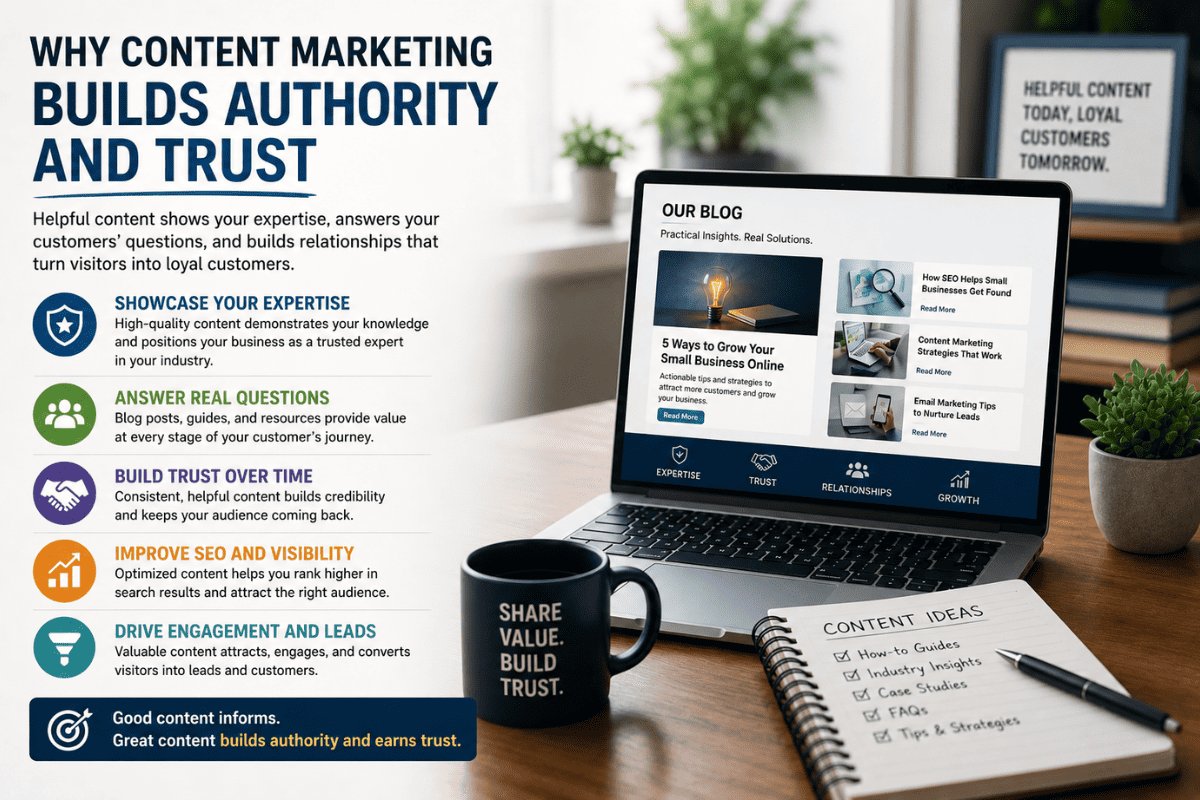
Content marketing supports long-term growth because it helps your business answer customer questions before a sales conversation ever happens. Many small businesses create content randomly, but effective content creation starts with the target audience, common objections, search intent, and business goals.
For example, a local business might publish helpful articles explaining pricing, timelines, service options, warning signs, or how to choose the right provider. This content that resonates builds trust because it shows expertise instead of simply asking people to buy.
Content also strengthens SEO, social media marketing, email marketing, and lead generation. A strong blog post can rank in search results, be shared on LinkedIn, support an email campaign, and guide readers toward a consultation. That is why content strategy should never exist in isolation.
The challenge is consistency. Small businesses often publish a few posts, stop when they get busy, then restart months later. A better approach is to plan content around customer needs and marketing best practices. When your content supports the full buyer journey, it becomes a cost-effective strategy for building authority, increasing website traffic, and helping your business grow.
Social Media Marketing and Engagement
Social media marketing helps small businesses stay visible, build relationships, and show personality, but it works best when it supports a larger marketing strategy. Posting just to stay active rarely creates meaningful business growth. The goal is not only to publish more content. The goal is to create effective social media that connects with the right audience and moves people closer to trust.
Different social media platforms serve different purposes. LinkedIn may help a service-based business build authority and referral relationships. Facebook may support local community engagement. Instagram may help visual businesses show their work. The best platform depends on where your target audience spends time and how they evaluate businesses.
Strong social media engagement also depends on consistency and relevance. Small businesses create better results when they share helpful tips, real examples, behind-the-scenes updates, customer stories, and answers to common questions. These posts can support SEO, email marketing, content marketing, and lead generation when they connect back to your website or offer.
Social media should not replace your website, email list, or search strategy. It should support them. When your media presence reinforces the same message across every channel, your business becomes easier to recognize and remember.
Email Marketing and Customer Retention
Email marketing is one of the most useful digital tools for small businesses because it helps maintain relationships after someone leaves your website, follows your social media, or downloads a resource. Many small businesses focus heavily on attracting new leads but forget to nurture the people who already showed interest.
A strong email strategy supports customer retention, repeat sales, referrals, and long-term trust. For example, a service-based business can send helpful tips, seasonal reminders, educational content, customer success stories, and follow-up offers. These messages keep the business top of mind without depending on social media platforms or paid visibility.
Email also connects other marketing efforts. SEO and content marketing can bring visitors to your website, lead magnets can turn website traffic into subscribers, and automated email sequences can guide those subscribers toward booking a call or requesting a quote.
The key is relevance. Good digital marketing uses email to deliver useful content that matches the customer journey. When small business owners send consistent, helpful, and targeted emails, they create a stronger online marketing system that supports lead generation, loyalty, and measurable business growth.
Google Business Profile and Local Search
For a local business, Google Business Profile and local search are essential parts of a small business digital strategy. Many small businesses depend on nearby customers, yet their local visibility is often incomplete, outdated, or disconnected from the rest of their marketing plan.
A strong Google Business Profile helps your business appear when people search for services in their area. Accurate hours, categories, photos, reviews, service descriptions, and contact details all support trust and discovery. When this profile is neglected, even a good website may struggle to attract local leads.
Local search also connects closely with SEO, content marketing, and website development. Your website should clearly explain where you serve customers, what services you provide, and why your business is a strong choice. Location-focused content, consistent business information, and customer reviews help reinforce credibility across the digital landscape.
Many small businesses face competition from larger brands, directories, and nearby providers. Local optimization gives your business a better chance to show up when intent is highest. When your Google Business Profile, website, reviews, and content strategy align, your online presence becomes more visible, trustworthy, and useful for lead generation.
Website Development, User Experience, and Conversion
Your website is the center of your digital presence. Even if SEO, social media marketing, email marketing, and paid campaigns bring people to your business online, the website usually decides whether those visitors trust you enough to take action.
Many small businesses struggle because their website was built as a brochure instead of a conversion tool. It may look fine, but it does not clearly explain the offer, guide visitors to the next step, answer common objections, or make contact easy. Weak website development can quietly hurt lead generation, website traffic performance, and ROI.
User experience matters because customers make decisions quickly. If pages load slowly, navigation is confusing, service descriptions are vague, or calls to action are hidden, potential buyers may leave before understanding your value. A strong website supports business needs by making information clear, simple, and action-focused.
Every small business needs a website that connects strategy with conversion. That means clear messaging, mobile-friendly design, helpful content, trust signals, and visible next steps. When your website is optimized around the customer journey, your digital marketing efforts have a stronger foundation for business growth.
Building a Marketing System Instead of Random Activities
Random marketing activities create random results. A business might write a blog post one week, run an ad the next, post on social media when time allows, and send an email only when sales are slow. Each action may be useful, but without a system, the results are difficult to repeat.
A marketing system connects every activity to a clear purpose. SEO attracts people searching for solutions. Content marketing educates them. Social media keeps your business visible. Email marketing nurtures interest. Your website turns attention into leads. Analytics shows what to improve. Together, these pieces create an online growth strategy instead of a collection of disconnected tasks.
For example, a service-based business could publish a blog answering a common customer question, optimize it for search, share it on LinkedIn, turn the key points into an email, and guide readers to a consultation page. One idea now supports multiple marketing channels.
This is how small businesses create momentum. Instead of constantly starting from scratch, your marketing efforts build on each other, support business goals, and give your business a more consistent path to growth.
Digital Strategy Checklist
A practical small business digital strategy should be simple enough to follow and strong enough to guide daily decisions. Use this checklist to identify gaps before spending more time or money on disconnected marketing efforts.
- Business goals: Define what growth means, such as more calls, booked consultations, repeat customers, online sales, or stronger local visibility.
- Target audience: Clarify who you serve, what they need, what problems they want solved, and which marketing channels they trust.
- Core message: Explain your offer clearly so customers understand why your business is the right choice.
- Website foundation: Make sure your website is mobile-friendly, easy to navigate, conversion-focused, and built around customer questions.
- SEO plan: Optimize service pages, local search signals, blog content, and search engine visibility.
- Content strategy: Create content that resonates with buyers at each stage of the customer journey.
- Follow-up system: Use email marketing, retargeting, or direct outreach to nurture leads after the first interaction.
- Analytics: Track website traffic, lead generation, conversion rates, and ROI so you can optimize performance.
Measuring Results, Analytics, and ROI
Digital marketing becomes much easier to improve when small businesses measure the right numbers. Many small business owners look at surface-level activity, such as likes, impressions, followers, or email opens, but those numbers do not always show whether marketing efforts are creating business growth.
A stronger analytics process connects each marketing activity to a real outcome. SEO should be measured by qualified website traffic, search results visibility, calls, form submissions, and booked appointments. Social media marketing should be measured by engagement quality, referral traffic, conversations, and leads. Email marketing should be measured by clicks, replies, conversions, and customer retention. Paid campaigns should be measured by cost per lead and ROI.
The goal is not to track everything. The goal is to track what helps your business make better decisions. If a blog post brings traffic but no leads, it may need a stronger call to action. If a landing page gets clicks but few conversions, the offer or user experience may need improvement.
Analytics helps small businesses optimize instead of guessing. When performance data guides the plan, your digital marketing strategy becomes more efficient, more focused, and more connected to business goals.
Lead Generation and Conversion Optimization
Lead generation is where digital strategy becomes measurable. Website traffic, social media engagement, SEO rankings, and email clicks are useful, but they only matter when they help turn interest into real business opportunities.
Many small businesses struggle because they focus on visibility without building a conversion path. A customer may find your business through search results, read a blog post, visit a service page, or click from LinkedIn, but if the next step is unclear, that attention disappears. Conversion optimization solves this by making it easy for visitors to take action.
Effective conversion paths include clear calls to action, simple contact forms, persuasive service pages, trust signals, follow-up emails, and offers that match customer intent. For example, a visitor reading about a marketing challenge may not be ready to buy immediately, but they may be ready to book a strategy consultation, download a checklist, or request guidance.
A strong small business digital strategy connects lead generation to every marketing channel. Instead of chasing traffic alone, your business can optimize the full journey from discovery to inquiry to sale.
Creating a Sustainable Online Growth Strategy
A sustainable online growth strategy gives small businesses a repeatable way to attract attention, build trust, generate leads, and improve results over time. It does not depend on one viral post, one ad campaign, one ranking, or one platform. It depends on a connected system that supports business goals consistently.
The first step is choosing the right priorities. A new local business may need stronger website development, Google Business Profile optimization, and local search visibility. A business with steady website traffic may need better conversion paths, stronger calls to action, and email marketing follow-up. A company with brand awareness but weak authority may need SEO, content marketing, and thought leadership on LinkedIn.
The second step is consistency. Small businesses must create a rhythm for content creation, social media engagement, email marketing, analytics review, and campaign optimization. This does not require a large marketing team. It requires a realistic plan that matches the budget, business needs, and available resources.
Long-term growth comes from improving the system month after month. When your digital marketing strategies are aligned, your business can adapt to the digital landscape and build momentum that compounds.
Book a Digital Strategy Consultation With Innovative Flare
If your marketing feels disconnected, the problem may not be your effort. It may be the strategy behind it. Many small businesses are doing the right activities in the wrong order, using the wrong message, or measuring the wrong results. That can make digital marketing feel frustrating even when you are consistently trying to grow your business.
Innovative Flare helps small business owners turn scattered marketing efforts into a focused online growth strategy. Instead of treating SEO, content marketing, social media marketing, email marketing, website development, lead generation, and analytics as separate tasks, we help connect them into one roadmap built around your business goals.
A strategy consultation gives your business clarity on what to prioritize, where your digital presence is underperforming, and which marketing channels can create the strongest ROI. Whether you need more visibility, better website traffic, stronger local search performance, or a more consistent lead generation system, the right plan can help your business move forward with confidence.
If your online efforts are not producing results, let’s build a smarter digital roadmap. Book your strategy call today.
FAQs About Small Business Digital Strategy
Why do many small businesses struggle with digital marketing?
Many small businesses struggle because their marketing efforts are disconnected. They may use SEO, social media, email marketing, paid ads, and content creation, but without one clear strategy, those activities do not support the same business goals.
What is the most important part of a small business digital strategy?
The most important part is alignment. Your target audience, website, message, marketing channels, budget, analytics, and lead generation process should all work together. When the plan is aligned, each channel has a clear purpose.
How is a marketing plan different from a digital strategy?
A marketing plan often lists campaigns, timelines, budgets, and activities. A digital strategy explains how online channels will support business growth. The best approach uses both: strategy for direction and the plan for execution.
Do small businesses need SEO?
Yes. SEO helps small businesses appear in search results when potential customers are already looking for services, answers, or local providers. Search engine optimization supports long-term website traffic, credibility, and lead generation.
Is social media enough for online growth?
No. Social media marketing can build awareness and engagement, but it should not be the entire strategy. A strong digital presence also includes a website, SEO, email marketing, local search, content marketing, and analytics.
How much should a small business spend on digital marketing?
The right marketing budget depends on business goals, competition, industry, location, and growth targets. Small businesses should focus first on cost-effective strategies that support measurable outcomes, such as qualified leads and conversions.
Why is my website getting traffic but no leads?
Traffic without leads often means there is a conversion problem. Your website may need clearer messaging, stronger calls to action, better service pages, trust signals, faster performance, or a simpler path for visitors to contact your business.
How do analytics improve digital marketing performance?
Analytics show which marketing activities are working and which need improvement. By tracking website traffic, conversions, lead sources, and ROI, small business owners can optimize campaigns instead of relying on guesses.
When should a small business get professional digital strategy help?
Professional guidance is useful when marketing feels inconsistent, results are unclear, or growth has stalled. A strategy consultation can help identify gaps, prioritize the right channels, and create a roadmap that supports long-term business growth.