
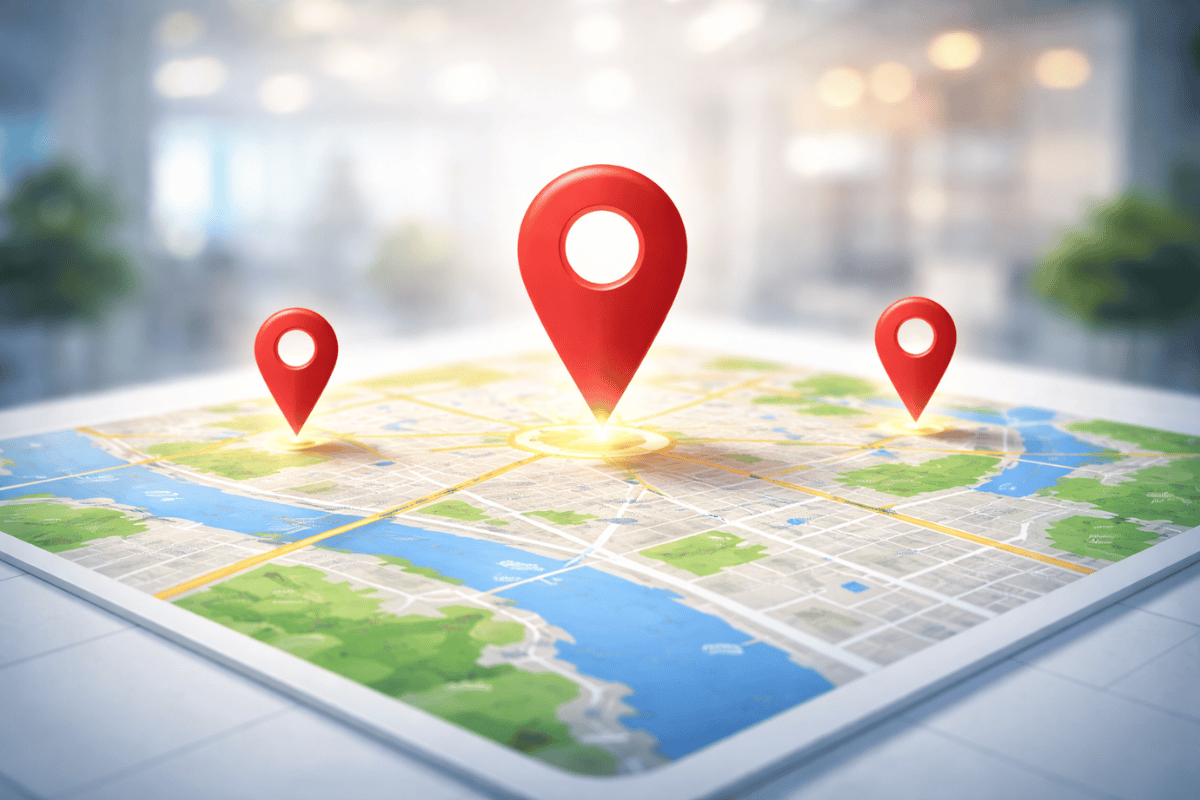
If you want to rank your business in the Google Local Pack in 2026, you’re not just trying to improve visibility — you’re competing for the most valuable real estate in local search.
The Google Local Pack appears at the very top of Google search results for queries with local intent. It sits above traditional organic listings. Above blog posts. Above service pages. Above almost everything except paid ads.
And for small businesses, it often drives more phone calls, direction requests, and booked appointments than their actual website.
But here’s the problem:
Most businesses approach local SEO like it’s 2018. They focus on citations. They stuff keywords into their business name. They chase review volume without a strategy. And they wonder why they’re stuck below competitors who consistently appear in the top three local results.
Ranking in the Google Local Pack in 2026 requires understanding how Google evaluates local businesses today — not five years ago.
Google’s local algorithm now incorporates:
- Entity-based relevance signals
- Behavioral engagement data
- Review velocity patterns
- Brand authority indicators
- On-page semantic alignment
- Cross-platform consistency signals
This is no longer about simply “optimizing your Google Business Profile.” It’s about building a layered local authority system that signals trust, relevance, and engagement across multiple touchpoints.
In this guide, you’ll learn:
- How the Google Local Pack actually works in 2026
- The real local search ranking factors that matter now
- Why most small businesses fail to rank
- How to engineer behavioral signals in your favor
- A 90-day roadmap to increase local pack visibility
If you implement this correctly, you won’t just rank higher. You’ll build defensible local dominance.
What Is the Google Local Pack?
The Google Local Pack — sometimes called the Map Pack or 3-Pack — is the box that appears at the top of search results when someone performs a search with local intent.
For example:
- “HVAC repair near me”
- “best personal injury lawyer Dallas”
- “coffee shop open now”
- “marketing agency Miami”
When Google detects geographic intent, it displays:
- A map with business pins
- Three highlighted business listings
- Star ratings
- Review counts
- Business hours
- Service tags
- Call and direction buttons
This section is powered primarily by your Google Business Profile, but it is not controlled by it alone.
Google cross-references data from:
- Your website
- Local business directories
- Structured data markup
- Backlinks
- User behavior signals
- Review content
The Local Pack is not just a “map result.” It is a trust filter.
Google uses it to present what it believes are the three most relevant, trustworthy, and useful nearby businesses for that specific query.
This is important: the Local Pack is query-dependent.
You might rank in the top three for “emergency plumber,” but not for “water heater installation.” Each keyword variation can trigger a different 3-Pack lineup.
This means ranking in the Google Local Pack is not a one-time achievement. It’s a dynamic positioning system influenced by:
- Searcher location
- Search intent
- Device type
- Competition strength
- Historical engagement patterns
Understanding this dynamic nature is critical. If you treat local ranking like a static trophy instead of a living system, competitors will overtake you.
To consistently rank in the Google Local Pack in 2026, you must optimize for:
- Relevance
- Proximity
- Prominence
- Engagement
- Consistency
We’ll break down each of these in detail in the next section.

Why the Google Local Pack Drives Disproportionate Revenue
Ranking in the Google Local Pack is not just about visibility. It is about capturing high-intent demand at the exact moment someone is ready to act.
Search behavior has fundamentally shifted. When users perform searches with local intent, they are rarely in research mode. They are in decision mode.
Someone searching:
- “emergency electrician near me”
- “best dentist in Phoenix”
- “AC repair open now”
is not browsing casually. They are actively looking for a provider to call, visit, or book.
The Google Local Pack is designed to reduce friction in that moment.
Instead of forcing users to:
- Click through multiple websites
- Compare pricing pages
- Search for contact information
- Verify business hours
Google consolidates trust signals directly inside the search results.
This creates what we call “compressed decision architecture.”
Users see:
- Ratings and reviews
- Distance from their location
- Business hours
- Service highlights
- Call and direction buttons
All before ever visiting your website.
Because of this, ranking in the Google Local Pack often generates:
- Higher call volume
- More direction requests
- Stronger conversion rates
- Shorter sales cycles
In many industries, over 50% of local clicks occur within the map pack section rather than organic listings below it.
This means if you are ranking #1 organically but not appearing in the top three local results, you are likely losing significant lead volume to competitors who are.
There is another strategic layer to understand.
The Local Pack reinforces brand authority.
When a business consistently appears in the top three local listings, it signals legitimacy. Even users who do not click immediately begin associating that brand with leadership in the category.
Over time, this repeated exposure strengthens:
- Brand recall
- Click-through rates
- Direct searches for your business name
- Trust before first interaction
Ranking in the Google Local Pack is not just a traffic play. It is a brand dominance play.
And in 2026, as AI-powered summaries and instant results continue to compress traditional search journeys, owning that top-of-page real estate becomes even more valuable.
How Google Ranks the Local 3-Pack in 2026 (Deep Dive)
Google officially states that local rankings are determined by three primary factors:
- Relevance
- Distance
- Prominence
However, in practical application, ranking in the Google Local Pack in 2026 involves a far more nuanced evaluation system.
Let’s break down how each layer actually functions.
1. Relevance: Entity Alignment and Context Matching
Relevance determines how well your business matches a specific search query.
This is not limited to keywords in your business description.
Google analyzes:
- Your primary category
- Your secondary categories
- Services listed in your profile
- Keywords inside reviews
- Content on your website
- Structured data markup
- Backlink anchor text
In 2026, Google relies heavily on entity recognition.
For example, if your primary category is “General Contractor” but most of your website content discusses “Kitchen Remodeling,” you may struggle to rank for kitchen-specific local searches unless your profile and on-site signals clearly align.
Relevance requires consistency across platforms.
If your Google Business Profile says one thing and your website emphasizes another, Google’s confidence decreases.
Strong entity alignment increases your chances of appearing in the local pack for multiple related keyword variations.
2. Distance: Proximity to the Searcher
Distance measures how close your business is to the searcher’s physical location or the geographic term used in the search.
You cannot directly control proximity, but you can influence how broadly Google associates your business with surrounding areas.
This is done through:
- Service area settings
- Location-based landing pages
- Local backlinks
- Geo-relevant content
- City-specific reviews
While proximity remains foundational, businesses with stronger prominence and relevance signals can often extend their visibility radius beyond immediate competitors.
3. Prominence: Authority and Trust Signals
Prominence measures how well-known and trusted your business appears across the web.
Google evaluates:
- Backlink quality and relevance
- Mentions across authoritative sites
- Press coverage
- Review count and rating
- Review sentiment
- Brand search volume
Two businesses in the same location with similar relevance can rank differently based on prominence alone.
This is why strong brands often dominate the local pack.
4. Behavioral Signals: The Engagement Multiplier
Behavioral signals have become increasingly influential in local pack ranking.
Google monitors how users interact with your listing compared to competitors.
Key engagement metrics include:
- Click-through rate from the map pack
- Call button clicks
- Direction requests
- Website visits
- Photo views
- Review interactions
If users consistently choose your listing over others, Google interprets that as a quality signal.
This creates a feedback loop: higher engagement can reinforce higher rankings.
5. Consistency Signals: Trust Through Uniform Data
Consistency remains a foundational layer.
Google cross-verifies your business information across:
- Local directories
- Industry listings
- Your website
- Social platforms
Inconsistent business name, address, or phone number data weakens trust.
While citations are no longer the dominant ranking factor they once were, data consistency still stabilizes local pack visibility.
When these five signal groups align — relevance, distance, prominence, behavioral engagement, and consistency — your ability to rank in the Google Local Pack increases significantly.
The 2026 Local Pack Ranking Matrix (A Strategic Framework)
Most businesses approach local SEO as a checklist:
- Claim Google Business Profile
- Add citations
- Ask for reviews
That approach might have worked years ago. It does not create defensible rankings in 2026.
To consistently rank in the Google Local Pack, you need to think in systems — not tactics.
The 2026 Local Pack Ranking Matrix is built around five interdependent signal layers:
- Foundational Signals (Accuracy + Setup)
- Relevance Signals (Entity Clarity)
- Authority Signals (Prominence)
- Engagement Signals (Behavioral Reinforcement)
- Conversion Signals (User Satisfaction Feedback)
Let’s break this down.
Layer 1: Foundational Signals
This includes:
- Accurate NAP (Name, Address, Phone)
- Verified Google Business Profile
- Correct primary category
- Consistent hours
- Proper service area configuration
Without this layer, everything else becomes unstable.
Think of this as the infrastructure of your local presence.
Layer 2: Relevance Signals
This layer determines whether Google clearly understands what you do.
It includes:
- Primary + secondary categories alignment
- Service keyword mapping
- Location-based landing pages
- Structured data markup
- Keyword presence in reviews
If Google cannot confidently match your business to a query, you will not rank in the local pack consistently — even with strong reviews.
Layer 3: Authority Signals
This is where most competitive separation happens.
Authority includes:
- Local backlinks
- Industry backlinks
- Press mentions
- High-quality citations
- Brand searches
Authority is what allows one nearby business to outrank another equally close competitor.
Layer 4: Engagement Signals
This is the multiplier layer.
Google evaluates which listing users interact with most frequently.
If your listing generates:
- Higher click-through rates
- More calls
- More direction requests
- More review engagement
you strengthen your ranking position over time.
This is where conversion optimization intersects with SEO.
Layer 5: Conversion Signals
This layer is often overlooked.
When users click your website and remain engaged, when they leave positive reviews after visiting, when they interact with your content — Google interprets those behaviors as satisfaction signals.
Local pack ranking in 2026 is not just about visibility. It is about perceived usefulness.
Businesses that deliver strong user experiences reinforce their ranking position.
Step 1: Advanced Google Business Profile Optimization
Your Google Business Profile is the control center of your local pack visibility.
Most businesses complete only 60–70% of available optimization fields. That leaves ranking opportunities on the table.
Primary Category Selection
Your primary category is one of the strongest relevance signals in the local algorithm.
It should represent your highest-value service, not necessarily your broadest description.
For example:
- “Personal Injury Attorney” instead of “Law Firm”
- “HVAC Contractor” instead of “Contractor”
- “Medical Spa” instead of “Spa”
Your primary category directly influences which searches trigger your listing.
Secondary Categories Strategy
Secondary categories expand keyword eligibility.
Instead of guessing, analyze competitors ranking in the top three local results and identify category patterns.
Choose categories that align with your actual services — not aspirational keywords.
Services Section Optimization
The services section is underutilized.
Each service should include:
- Specific service name
- Keyword-rich but natural description
- Service variations
This helps Google better understand your business offerings and increases local relevance for long-tail searches.
Business Description Optimization
Your description should:
- Clearly define your services
- Include primary geographic terms
- Highlight differentiators
- Reinforce authority signals
Avoid keyword stuffing. Focus on clarity and trust.
Photo and Media Strategy
Listings with high-quality photos generate more engagement.
Upload:
- Exterior location photos
- Interior workspace photos
- Team photos
- Project examples
- Before-and-after images
Update consistently. Fresh content signals activity.
Google Posts Cadence
Weekly Google posts improve engagement and freshness signals.
Use posts for:
- Promotions
- Case studies
- Service highlights
- Educational tips
- Seasonal updates
Strong calls to action in posts can increase click-through rates.
Q&A Management
Proactively seed common questions and answer them thoroughly.
This improves relevance and pre-qualifies leads.
Review Response Strategy
Responding to reviews does more than protect reputation.
It reinforces keyword associations and engagement signals.
Responses should:
- Address the customer by name
- Mention the service provided
- Include natural geographic references
- Remain authentic and concise
A fully optimized Google Business Profile increases your eligibility to rank in the Google Local Pack across more search variations.
Step 2: Build High-Performance Location-Specific Landing Pages
Your Google Business Profile helps you appear in the local pack.
Your website determines whether you stay there.
One of the biggest ranking gaps we see in local businesses is weak or generic service pages. Many businesses have a single “Services” page and expect to rank across multiple cities and service variations.
That is not how Google evaluates local relevance in 2026.
Why Location Pages Matter for Local Pack Rankings
When Google evaluates your eligibility to rank in the Google Local Pack, it cross-references your Business Profile with your website content.
If your listing says you offer “water heater repair,” but your website barely mentions it — or only references it once — your relevance confidence drops.
High-performing local businesses build dedicated landing pages for:
- Primary service + primary city
- Primary service + surrounding cities
- High-value service variations
This strengthens entity clarity and geographic alignment.
Structure of a High-Converting Local Landing Page
Each location-specific page should include:
1. Clear Service + Location Headline
Example: “Water Heater Repair in Scottsdale, AZ”
2. Localized Introduction
Reference the city naturally. Mention neighborhoods, local landmarks, or community context where appropriate.
3. Detailed Service Breakdown
Explain exactly what is included in the service. Avoid thin, generic descriptions.
4. Local Proof
- Testimonials from customers in that city
- Case studies
- Project photos
5. Embedded Google Map
Embed your business location to reinforce geographic association.
6. Structured Data Markup
Implement Local Business schema and Service schema to strengthen machine readability.
7. Strong Internal Linking
Link to related services and supporting content clusters.
Avoid Duplicate Content Traps
Do not create dozens of nearly identical city pages with only the city name swapped.
Google recognizes templated content patterns.
Instead:
- Customize each page with meaningful local references
- Add unique testimonials per city
- Highlight different service nuances
- Include locally relevant FAQs
High-quality, location-specific landing pages expand your effective proximity radius and improve your ability to rank in the Google Local Pack beyond your immediate address.
Step 3: Build a Review Velocity System (Not Just a Review Strategy)
Reviews are one of the most visible signals in the local pack.
But most businesses approach reviews reactively instead of systemically.
In 2026, review velocity matters more than raw volume.
What Is Review Velocity?
Review velocity measures:
- How often you receive new reviews
- How consistent that frequency is
- How recent your latest reviews are
A business receiving 5 reviews per month consistently will often outrank a business that gained 100 reviews last year but none recently.
Google interprets steady review growth as an indicator of active operations and ongoing customer satisfaction.
The 4-Part Review Velocity Framework
1. Trigger Timing Optimization
The best time to request a review is immediately after a successful service outcome — when satisfaction is highest.
Train staff to identify this moment.
2. Automated Follow-Up
Implement automated SMS and email follow-up sequences.
Example sequence:
- Day 1: Thank-you message + review link
- Day 3: Friendly reminder
- Day 7: Final follow-up
Keep messaging simple and frictionless.
3. Friction Reduction
Make leaving a review as easy as possible:
- Direct review link (not homepage)
- QR codes for in-person locations
- Short instructions
4. Review Response Amplification
Responding to reviews reinforces engagement signals.
Each response should:
- Acknowledge the customer
- Reference the service performed
- Include natural keyword reinforcement
- Express appreciation
Leveraging Review Content for Relevance
Google analyzes keywords inside reviews.
If customers consistently mention specific services, neighborhoods, or outcomes, your relevance signals strengthen.
This is why operational excellence indirectly influences local pack rankings.
Handling Negative Reviews Strategically
Negative reviews do not automatically destroy rankings.
What matters is:
- How you respond
- How quickly you respond
- Whether positive reviews continue afterward
A professional response often increases trust among potential customers.
A structured review velocity system transforms reviews from passive reputation management into an active ranking asset.
Step 4: Build Local Authority Through Strategic Backlinks
If proximity and relevance get you into the conversation, authority is what separates you from competitors in the top three local results.
When two businesses are similarly located and offer comparable services, Google often ranks the one with stronger authority signals higher in the local pack.
Authority is primarily built through backlinks and brand mentions.
Why Backlinks Still Matter for Local Pack Rankings
There is a common misconception that backlinks only influence organic SEO and not local pack rankings.
In reality, prominence — one of Google’s core local ranking factors — is heavily influenced by link authority.
Google evaluates:
- Quality of linking domains
- Topical relevance of links
- Local geographic relevance
- Anchor text patterns
- Brand mention frequency
Strong backlink profiles reinforce that your business is credible and trusted within its market.
High-Impact Local Backlink Sources
1. Local News Websites
Press features, interviews, and event coverage generate highly relevant authority signals.
2. Chamber of Commerce
Membership listings are geographically aligned and trustworthy.
3. Local Sponsorships
Community events, charities, youth sports teams, and nonprofit partnerships often provide backlinks from relevant local domains.
4. Industry Associations
Professional memberships build both authority and trust.
5. Strategic Business Partnerships
Cross-promotional partnerships with complementary local businesses can create natural link opportunities.
Anchor Text Strategy for Local Relevance
Avoid over-optimized anchor text patterns.
Instead, aim for:
- Branded anchors
- Service + city variations
- Natural contextual mentions
- Naked URLs
Diversification protects ranking stability.
Authority Stacking
The most effective local SEO strategies combine:
- Local backlinks
- Industry backlinks
- Content-driven links
- Brand mentions without links
This layered authority approach strengthens your prominence signal and increases your ability to rank in the Google Local Pack in competitive markets.
Step 5: Engineer Behavioral Signals to Reinforce Rankings
Behavioral signals are the hidden multiplier in local pack performance.
Google continuously monitors how users interact with listings inside the local pack.
If your listing generates more engagement than competitors, your ranking stability improves.
Key Behavioral Signals That Influence Local Rankings
- Click-through rate from the local pack
- Call button clicks
- Direction requests
- Website visits
- Photo views
- Time spent on the website after a click
These interactions help Google determine which businesses users prefer.
How to Increase Click-Through Rate in the Local Pack
Your local listing competes visually.
Optimize for:
- High review rating (4.5+ ideally)
- Recent reviews
- High-quality photos
- Clear business description
- Relevant service highlights
Even small improvements in visual appeal can increase engagement.
Improve Call and Direction Clicks
Encourage action through:
- Clear call-to-action language in posts
- Timely responses to inquiries
- Accurate hours
- Holiday updates
Listings that generate more real-world actions send stronger satisfaction signals to Google.
Website Engagement Optimization
When users click through from the local pack to your website, Google observes engagement patterns.
If visitors:
- Bounce immediately
- Spend little time on page
- Return to search results quickly
It may weaken perceived quality.
Improve on-site engagement by:
- Clear above-the-fold messaging
- Fast loading speeds
- Mobile optimization
- Trust badges and testimonials
- Strong internal linking
The Behavioral Feedback Loop
When your listing generates high engagement:
- Google increases confidence in your listing
- Your ranking stabilizes or improves
- You receive more visibility
- More users engage
- The cycle reinforces itself
This is why local pack ranking is not static.
It is a living feedback system driven by real user interaction.
Businesses that intentionally engineer engagement outperform those who passively wait for traffic.
Common Mistakes That Suppress Google Local Pack Rankings
Many businesses do not fail to rank in the Google Local Pack because they lack effort.
They fail because they are unknowingly sending negative or conflicting signals.
Before accelerating growth, you must eliminate ranking suppressors.
1. Choosing the Wrong Primary Category
Your primary category is one of the strongest relevance signals in the local algorithm.
If you select a broad category when a more specific one exists, you reduce your ranking potential for high-value searches.
For example:
- Using “Contractor” instead of “Roofing Contractor”
- Using “Law Firm” instead of “Criminal Defense Attorney”
- Using “Spa” instead of “Medical Spa”
This single decision can significantly impact local pack visibility.
2. Keyword Stuffing the Business Name
Adding extra keywords to your business name may temporarily improve rankings, but it violates Google’s guidelines.
Google increasingly enforces business name accuracy.
Penalties can include:
- Ranking suppression
- Profile suspension
- Removal from map results
Short-term manipulation often leads to long-term instability.
3. Inconsistent NAP Information
If your business name, address, or phone number differs across directories, Google’s trust confidence decreases.
Common causes:
- Old addresses still listed online
- Call tracking numbers used inconsistently
- Abbreviations vs full spelling variations
Consistency does not create dominance — but inconsistency creates suppression.
4. Inactive Google Business Profile
A stagnant profile sends weak engagement signals.
If you have not:
- Posted updates in months
- Added new photos
- Responded to reviews
- Updated services
your listing may lose competitive momentum.
5. No Service-Specific Landing Pages
Generic websites weaken relevance alignment.
If competitors have robust service pages with structured content and you rely on a single overview page, Google may favor them for service-specific local searches.
6. Weak Internal Linking Structure
Internal links help distribute authority and reinforce entity relationships.
Without structured internal linking:
- Service pages lack authority
- Location pages remain isolated
- Content clusters fail to strengthen core pages
This reduces overall ranking potential.
7. No Authority Acquisition Strategy
If your backlink profile has not grown in the past year, your prominence signal may be stagnating.
Local pack rankings reward businesses that demonstrate growing authority.
8. Ignoring Engagement Metrics
Many businesses never review insights inside their Google Business Profile dashboard.
If clicks, calls, or direction requests decline, it is often an early warning signal of competitive displacement.
Regular monitoring prevents silent ranking erosion.
90-Day Execution Roadmap to Rank in the Google Local Pack
Ranking improvements rarely happen by accident.
They happen through structured execution.
Below is a practical 90-day roadmap with measurable benchmarks.
Days 1–30: Foundation and Cleanup
Objectives:
- Eliminate suppressors
- Strengthen foundational signals
- Improve relevance clarity
Actions:
- Audit primary and secondary categories
- Complete full Google Business Profile optimization
- Fix NAP inconsistencies across top directories
- Create or improve 2–3 high-value service landing pages
- Implement LocalBusiness schema
- Upload at least 10 high-quality photos
KPIs:
- Profile completeness at 100%
- Consistent NAP across top citations
- Increased profile impressions
Days 31–60: Authority and Review Acceleration
Objectives:
- Increase prominence
- Improve review velocity
- Strengthen entity alignment
Actions:
- Launch automated review request system
- Secure 3–5 local backlinks
- Publish 2 locally relevant content pieces
- Increase Google Posts cadence to weekly
- Respond to all new reviews within 48 hours
KPIs:
- Minimum 4 new reviews per month
- Increase in direction requests
- Growth in profile engagement metrics
Days 61–90: Engagement Optimization and Expansion
Objectives:
- Reinforce behavioral signals
- Expand geographic visibility
- Improve conversion rates
Actions:
- Optimize top landing pages for conversion clarity
- Add additional city-specific pages
- Strengthen internal linking structure
- Analyze competitors currently ranking in top three
- Refine review request timing
KPIs:
- Increase in click-through rate from local pack
- Growth in call volume
- Improvement in local keyword positions
Consistent execution across these 90 days often produces measurable ranking movement.
In competitive markets, this roadmap becomes an ongoing quarterly cycle.
Should You DIY Local SEO or Hire a Professional?
Ranking in the Google Local Pack is possible without hiring an agency — but whether you should depends on your competitive environment, internal bandwidth, and growth goals.
When DIY Local SEO Can Work
You may be able to manage local optimization internally if:
- Your market is low competition
- You operate in a smaller geographic area
- You have time to monitor and execute weekly updates
- You understand structured data and on-page optimization
- You can consistently generate reviews
In these environments, foundational improvements alone may move you into the top three local results.
When Professional Strategy Becomes Necessary
You should strongly consider hiring a local SEO partner if:
- You are in a competitive metro area
- Multiple competitors have 200+ reviews
- Your industry has aggressive marketing players
- You lack time to manage ongoing optimization
- Your rankings fluctuate unpredictably
Competitive local markets require more than profile optimization. They require authority acquisition, engagement engineering, and ongoing competitive analysis.
In high-value industries — legal, medical, home services, finance — even one additional local pack position can represent thousands of dollars in monthly revenue difference.
The real question is not “Can I do this myself?”
The question is: “What is the opportunity cost of staying invisible?”
Ready to Rank in the Google Local Pack?
If your competitors consistently appear in the top three local listings and your business does not, that gap is not random.
It is structural.
At Innovative Flare, we build strategic local SEO systems designed to:
- Increase local pack visibility
- Strengthen authority signals
- Accelerate review velocity
- Engineer engagement improvements
- Convert map visibility into booked revenue
On your strategy consultation, we will:
- Analyze your current Google Local Pack positioning
- Break down your top three competitors
- Identify missing ranking signals
- Outline a customized 90-day roadmap
This is not a generic sales call.
It is a focused strategic evaluation of your local growth potential.
Book your strategy consultation now:
https://call.innovativeflare.com
Frequently Asked Questions About Ranking in the Google Local Pack
How long does it take to rank in the Google Local Pack?
In moderately competitive markets, noticeable improvements can occur within 30–90 days after implementing structured optimization. In highly competitive metro areas, meaningful movement may require 3–6 months of authority and engagement building.
What is the single most important local ranking factor?
There is no single factor. Local pack rankings are influenced by proximity, relevance, prominence, behavioral engagement, and consistency signals working together. Weakness in one area can limit overall performance.
Does Google Business Profile activity affect rankings?
Yes. Frequent updates, new photos, review responses, and post activity contribute to engagement and freshness signals that can support local pack visibility.
Can I rank in multiple nearby cities?
Yes, but it requires strong location-specific landing pages, consistent service area configuration, local backlinks, and review mentions referencing those areas.
Do citations still matter in 2026?
Citations are no longer a dominant ranking lever, but consistency across directories reinforces trust and ranking stability. They remain foundational.
How many reviews do I need to rank?
There is no universal number. Focus on steady review velocity, maintaining a high rating, and responding consistently. Quality and consistency often outweigh sheer volume.
Why did my business drop out of the local pack?
Common causes include competitor authority growth, reduced engagement signals, outdated profile information, inconsistent citations, or algorithm updates. Regular monitoring is essential.
Is ranking in the local pack better than ranking organically?
For searches with local intent, map pack visibility often generates higher conversion rates because it presents immediate trust signals and one-click contact options.
Does website SEO affect local pack rankings?
Yes. Google cross-references your Business Profile with on-site content, structured data, and backlink authority. Weak website signals can limit local pack performance.
Is local SEO still worth investing in?
For service-based businesses, ranking in the Google Local Pack remains one of the highest ROI marketing channels available due to high-intent search behavior.
Quick Summary: How to Rank in the Google Local Pack (2026 Snapshot)
To rank in the Google Local Pack in 2026, focus on five core signal groups:
- Relevance: Optimize your Google Business Profile categories and service pages.
- Proximity: Strengthen location-specific landing pages and service area signals.
- Prominence: Build high-quality local backlinks and brand mentions.
- Behavioral Signals: Increase click-through rate, calls, and direction requests.
- Consistency: Maintain accurate NAP data across all platforms.
Businesses that optimize across all five layers consistently outperform competitors who focus on only one or two ranking factors.
Local SEO Performance Tracking Framework
If you want sustainable rankings in the Google Local Pack, you must measure progress.
Core Metrics to Monitor Monthly
- Local pack keyword rankings (primary + secondary services)
- Google Business Profile impressions
- Call clicks
- Direction requests
- Website clicks from profile
- Review velocity (new reviews per month)
- Average star rating
- Backlink growth
Warning Signs of Ranking Instability
- Sudden drop in impressions
- Declining engagement metrics
- Competitors increasing review volume rapidly
- Negative reviews without response
- Outdated business information
Proactive tracking prevents ranking erosion before revenue declines.
Featured Snippet Answer: What Are the Google Local Pack Ranking Factors?
The main Google Local Pack ranking factors in 2026 are:
- Relevance (category and service alignment)
- Distance (proximity to searcher)
- Prominence (authority and backlinks)
- Review velocity and sentiment
- Behavioral engagement signals
- Data consistency across directories
Strong performance across all six areas increases local pack visibility.