seolounge
Picture a roofing contractor in Wellington who sits through a Tuesday afternoon webinar on social media marketing. By Wednesday he has a Facebook business page, an Instagram account, a TikTok, a LinkedIn company page, and a YouTube channel with his logo on it. Five accounts. One very motivated owner.
Fast forward three months. The TikTok has two videos. LinkedIn still shows the default gray banner. His last Facebook post is a photo of a new truck from March, and the Instagram grid holds nine squares, six of them the same job shot from different angles.
He wasn’t lazy about it. He gave up evenings to those accounts, squeezed in between estimates and invoicing. He just got bad advice, and he’s far from the only one.
If you run a plumbing company, a salon, a pest control route, or any other local business that sells a service, you’ve probably lived some version of this. Everyone tells you to “be on social media,” and almost nobody tells you which platform reaches the people who hire you. Using national survey data from Pew Research Center, we’ll look at the best social media platforms for local service businesses in 2026: which ones deserve a slot in your week, and which ones you can skip without feeling guilty about it. By the end you should have a short list of two or three accounts you can keep up with, instead of five you can’t.
Key takeaways
- Pick two or three platforms you can keep active. A handful of abandoned profiles does more harm than having none at all.
- Facebook is still the safest default for most local service businesses. Pew found that 75% of adults ages 50 to 64 and 61% of adults 65 and older use it.
- Instagram and short-form video (Instagram Reels and TikTok) pay off when your work photographs well: remodels, lawns, haircuts, freshly detailed cars.
- YouTube reaches the widest age range of any platform, but it asks the most of you in production time.
- LinkedIn is worth it only if you sell to other businesses, the way commercial contractors, accountants, and law firms do.
- Google Business Profile isn’t social media, yet for local search it likely matters more than any single platform you choose.
- Choose based on who your customers are and what you can realistically produce every week. Whichever app has the most buzz this year is beside the point.
Why “be everywhere” is bad advice for a local service business
Most “be on every platform” advice is written for brands with a marketing department. It was never meant for an owner with forty-five minutes a week and a phone full of job-site photos.
Run the math for a two-chair salon. Say the owner wants to post three times a week on five social media channels. That’s fifteen posts. At a quick 20 minutes apiece (picking the photo, writing the caption, answering whatever comments come in), she’s looking at five hours a week, and that’s before anyone films a Reel or edits a YouTube video. Five hours is most of a day of appointments she isn’t booking. Most owners in her spot try it for a few weeks, fall behind during a busy stretch, and stop.
Owners also tend to underestimate what a dead account costs. It isn’t neutral. When potential customers find your Instagram and the newest post is fourteen months old, they don’t assume you’ve been busy. They wonder whether you’re still open. A Facebook page whose latest update is a holiday greeting from two Christmases ago sends the same signal, and so does a YouTube channel with one video and eleven views. For a local business, that kind of silence costs visibility and trust at the exact moment someone is deciding whether to pick up the phone.
Spreading thin also makes it nearly impossible to learn anything. With fifteen posts scattered across five places, no single account builds enough history to show a pattern. You can’t tell whether before-and-after photos outperform promo graphics, or whether Tuesday evening beats Saturday morning. You end up guessing everywhere, when two accounts with a few months of posts behind them would already be showing you what works.
Then there are the replies. Every account you open is another inbox. A homeowner who messages your neglected Instagram about a leaking water heater and hears nothing back for nine days doesn’t wait around. She calls the next company in the search results, and you never even find out she existed.
Concentrating your time fixes most of this. Put the same five hours into two platforms and you get consistency, which every platform’s feed tends to reward, plus enough posts to see what your audience responds to. You also end up with a social media strategy that holds up in a slammed June as well as a slow January.
So the useful question for a small business is which two or three platforms have earned the time.
Where do your customers actually spend time online?
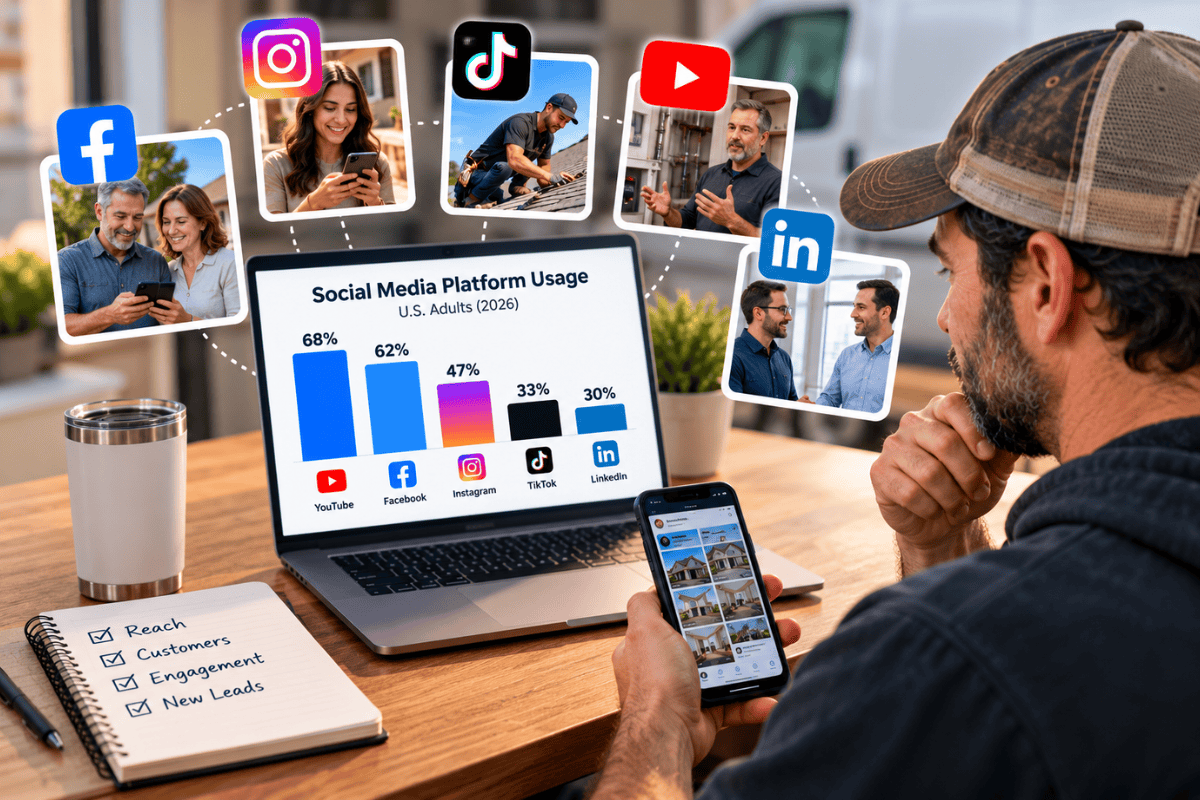
Before picking anything, look at the data. The most reliable read on American platform use comes from Pew Research Center, which surveyed 5,022 U.S. adults between February and June 2025 and published the results that November. It’s a nationally representative survey, a clear step above the recycled “stats” that bounce around marketing blogs. You can see the full numbers on Pew’s social media fact sheet.
Here’s the share of U.S. adults who say they use each of the most popular social media platforms:
- YouTube: 84%
- Facebook: 71%
- Instagram: 50%
- TikTok: 37%
YouTube and Facebook sit well above the rest. The age breakdown is where this gets useful for a local business.
Facebook’s strongest group is adults 30 to 49, at 80%, and it holds up remarkably well with older adults: 75% of people ages 50 to 64 and 61% of those 65 and older use it. Instagram runs the opposite direction. Eight in ten adults under 30 are on it, but that falls to 37% among 50-to-64-year-olds and 19% among people 65 and up. YouTube barely drops off at all, sliding from about 95% of adults under 30 to roughly two-thirds of adults 65 and older.
Now think about who actually calls you. The person replacing a roof, booking a new AC system, or hiring someone to re-screen a pool cage is often in their 40s, 50s, or 60s. They own the house and control the budget. For that target audience, Facebook and YouTube reach far more people than Instagram does, and it isn’t close. A barbershop whose regulars are mostly 22-year-olds is looking at a very different picture.
If you’re not sure which group you serve, check your own records. Pull up your last 20 invoices and jot down a rough age for each customer. It takes ten minutes, and it usually settles the argument.
How often people open an app matters as well, since a platform someone checks once a month won’t keep your name in front of them. According to Pew, about half of U.S. adults visit Facebook and YouTube at least once a day. Those daily users are the people most likely to see what you post this week.
The second filter: what you can realistically make
Reach is only half of it. The other half is whether you can keep feeding a platform week after week.
Every platform runs on a different type of content. Facebook is forgiving, and a phone photo with two sentences underneath works fine there. Instagram leans on strong visual content. YouTube wants video, ideally a few minutes long and reasonably well lit. Before you commit anywhere, ask yourself a few blunt questions. Does your work look impressive in a photo? A paver patio, a hair color correction, or a refinished hardwood floor, absolutely. A tax return or a rewired electrical panel, not so much. Is anyone on your team comfortable talking to a camera? How many hours a week can you actually protect for this, even during your busiest month?
A pressure-washing company with dramatic before-and-after shots and a 45-minute weekly window is built for photo and short video platforms. An insurance agency with the same 45 minutes probably isn’t. Neither one is better at social media. They just belong in different places.
Facebook is still the default for most local service businesses
If you’re only going to run one social account, make it Facebook. For most contractors, repair companies, and home service providers, it’s the best platform for small businesses by a comfortable margin, and the Pew numbers above explain why. It reaches the age groups that own homes and hire help, and a big share of them open it every day.
Younger marketers love to call Facebook dated. Your customers don’t care. They aren’t grading your platform choice on how trendy it looks; they’re checking whether you show up, answer questions, and have recent proof of good work.
Facebook also handles a few jobs that other platforms don’t do as well for a local business. Neighborhood and community groups are where people post, “Anyone know a good plumber in Royal Palm Beach?” Your page can display reviews and recommendations right alongside your photos. Messenger lets someone ask for a quote at 10 p.m. without having to call. And if you ever run paid ads, Facebook’s local targeting lets you limit spending to the ZIP codes you actually serve, so you’re not paying to reach people two counties away.
What to post on Facebook
Skip the polished plan and settle into a rhythm. A handful of post types do most of the work:
- Finished jobs: a photo of the completed project, the neighborhood (never the street address), and one line about the problem you solved.
- Review highlights: a quote from a recent five-star review, with a thank-you to the customer by first name if they’re comfortable with it.
- Seasonal reminders: “Hurricane season starts June 1. Here’s what to check on your roof this week.” Posts like this get shared.
- Your people: a new technician’s first week, the crew loading up at 7 a.m., the office dog. Behind-the-scenes content makes you familiar before anyone ever meets you.
- Quick answers: the question you hear five times a week, answered in a short post.
Groups are where Facebook beats every other platform at attracting local customers. Take a pressure-washing company in Jupiter. The owner doesn’t spam neighborhood groups with ads; most admins ban that anyway. He answers questions. When someone asks how often a paver driveway should be resealed, he gives a real answer, signs it with his name and company, and moves on. Over a year, dozens of those small replies turn him into the name people tag when a neighbor asks for a recommendation.
A realistic week for a two-truck HVAC company might be a finished-install photo on Monday, a customer review on Wednesday, and a filter-change reminder on Friday. That’s maybe 30 minutes of work, and it’s enough to make the page look alive to anyone who checks it before calling.
Keep the rules simple. Post two or three times a week, reply to every comment and message within a business day, and stop worrying about going viral. For a service company, the goal on Facebook is steady brand awareness among the few thousand households in your service area.
Instagram, Reels, and TikTok: made for work you can show off
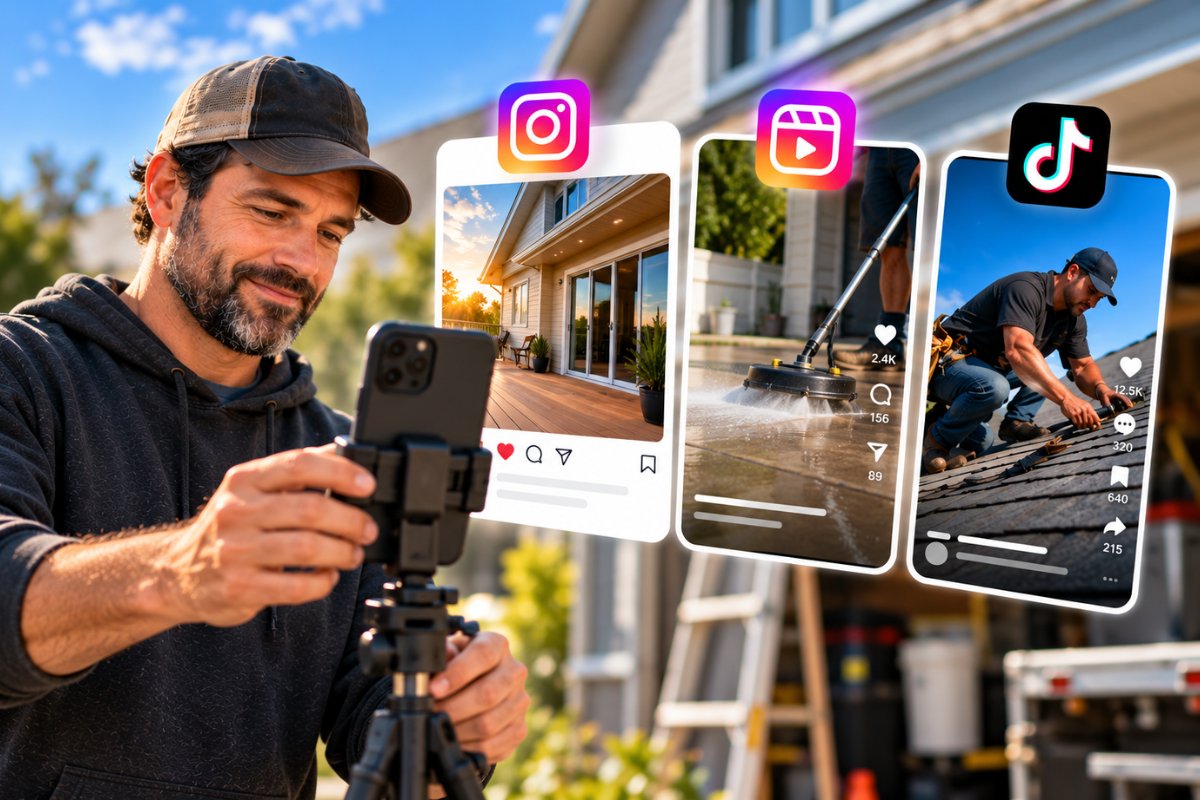
A kitchen remodeler in Palm Beach Gardens films fifteen seconds on her phone. The first five seconds show a 1990s kitchen with honey-oak cabinets and a cracked tile counter. The last ten show the finished room: white shaker cabinets, quartz, new pendant lights over the island. There’s no voiceover, just a caption with the neighborhood and the timeline. That clip will likely do more for her than a month of text posts, because the work sells itself the moment someone sees it.
Photo-driven platforms and short-form video are built for exactly that kind of clip. Short-form video just means vertical clips, usually under a minute, made to be watched on a phone. Instagram calls them Reels. Other apps are built entirely around them. If the difference between your “before” and your “after” is obvious at a glance, these platforms were practically designed for you.
Instagram reaches about half of U.S. adults, according to Pew, and its audience skews young. Eight in ten adults under 30 use it, compared with fewer than one in five adults 65 and older. That works in your favor if your customers are younger. If they’re older, it’s a problem.
The business types that tend to do well here aren’t hard to spot: salons and barbers, landscapers, pool builders, auto detailers, painters, remodelers, custom closet companies. What they share is work that proves itself in a photo, like a fresh balayage, a newly laid lawn with crisp edges, or a ceramic-coated pickup shining in a driveway. Nobody needs those explained.
A few habits keep the account working without eating your week:
- Shoot the “before” every single time, even if you’re not sure you’ll post it. You can’t go back for it later.
- Use Reels for transformations and save the photo grid for your strongest finished shots.
- Tag the city or neighborhood so people searching nearby can find the post.
- Put your service area and a booking link in your bio, since that’s often the first thing a new follower reads.
How often should you post? For a local business, two or three times a week is plenty. A landscaping crew can hit that without trying: whoever finishes the job snaps a photo before the trailer gets loaded, and someone writes all the captions in one sitting on Sunday night.
TikTok
The app is bigger than a lot of owners assume. TikTok says more than 170 million Americans use it, so it’s no longer just a teenager’s app. Pew’s data still shows a strong tilt toward the young, though: 60% of adults under 30 use it, compared with 23% of adults 50 to 64 and just 7% of those 65 and older. For most home service companies, the crowd it reaches best isn’t the crowd writing checks for a new roof.
Owners ask all the time whether a plumber needs TikTok. The short answer is no.
If you enjoy making videos and your personality comes through on camera, it can work, and a handful of tradespeople have built large followings by explaining their jobs with humor. Nobody should feel obligated, though. If you’re already filming Reels, you can upload the same clip to TikTok in about a minute. That’s the cheapest way to test the app without taking on a second round of content creation every week.
YouTube reaches every age group, if you can commit to it
YouTube has the widest reach in Pew’s survey: 84% of U.S. adults use it. It also holds up with age far better than other apps, going from about 95% of adults under 30 to roughly two-thirds of adults 65 and older.
People use it differently, too. Nobody scrolls YouTube waiting for updates from a local company. They search it. “How to reset a tripped GFCI outlet.” “What does a roof inspection include?” “Is a tankless water heater worth it in Florida?” A service company that answers those searches on video can keep getting found for years.
That staying power is the big upside. A five-minute video answering a common question keeps pulling in views long after you post it, while a Facebook post is gone from feeds in two days. A pool service company that films “Why is my pool green after a storm?” this year could still be getting calls from it in 2029.
Practical videos tend to work best: project walkthroughs where you explain what you found, what you fixed, and why; cost explainers like “What affects the price of a new AC system?”, which answer the question every customer is nervous to ask; and FAQ videos that knock out the questions you hear on every estimate. None of these need a studio. A recent phone, a clip-on microphone that costs less than a tank of gas, and a quiet room will get you most of the way.
Stuck on topics? Look at your call log and your estimate notes from the past month, and write down every question a customer asked you more than once. Most small business owners can list twenty in one sitting, which is well over a year of monthly videos.
The downside is effort. Of everything on this list, YouTube asks the most of you: you have to pick a topic, talk on camera, and do at least some editing. Plenty of owners launch a channel full of enthusiasm and stall out at three videos.
Treat it as a long play. One solid video a month beats a weekly schedule you’ll abandon by spring. And since each video can also live on your website or run as a Facebook post, the hour you spend on it stretches further than it looks.
LinkedIn: worth it only if you sell to other businesses
For most local service businesses, LinkedIn is a waste of time. Homeowners don’t browse it looking for someone to fix a garage door. A residential cleaning company, a nail salon, or a family plumbing shop can skip it entirely and lose nothing.
The exception is B2B work. B2B, short for business-to-business, means your customers are other companies rather than households. If that describes you, the picture changes fast. LinkedIn is a professional social network, and it’s where property managers, facility directors, office managers, and business owners go to think about work, including which vendors they hire.
Local companies that tend to get real value from it include:
- Commercial contractors, roofers, and HVAC firms serving office buildings, HOAs, and retail centers
- Accountants and bookkeepers
- Law firms
- IT support companies and business consultants
- Commercial cleaning and janitorial services
Picture a commercial HVAC firm in West Palm Beach. Its best customers are property management companies, each controlling a dozen or more buildings. One relationship with the right regional manager can be worth more than a hundred residential service calls. So the owner connects with those managers directly, shares a short write-up about a rooftop unit swapped out over a weekend so tenants never lost cooling, and leaves thoughtful comments on local industry posts. There’s nothing fancy about that kind of B2B marketing, but it opens doors a Facebook post never would.
For professional services like accounting and law, the value is similar but more personal. People hire the accountant, not the firm, so posts should come from the partner’s own profile, with the company page playing a supporting role. A short weekly post explaining a tax deadline in plain English builds more trust than an ad ever will.
Mixed businesses, like a roofing company that does both residential and commercial work, should treat LinkedIn as a secondary channel aimed at the commercial side. Thirty minutes a week is enough. One post from the owner’s profile and a few genuine comments on other people’s posts will keep you visible to the property managers who matter.
Google Business Profile comes before any social platform
If you only have time for one thing on this entire list, make it this one.
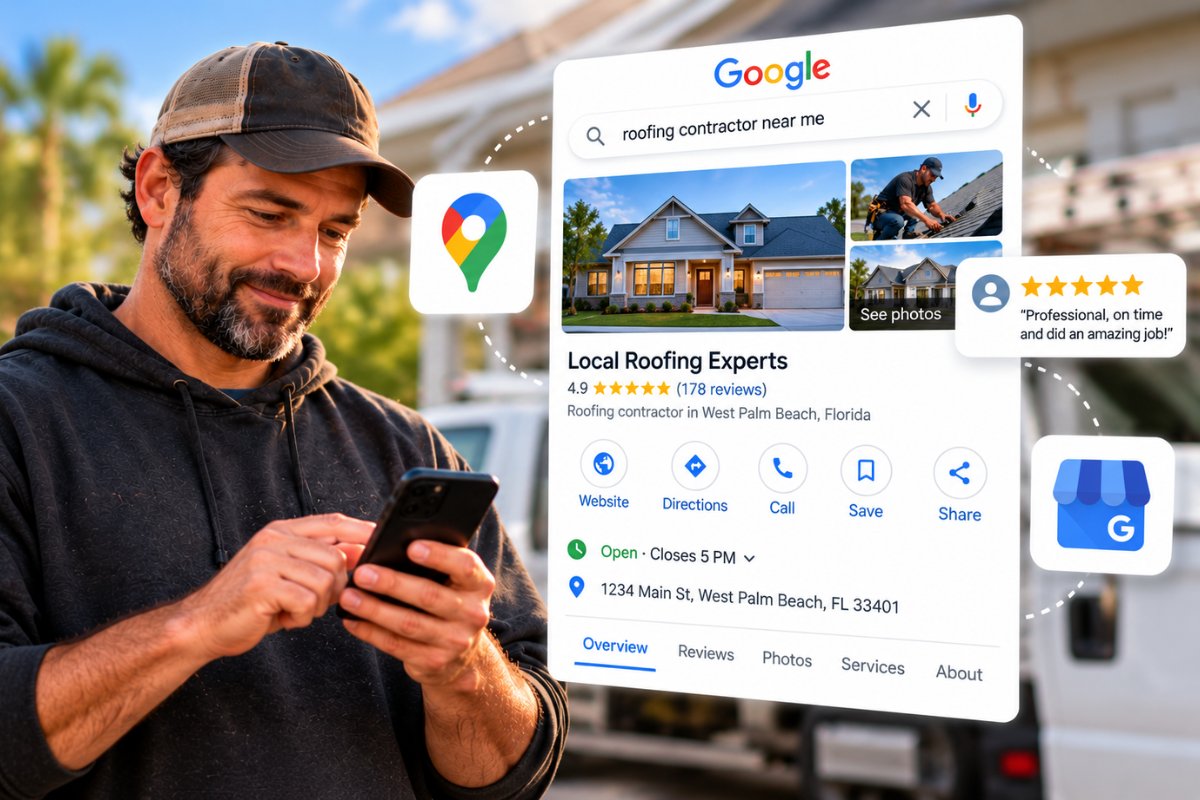
Google Business Profile isn’t a social platform. It’s the listing that appears in Google Maps and in the local results when someone searches “AC repair near me” or “hair salon Wellington.” It belongs to local search, it’s often the first thing a new customer sees of your company, and the rest of your online presence, social accounts included, builds on top of it.
Owners lump it in with social media all the time, and that’s understandable. It has posts, photos, reviews, and a Q&A section, so it looks like one. But the people who find you there aren’t scrolling for entertainment. They have a problem right now and they’re deciding who to call, which makes them warmer leads than anyone scrolling a feed.
Get the basics right:
- Correct hours, including holidays and any after-hours emergency availability
- The service area you actually cover
- Categories that match what you actually do
- Fresh photos of recent jobs, your trucks, and your team
Don’t overlook the Q&A section and the business description, either. Answer the questions people ask on every phone call right there: whether you charge for estimates, which towns you cover, whether you handle emergency calls on weekends. Google itself advises businesses to keep their profile information complete and accurate, and every answer you post there is one less reason for someone to click on a competitor.
Then make reviews a weekly habit. Ask happy customers for a review the same day the job wraps, while they’re still pleased, and reply to every review you get, good or bad. A calm, specific reply to a one-star review often does more for your reputation than the review itself did damage, because future customers read how you handle problems.
This is also where Google and social media overlap. The finished-job photos you post on your Facebook page can go straight onto your profile as updates. It’s the same photo in two places for about two extra minutes of work.
How to pick the right social media platforms for your business
Choosing the right social media mix doesn’t require a consultant or a complicated spreadsheet. Answer four questions, in this order, and the list usually sorts itself out.
- Who is your customer? Go back to those last 20 invoices. If most of your customers are over 45, Facebook goes on the list. If most are under 35, photo and short-video platforms move up.
- Is your work visual? If a photo proves the quality of what you do, add Reels-style video. If it doesn’t, skip it.
- Do you sell to businesses? If yes, add LinkedIn. If not, cross it off.
- How many hours a week do you really have? Under two hours means two platforms, max. Two to four hours can support three platforms. Beyond that, YouTube becomes realistic. Plan around your busiest month rather than your slowest, because that’s when any local business schedule gets tested.
Google Business Profile sits outside this count. It isn’t optional for anyone.
Sample setups by business type
Here’s how the framework plays out for a few common businesses. Every setup assumes the Google profile is already handled.
- Residential HVAC or plumbing company: Facebook. Add YouTube later if someone on the team likes explaining things on camera.
- Hair salon or barbershop: Instagram and Facebook, with Reels doing most of the heavy lifting.
- Pressure washing or landscaping: Facebook plus short before-and-after videos, since the transformations are the whole pitch.
- Commercial contractor: LinkedIn, plus Facebook if there’s a residential side to the business.
- CPA or law firm: LinkedIn, with posts coming from the partners’ personal profiles.
Once you’ve picked, build a simple content calendar. A shared Google Sheet listing the week’s posts is enough. If you’d like to schedule posts ahead of time, social media management tools like Sprout Social, or the free scheduler inside Meta Business Suite, let you batch a full week in one sitting.
What about the accounts you already opened and abandoned? Don’t leave them sitting there looking closed. Either post one final pinned update that points people to the places where you’re active, or delete the account outright. A quiet profile that points somewhere useful is fine; a ghost town with a 2023 post at the top is not.
Then give your choices ninety days before you judge them. Each month, track a couple of simple numbers: calls or messages where someone mentions seeing you on social media, profile visits, and which posts drew the most comments. If a platform has produced nothing after three months of consistent posting, swap it for another. For a busy owner, effective social media is small and steady, adjusted by what your own customers do rather than what some webinar promised.
Get a social media plan built for your local service business
Picking platforms is the easy part. Keeping them running while you also manage crews, estimates, and invoices is harder.
Innovative Flare is a digital marketing agency in West Palm Beach that works with small and mid-sized businesses across South Florida. We’ll look at who your customers are, what your team can realistically keep up with, and how social media fits with your website and Google profile. From there we’ll help you choose the right channels and build a marketing strategy measured in calls and booked jobs rather than likes.
If you want a social media presence that brings in business without eating your evenings, schedule a call with Innovative Flare. You’ll get a clear answer on which platforms will help your business and which ones you can let go.
Frequently asked questions about social media platforms for local businesses
What is the best social media platform for a small local business?
For most small local businesses, Facebook is the best place to start. Pew Research Center found that 71% of U.S. adults use it, including 75% of adults ages 50 to 64, an age group that owns a large share of homes and hires plenty of local services. Pair it with a complete Google Business Profile, then add a second platform based on who your customers are and what kind of work you do.
How many social media platforms should a small business be on?
Most small businesses do best on two platforms, three at most, plus a Google profile. When you're choosing the best social media platforms for a small business, two factors decide it: where your customers spend time, and how many hours you can commit every week, busy season included. Two active accounts will do more for you than five neglected ones.
Does a plumber need to be on TikTok?
No. Most plumbing customers are homeowners, and Pew's 2025 data shows TikTok use drops sharply with age, to 23% of adults 50 to 64 and 7% of adults 65 and older. A plumber is usually better served by Facebook and a well-maintained Google profile. If you already make short videos for another platform, reposting them to TikTok is a cheap experiment, but it's optional.
Is LinkedIn worth it for a home services business?
Usually not. LinkedIn works best for companies that sell to other businesses, such as commercial contractors, accountants, and law firms, and homeowners rarely look for residential help there. If your company also does commercial work, a light presence aimed at property managers and facility directors can be worth thirty minutes a week.
Is Facebook still worth it for local businesses in 2026?
Yes. According to Pew Research Center, 71% of U.S. adults use Facebook and about half visit it at least once a day. It's especially useful for businesses that serve a specific area, thanks to neighborhood groups, reviews, and ad targeting by ZIP code.
Is Google Business Profile considered social media?
No. It's a business listing that appears in Google Search and Google Maps, which makes it part of local search rather than one of the social media sites people scroll for entertainment. Because it includes posts, photos, and reviews, it's easy to confuse with a social account. For most local service businesses, it matters more than any single social platform.
What should a contractor post on social media?
Before-and-after photos of finished jobs tend to work best for contractors, followed by short clips of work in progress and quotes from happy customers. Seasonal tips, like hurricane prep or AC maintenance reminders, are also easy to share in neighborhood groups. Mention the neighborhood in your captions so local customers recognize the work as nearby.
How often should a local service business post on social media?
Two or three times a week per platform is enough for most local service businesses. Consistency matters more than volume, so pick a schedule you can keep during your busiest month. Replying to comments and messages within one business day matters just as much as posting.
Can social media replace traditional marketing for a local business?
For most local service companies, social media works best alongside traditional marketing. Truck wraps, yard signs, referrals, and mailers still bring in work, and your social accounts give people who see them a place to check recent jobs and reviews before calling.