seolounge
Guaranteed page 1 rankings: real promise or red flag?
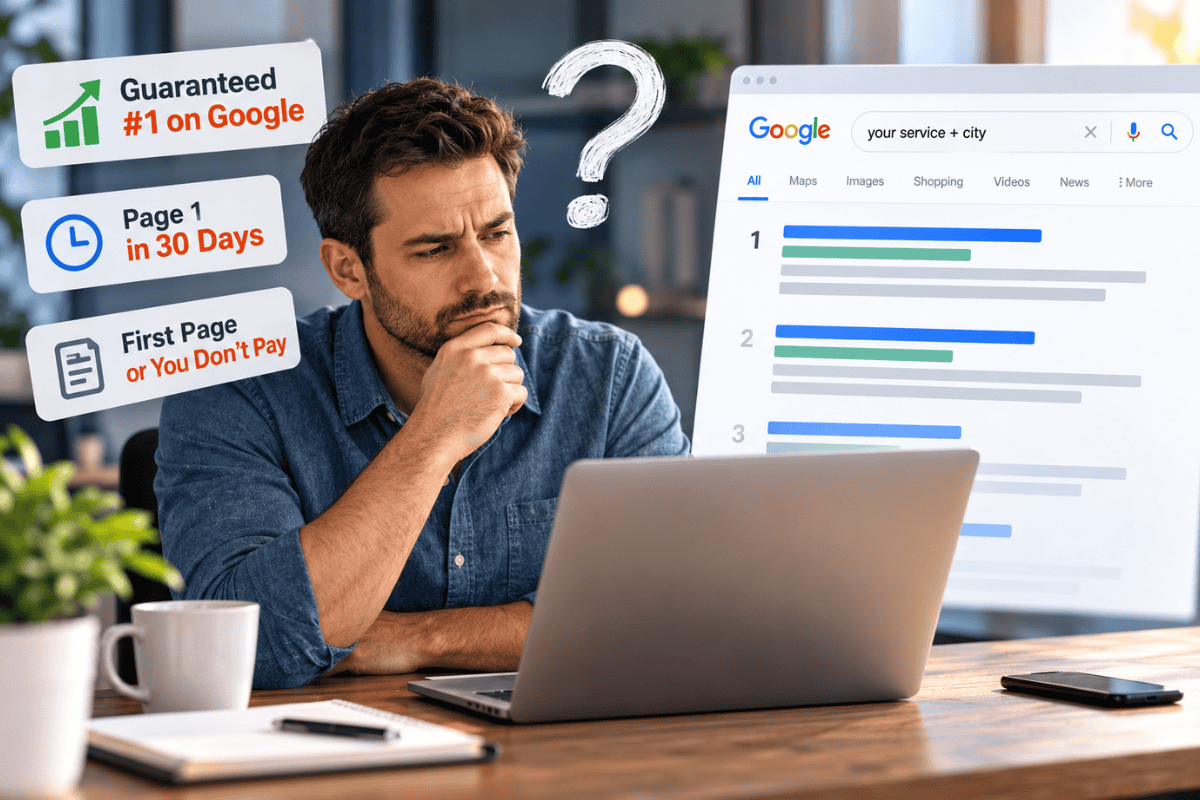
It usually starts with a phone call on a busy afternoon. You’re between jobs, the number looks local, and the person on the line already knows your business name. They’ve run a free SEO analysis of your site, they say, and it turned up problems. Then comes the offer: guaranteed page 1 rankings in 30 days, or you don’t pay.
The wording varies. Sometimes it’s “guaranteed #1 on Google.” Sometimes it’s “first page in 90 days,” or an email that opens by telling you your site isn’t showing up for searches you’ve never heard of and closes with a link to book a 15-minute call. Underneath, it’s the same offer every time. You get a specific position by a specific date, and someone else supposedly carries the risk.
That’s a hard pitch to shrug off. You’ve watched a competitor sit above you in the search results for the jobs that pay your bills, month after month. You don’t have time to learn search engine optimization yourself. And here’s someone willing to put a promise in writing, when every other vendor you’ve talked to gave you a range and a “we’ll see.” A guarantee feels like the safe choice.
It isn’t one, and you don’t have to take an agency’s word for that, ours included. Google has answered the question in its own documentation.
The reasons behind the answer are more useful than the answer, though. Once you understand why a spot on a results page is something nobody outside Google can lock in (and nobody inside Google will sell you), the pitch stops sounding like confidence. You’ll also be able to tell a serious proposal from a risky one in about five minutes.
Key takeaways
- Google states in its own guidance that no one can guarantee the top spot, and it tells business owners to be wary of any SEO who claims otherwise.
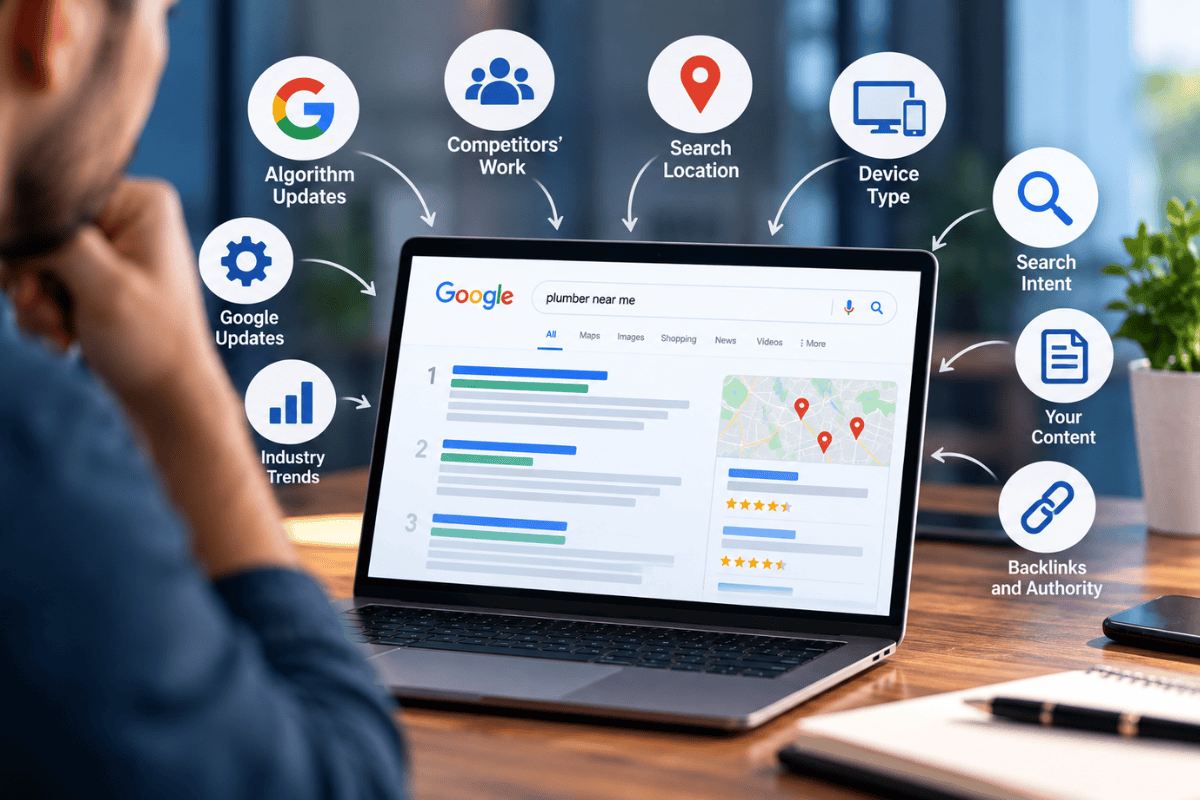
- A position on a results page shifts with every Google update, with your competitors’ work, and with the location and device of the person searching.
- Agencies that sell a guaranteed position usually meet the promise on a technicality (a phrase nobody searches, or a paid ad) or chase it with tactics that break Google’s spam policies.
- If a vendor you hired gets your site penalized, the penalty lands on you. Google holds the site owner responsible for what’s done in their name.
- Google handles roughly nine out of 10 searches worldwide, with Bing and Yahoo a distant second and third. Any guarantee needs a follow-up question: on which engine, for which search, seen by whom?
- AI hasn’t killed SEO, but it has added more places to show up than a single ranked list, and that makes a position guarantee even emptier than it used to be.
- A trustworthy offer commits to specific work, a timeframe measured in months, and reporting you can check. It never commits to a number on a results page.
The short answer: no, and Google says so itself
Google publishes a help page for business owners called “Do you need an SEO?” It’s written for people in your position, who are deciding whether to hire help and how to avoid getting burned, and one line in it settles the question in this article’s title. In Google’s guidance on hiring an SEO, the company says that “no one can guarantee a #1 ranking on Google.”
The same page tells you to beware of SEOs who claim they can guarantee rankings, who hint at a special relationship with Google, or who advertise some kind of priority submission. None of those things exist. An agency can earn a Google Partner badge for managing ad accounts, but that badge has nothing to do with where a site appears in the unpaid listings, and Google says outright that it never accepts money to include or move a site in them.
Think about who’s speaking. Every agency, including this one, has a stake in how you read a competitor’s pitch. Google has none. It owns the results page, and it’s telling you in writing that the thing being pitched to you can’t be delivered.
Google is just as blunt about audits. If someone reviews your site and guarantees that their changes will put you in first place, the advice is to find someone else. An audit is supposed to give you a realistic estimate of what could improve and how much work that would take. It’s also the stage where Google suggests giving a prospective vendor read-only access to your Search Console data, and nothing more, until you’ve decided to hire them.
The page even admits, with some amusement, that Google gets these pitches too. It describes a cold email addressed to google.com, warning the company that its website isn’t listed in most of the major search engines.
So if an agency is confident enough to guarantee a specific position, ask them to show you where Google backs that up. They can’t, because Google says the opposite. An honest vendor will tell you so in the first conversation. If what you get back is a list of clients they’ve taken to the top, notice that it’s a different claim from being able to promise the same thing to you in advance.
SEO works, and first-page rankings aren’t out of reach for a small business. Local companies earn those spots all the time, usually through steady and fairly unglamorous work. What nobody can honestly do is promise one ahead of time, on a deadline, for a search someone else gets to pick.
Why even the best SEO agency can’t promise a position
A guarantee makes sense when the person giving it controls the outcome. A roofer can warrant a roof because the roofer chose the materials and did the installation. A lawyer can’t ethically promise you a verdict, since a judge or jury decides that.
SEO sits in the second group. The agency does the work, and Google decides what the work is worth compared with everyone else doing the same thing.
Google’s ranking systems never sit still
Google doesn’t run on one formula. It uses a collection of ranking systems that weigh hundreds of signals, including what’s written on the page, how other sites refer to it, how quickly it loads on a phone, and how well it matches what the searcher seems to want. You’ll see blog posts claiming there are exactly 200 ranking factors. Google has never confirmed a count, and the list of what affects the ranking of any given page keeps shifting anyway.
Those systems get revised constantly. Google announces broad “core updates” several times a year and keeps a public log of them, alongside separate spam updates aimed at manipulative tactics. Smaller adjustments roll out with no announcement at all. A page that held the third spot in March can be sitting in ninth by May without a single word on the site having changed, and the reverse happens too. The advice Google gives site owners who lose ground after a core update is that there may be nothing wrong to fix. Its systems reassessed which pages answer the search best, and the order changed. A 30-day guarantee is a promise about where you’ll stand under search algorithms that may be rewritten before the contract is up.
Your competitors get a vote
Being third means Google judged two other pages to be better answers for that search, on that day. Moving your website to the top means moving someone else’s down, and the someone else usually has a marketing budget too.
Say you run an air conditioning company in West Palm Beach, and you’d like to show up when someone searches “AC repair near me” in July. So would every other AC company in Palm Beach County. One of them might open a second location closer to the searcher. Another might collect 60 new reviews over the summer, or hire an agency of its own and publish a service page for every neighborhood it covers. A national franchise might move into the market with a site that has 15 years of history behind it.
Your agency controls none of that. It can make your site and your Google Business Profile as strong as they can be, and that’s worth paying for. It can’t make four competitors stop trying, and it has no way of knowing in January what any of them will do by June.
There isn’t one results page to be first on
When two people search for the same thing, their screens often don’t match.
Google search results are tailored to where the searcher is standing, what device they’re holding, the language they use, and to some degree what they’ve looked for before. For local businesses, location does most of the work. Someone hunting for an emergency plumber from a kitchen in Jupiter sees a different map and a different set of listings than someone typing the same words in Boca Raton, about 40 miles south. So when a vendor promises you’ll rank first, it’s fair to ask who you’d be first for.
The map listings add another wrinkle. Google has said local rankings come down mostly to how relevant a business is to the search, how far it is from the searcher, and how well known it is. An agency can work on the first and the last. It can’t move your building closer to the customer.
The page itself has changed as well. The industry calls these search engine results pages, or SERPs for short, and a current one stacks several things above the classic list of 10 blue links: sponsored ads, a map showing three local businesses, a box of related questions, and often an AI-written summary. A report that claims a “number one position” usually means first among the organic results (the unpaid listings), which on a phone can sit a full scroll or two down the screen.
Even the reports deserve a second look. The rank trackers built into SEO tools check a keyword from one simulated location, on one device, at one moment. That same Google hiring page points out that third-party tools have no access to its internal ranking data. A tracker can say you’re in position two while half the customers in your service area see you in position six, or don’t see you at all.
The agency doesn’t own what it’s selling
The listings belong to Google. An agency selling a guaranteed position is selling something it has no authority over, the way a realtor would be if she guaranteed your house would close at a specific price by a specific Friday.
To us, the guarantee itself is the tell. The pitch works because it sounds like confidence, but people who do this work for a living know how many moving parts sit outside their control, and that knowledge makes them careful about what they put in a contract. When someone skips the caution, either they don’t understand how search works, or they understand it fine and are counting on you not to. You don’t want either one holding the login to your website.
What are the top 3 most used search engines?
Google, Bing, and Yahoo, in that order, and the gap between first and second is enormous.
StatCounter Global Stats, which measures search engine share from visits to the websites in its network, puts Google at roughly 89% to 91% of worldwide search across all devices. Bing comes second, in the neighborhood of 4% to 5%. Yahoo is third with somewhere between 1% and 1.5%. Those figures drift a little every month, so read them as ranges and not as fixed scores. Everything else, including Yandex, DuckDuckGo, and Baidu, divides up what’s left.
Bing does better than its global share suggests on desktop computers and in the United States, largely because it’s the default in Windows and in the Edge browser. If your customers are office managers searching from work PCs, a bigger slice of them use Bing than you’d guess. Yahoo, despite appearing as a separate name on the list, doesn’t maintain its own independent index of the web. Its results are licensed from Bing, so the second-place and third-place engines are, underneath, largely the same engine.
For a small business, that means your customers are overwhelmingly on Google, and even more so on phones, where its share runs higher than the all-device figure. Bing still deserves an hour of your attention, since it has its own free webmaster tools and its own business listings, and because Yahoo draws on the same index, effort spent on one carries over to the other. You don’t need a separate plan for the engine in third place.
This matters for guarantees because the word “rankings” hides several unanswered questions. A contract that promises a “top search engine ranking” without naming the engine can be satisfied on Bing or Yahoo, where fewer businesses compete and far fewer of your customers are looking. Read the wording of any guarantee for that gap. The same goes for the query. “First page for five keywords” tells you nothing until you’ve seen the five.
A roofer in Wellington and a roofer in Delray Beach, a few towns apart, can both be told they hold the top spot for “roof repair,” and both reports can be accurate, because each one was checked from its own town.
So the next time someone offers to guarantee you a ranking, ask which search engine they mean, which query, and whose phone it’ll be judged from, in which zip code, with what search history. Search engines like Google return a different page for almost every combination of those answers.
How “guaranteed” rankings usually get delivered
The odd thing about these guarantees is how often they’re technically met. That’s what separates them from cruder SEO scams, where a vendor takes a deposit and disappears, and it’s why refund clauses rarely cost these companies anything. The trick is in what counts as meeting one.
The keyword nobody searches
A keyword is the word or phrase someone types into a search box. Some get typed thousands of times a month. Others are typed only by the business owner checking on them.
Read the fine print of a guaranteed SEO service and you’ll often find that the vendor chooses the keywords, or that the guarantee covers “at least five phrases” out of a list of 20. The five that reach the first page tend to look like “best family-owned residential roof repair contractor Lake Worth Beach Florida.” Your site will rank for that. It would have ranked for it anyway, since no competitor is trying, and almost no customer will ever type it.
A close cousin is the guarantee met with your own business name. Unless your company shares a name with something famous, you already come up first for it.
Meanwhile the phrases you want to rank for, the short ones with real demand like “roof repair Lake Worth,” stay where they were. The report shows green check marks, and the phone doesn’t ring any more than it did.
The ad sold as a ranking
The fastest way to put a business at the top of Google is to pay Google. Sponsored listings from Google Ads appear above everything else and can be live the same day, so a vendor who promised “top of page one within a week” can deliver that with your own money. Ads carry a “Sponsored” label, but in a screenshot cropped tightly enough, the label is easy to miss.
Paid search is a legitimate channel, and it’s one of the services we offer. The trouble starts when an ad is presented as an organic ranking. It disappears the moment the budget stops, and it does nothing for where your site sits in the unpaid listings. Google is explicit that advertising with it has no effect on a site’s presence in organic search. If the guarantee is being met through ads, you should know that, and you should know what share of your monthly fee is going to clicks.
Shortcuts that break the rules
Then there are the vendors who do try to move the real listings on a deadline. Earning that takes months, so the only way to force it is to cheat. The trade name is black-hat SEO, meaning methods meant to trick the search engine instead of helping the person searching.
The most common ones involve backlinks, which are links from other websites to yours. Google treats a backlink from a respected site a bit like a reference from a respected person, so links are worth having and hard to earn. A vendor on a deadline buys them in bulk, from networks of throwaway sites that exist only to sell them. Google’s spam policies call this a link scheme. The same policies cover cloaking (showing Google one page and visitors another), doorway pages (dozens of near-identical pages that each swap in a different city name), hidden text, and pages stuffed with repeated keywords.
These SEO tactics can produce a jump, which is the dangerous part, because it tends to show up right around the time the second invoice is due.
The penalty lands on your site
Google enforces its spam policies in two ways. Its automated systems discount or demote sites that show the patterns. Its human reviewers can also issue what’s called a manual action, a penalty applied by a person at Google who has looked at your site. Manual actions appear in a dedicated report inside Google Search Console, the free dashboard Google gives every website owner. The consequences range from a few pages being pushed down to the entire site being removed from the index, at which point you don’t appear for anything, your own business name included.
Recovering isn’t quick. Someone has to track down the bad links and get them removed, then rewrite or delete the offending pages. After that you file a reconsideration request and wait for a person at Google to review it.
During that stretch, the traffic to your website that you had before hiring anyone is gone too, so you end up worse off than when you started. For a contractor who gets half his calls from search, that can mean a slow season in the middle of a busy one.
Google also says you’re responsible for the actions of any company you hire. The vendor who built the links can close the account and start calling the next list of businesses under a new name, while the penalty stays attached to your domain.
Is SEO dead now with AI?
No. What’s fading is one narrow version of it, where you pick a phrase, chase a position for it, and assume the click will follow.
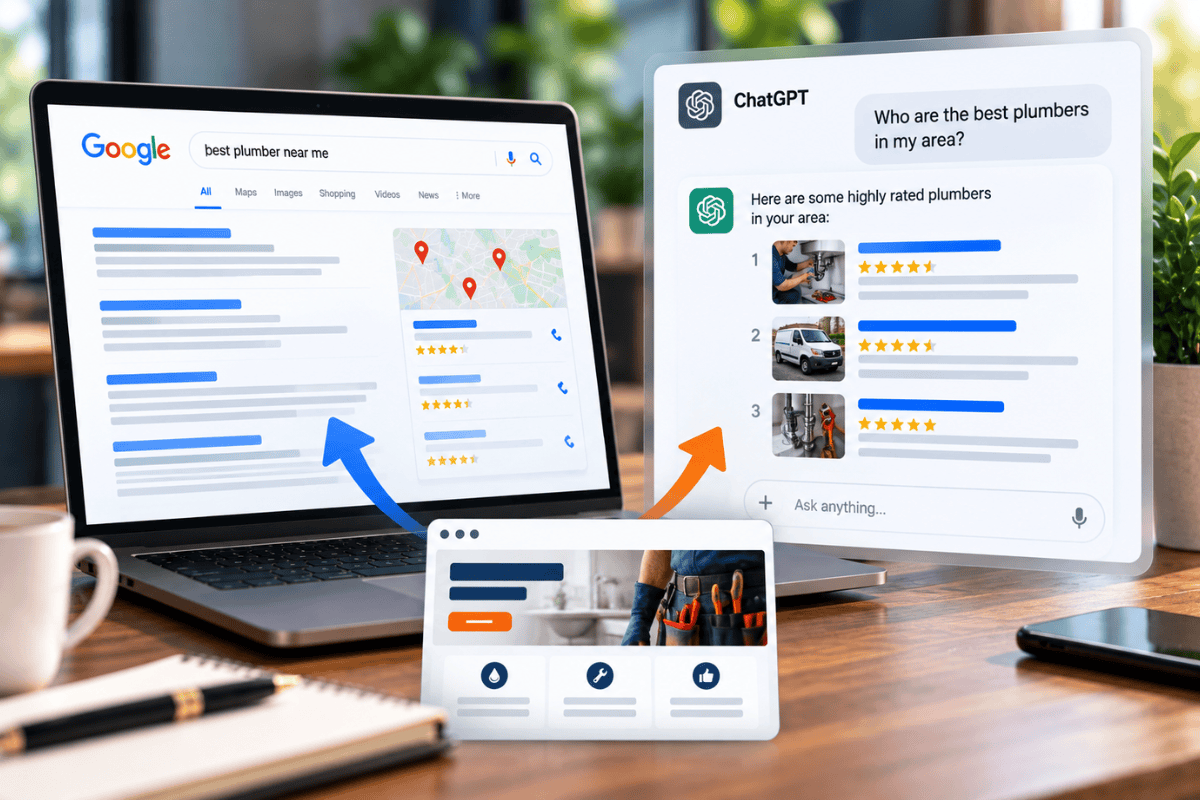
Search has started answering questions directly. Google’s AI Overviews place a written summary above the regular listings for many informational searches, and its AI Mode turns a search into a back-and-forth conversation. Outside Google, people ask ChatGPT and Perplexity the kinds of questions they used to type into a search box. When an AI Overview covers what the searcher wanted, there’s less reason to click anything beneath it. Ranking #1 no longer guarantees the click, let alone the customer.
So a second goal has appeared next to the first. You still want to be found in the listings, and now you also want to get cited, meaning named or linked as a source inside AI answers. Those AI citations tend to go to businesses that are described consistently across the web: on their own site, in reviews, in directory listings, and in the conversations people have about them on places like Reddit and Quora. A citation there can put your name in front of a customer who never scrolls down to the ranked list at all.
The underlying skills haven’t changed much. AI systems pull from pages that are technically sound and clearly written, published by businesses that look trustworthy, and those are the same qualities that earn a place in the regular listings. That’s why we describe this as an expansion of the job. Modern SEO focuses on visibility across every place a customer might ask the question, and being cited in AI summaries is one more of those places. Google’s page on hiring an SEO now touches on this as well. It suggests checking whether a vendor’s advice on AI (often sold under the labels AEO or GEO) lines up with what Google has published on the subject.
AI search makes a guarantee worth even less. There used to be one ranked list, and a promise of first place on it was already something no vendor could keep. Now there’s the list, the map, the AI summary above both, and several chat tools that don’t show a list at all. A vendor can no more guarantee your AI visibility than your position.
We’ve written a longer piece on whether SEO is dead now that AI, AEO, and GEO are everywhere if you want the full argument.
The kind of SEO offer worth signing
You can usually sort SEO promises into two kinds by their verbs. A risky one says “we guarantee.” A sound one says “we will,” followed by a list you could check off.
The promise is about the work
A reputable SEO proposal commits to things the agency controls. For a local business, that normally means a few distinct kinds of work. Technical SEO is the plumbing, which means fixing pages Google can’t crawl, speeding up slow ones, and cleaning up broken links and duplicates. On-page work is how an agency will optimize your website for the searches you care about, so that a service page for water heater installation reads like the best answer to someone looking for exactly that. Then there’s SEO content, the ongoing content creation that answers the questions your customers ask before they call. Off the site, the work covers your Google Business Profile, your reviews, your directory listings, and links earned from real local organizations.
A good proposal tells you which of those aspects of SEO it will tackle first and why, based on an audit of your own site. If your pages are fine but your business has 11 reviews and the competitor down the road has 300, the plan should say so.
The timeline is measured in months
In a video it published on how to hire an SEO, Google says that in most cases it takes four months to a year to implement improvements and then see the benefit. A new site in a crowded market sits at the long end of that range. An established business with one obvious technical problem can see movement sooner.
Getting your website to rank on Google for a search that brings in revenue is slow because the SEO strategies that last are slow. You publish useful pages, earn reviews, fix what’s broken, and wait for Google to notice. A reliable SEO plan is upfront about that curve. The first two or three months are mostly groundwork, and the reports from that period should show completed tasks more than results.
We’ve covered how long SEO takes to work for a small business in more detail elsewhere. The short version is that a vendor quoting 30 days either plans to use one of the shortcuts described above or hasn’t thought it through.
You can see what’s being done
Google suggests asking whether the agency will share every change it makes to your site, along with the reasoning behind it. A professional SEO firm says yes without hesitating.
In practice that looks like a monthly report in plain English, with a list of what was changed, and accounts that stay in your name. Your domain, your website login, your Google Business Profile, and your analytics should all belong to you, with the agency added as a user. If a vendor insists on owning those, ask what happens to them when you leave. Be wary of “proprietary methods” that can’t be explained, too. Many SEO pitches lean on secrecy to sound sophisticated, when the SEO practices that work are described publicly in Google’s own documentation.
The results are ones your business can feel
An SEO ranking report has its place, but a position is only worth what it brings in. What you’re buying is online visibility that turns into phone calls and booked jobs, and the organic traffic that produces them. A sound agency ties its SEO efforts to those numbers and tells you when a month went badly.
That requires tracking, set up before anything else starts, so you know which calls came from the website, which form submissions began with a search, and which pages those people landed on. Without that baseline, nobody can tell you in month six whether the work paid for itself, and a position report is all there is left to show you.
Goals can still mention a position. “Our aim is to rank on the first page of Google for water heater repair in Palm Beach Gardens within nine months, and here’s the work we’ll do to get there” is a target. It names a search you care about and leaves room for reality, which “guaranteed 1st page placement” doesn’t.
Guarantees that are fine to accept
The SEO guarantees worth having are the dull ones, the kind that cover effort and process. An agency can promise that the agreed work will be delivered on schedule, or that it will keep working at no extra charge until specific deliverables are finished, or that you get your money back if they aren’t. Those are promises about things the agency controls.
So when SEO companies offer guaranteed SEO results, read what the guarantee is attached to. If it’s attached to deliverables, you’re looking at a service commitment, and that’s fine. Once it’s tied to a position in Google rankings, it’s the red flag Google warned you about.
Questions to ask any SEO vendor making big promises

Most of these come from the list Google itself suggests, and we’ve added a few. None of them require you to know anything technical. You’re listening for whether the answers are specific.
- Which exact searches does your guarantee cover, and who picks them? If the vendor picks, ask how often each phrase gets searched in a month, then pull up the top results for those searches on your own phone.
- Is the promised position in the unpaid listings, in the map, or in an ad? Anything short of a clear answer tells you enough.
- Do you follow Google Search Essentials? That’s the published rulebook, formerly called the Webmaster Guidelines. A legitimate agency knows it by name.
- Where will my backlinks come from? Good answers mention real organizations, such as suppliers, trade associations, local news sites, and sponsorships. A package of 500 links for a flat fee is a bad answer.
- What will you change on my site in the first 90 days, and will you show me each change? Google recommends asking for exactly this.
- Can I talk to two current clients in a business like mine? Google says to check references and ask past clients whether the work produced results.
- Who owns the accounts, the content, and the website if we part ways? The answer should be you.
- What does the contract say about cancelling? A 12-month lock-in paired with a 30-day guarantee deserves a hard look.
- How do you measure success, and what will the monthly report contain? This one is on Google’s list too. The answer should include calls and leads alongside positions.
- What happens if results come slower than you expect? Even seasoned SEO experts run campaigns that take longer than planned, and you want to hear what they’d do about it. “That never happens” is the wrong answer.
SEO agencies that do the work properly tend to like these questions, because the answers separate them from the competition. Pay attention to the questions you get asked, too. In Google’s description, a good SEO is curious about your business and wants to know what makes it different, who your competitors are, and how customers find you now. A vendor who pitches a package before asking any of that is selling the same package to everyone.
SEO red flags: phrases that should end the conversation
- “We have a contact inside Google.”
- “Our method is proprietary, so we can’t tell you what we do.”
- “We’ll submit your site to hundreds of search engines.”
- “All we need is a link to our company in your footer.”
- “Sign today and we’ll lock in your spot.”
The Google page names most of these. It says you should never have to link to an SEO, and it calls mass submissions to search engines a useless exercise. The last line is ordinary pressure selling, since there’s no spot to lock in.
If you’ve already been burned, Google points US businesses to the Federal Trade Commission, which takes complaints about deceptive business practices. A complaint won’t undo a penalty, but it puts the vendor on record with a regulator.
Get an honest SEO assessment from a West Palm Beach agency
Innovative Flare is a digital marketing agency in West Palm Beach that works with small and mid-sized businesses, most of them local service companies and professional practices. We won’t promise you a position. On a first call, we’ll look at where your site and your Google Business Profile stand today, tell you what we think is holding them back, and give you a realistic picture of the work and the timeline.
We handle local SEO, websites, paid ads, Google Business Profile management, and reviews, so the plan can cover whichever of those your situation calls for.
If you’re holding a proposal with a guarantee in it, bring it. We’ll go through the wording with you, line by line if you like, and you can decide what to do with it. It also helps to have a rough idea of which services bring in your best jobs, since those are the searches worth looking at first.
Schedule a call with Innovative Flare and we’ll start with your questions, including any from the list above.
Guaranteed page 1 rankings: frequently asked questions
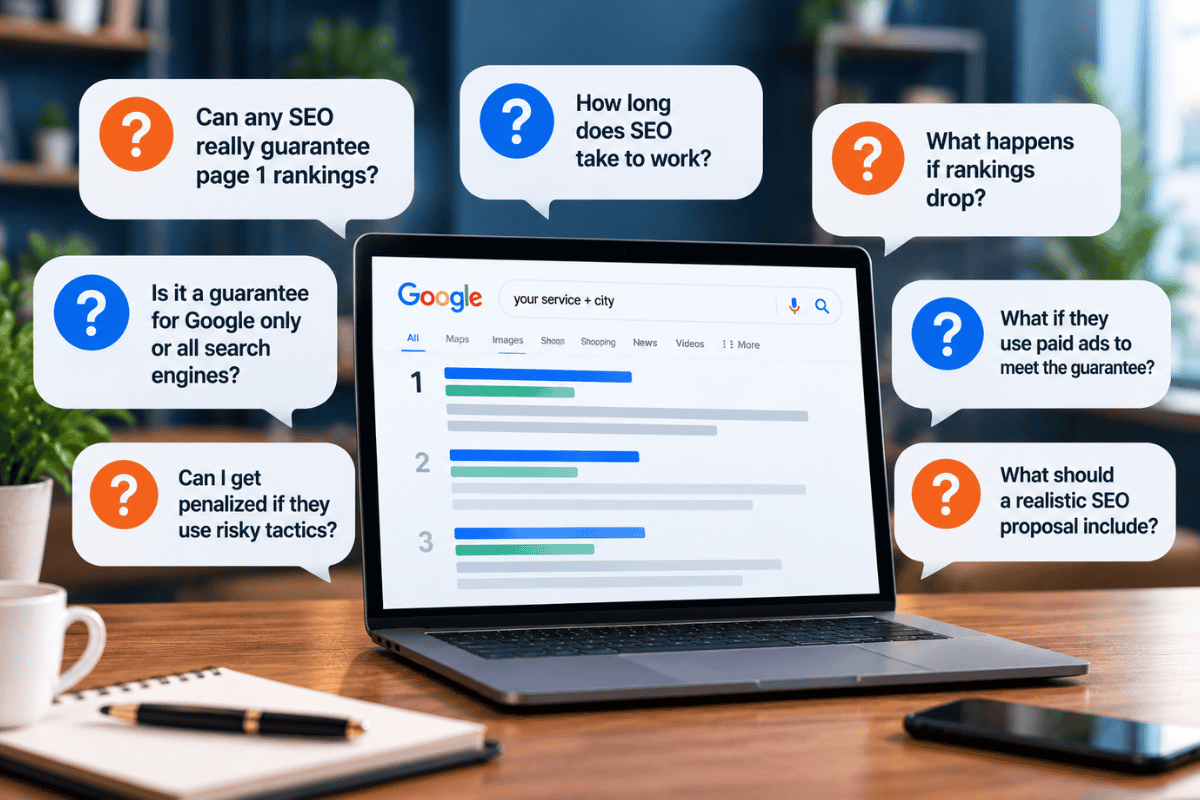
Can an SEO agency guarantee page 1 rankings?
No. Google states in its own guidance on hiring an SEO that no one can guarantee the top position, and it warns business owners to be wary of anyone who claims to. An agency controls the work it does on your site, but Google decides where pages appear, and that decision changes with every update and every competitor's move.
Why can’t anyone guarantee the top spot on Google?
A position on Google is a comparison between your page and every competing page, and it's recalculated constantly. Google weighs hundreds of signals and revises its systems throughout the year. It also shows different results depending on where the searcher is and what device they're using. An agency can improve your site, but it can't control Google's systems or what your competitors do.
Is a money-back guarantee on SEO rankings safe?
Read what triggers the refund before you trust it. These guarantees are often written so the vendor chooses the keywords, which lets them pick phrases with no search demand and call the promise met. A guarantee tied to completed work or deliverables is reasonable, but one tied to a specific position is the kind Google tells business owners to avoid.
What are the top 3 most used search engines?
Google, Bing, and Yahoo. Based on StatCounter Global Stats, Google handles roughly 89% to 91% of worldwide search, Bing about 4% to 5%, and Yahoo between 1% and 1.5%, with small changes from month to month. Yahoo's results are supplied by Bing, so the second and third engines draw on the same index.
Is SEO dead because of AI?
No, though the job has widened. AI summaries in Google, ChatGPT, and Perplexity now answer many questions directly, so being named as a source matters alongside holding a high position, and the work that earns those mentions is the work SEO has always involved: a technically sound site, useful content, and a business that looks trustworthy across the web.
How long does SEO take to show results?
Google has said most businesses should expect four months to a year for improvements to be implemented and the benefit to show. New websites and competitive markets fall at the longer end. An established site with one clear technical problem can move faster. A promise of results in 30 days should be treated as a warning sign.
What should I ask before hiring an SEO company?
Ask which searches they're targeting and who chose them, what they'll change on your site, where your links will come from, and who owns the accounts if you leave. Then ask for references from current clients and whether they follow Google's published guidelines, and expect a legitimate agency to answer all of it specifically and in writing.
What happens if an SEO company gets my website penalized?
The penalty applies to your website, whoever caused it. Google can demote pages or remove a site from its index through a manual action, which shows up in Search Console. Recovery means removing the offending links or content and asking Google to review the site again, and that can take weeks or longer.
What does a legitimate SEO service promise instead of rankings?
It promises specific work on and off your site and a realistic timeline in months, with reporting on calls and leads that you can verify. It may name a target position as a goal, but it won't guarantee one.