seolounge
You check your analytics on a Tuesday morning, coffee still in hand, and something looks off. Traffic is down from last month. Not a cliff, just a dip, the kind that used to mean nothing before you started reading headlines about AI killing organic search. Now every dip feels like a verdict.
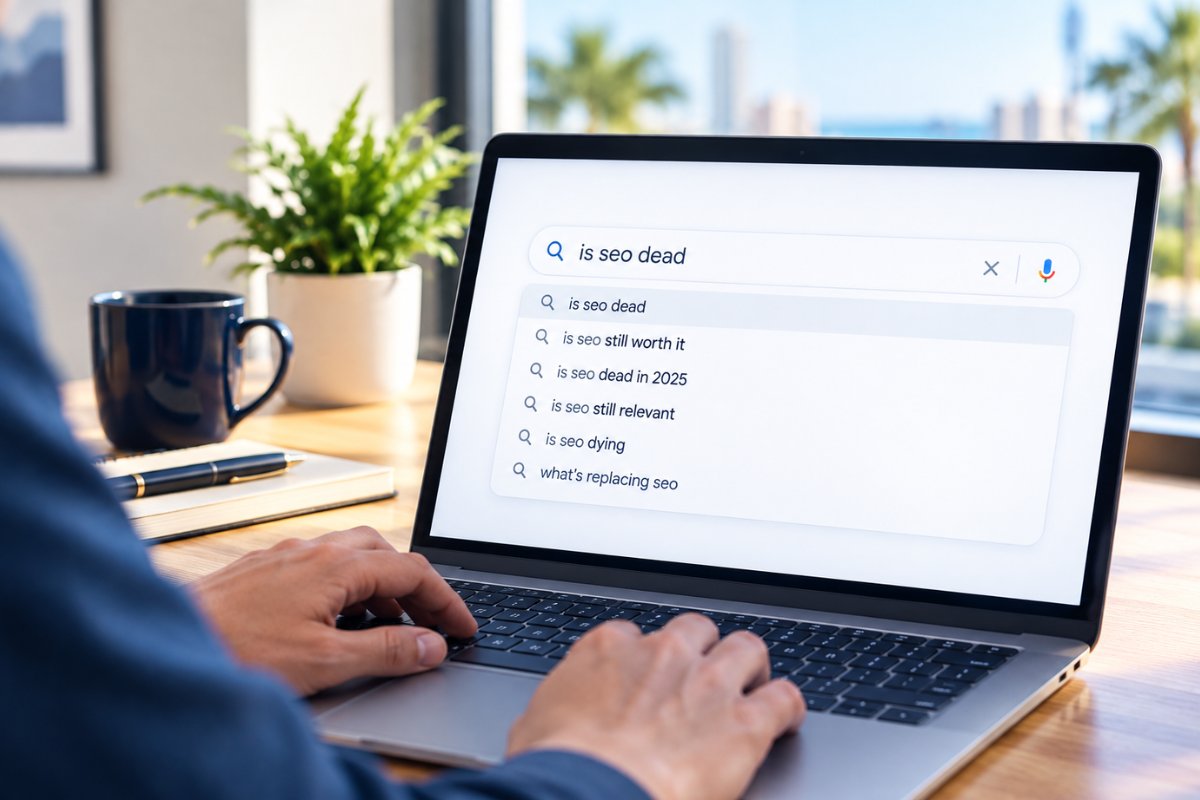
Maybe you saw the term AEO in a LinkedIn post and nodded like you knew what it meant. Maybe a competitor mentioned GEO the way people drop acronyms to sound ahead of the curve. Or maybe you just typed “is SEO dead” into Google at 11pm, half expecting the answer to be yes, half hoping someone would tell you the truth instead of trying to sell you something.
Here is the truth. Search behavior genuinely changed. Zero-click results are real and growing. AI Overviews sit on top of results now, answering questions before anyone clicks through to a website. Chatbots like ChatGPT and Perplexity have become a real destination for some searches, not a novelty. None of that is hype.
But “SEO is dead” is not an honest read of what is happening. Neither is “nothing has changed, stop worrying.” Both answers tend to come from someone with a product to move: a course, a tool, an agency retainer pitched on fear in one direction or complacency in the other.
This article gives you the less exciting, more accurate answer. What actually shifted. What never moved at all. And what a small business, in West Palm Beach or anywhere else, should actually do about it heading into 2026.
Key takeaways
- SEO is not dead. What is fading is the narrow version of SEO that only chased rankings for a click, with no plan B once the click stopped coming.
- Zero-click search predates generative AI by years. SparkToro documented searches ending without a click back in 2019, driven by featured snippets and knowledge panels.
- The most solid recent figure comes from SparkToro and Datos: 58.5% of US Google searches in 2024 ended without a click to any website. Be skeptical of bigger, flashier numbers floating around online.
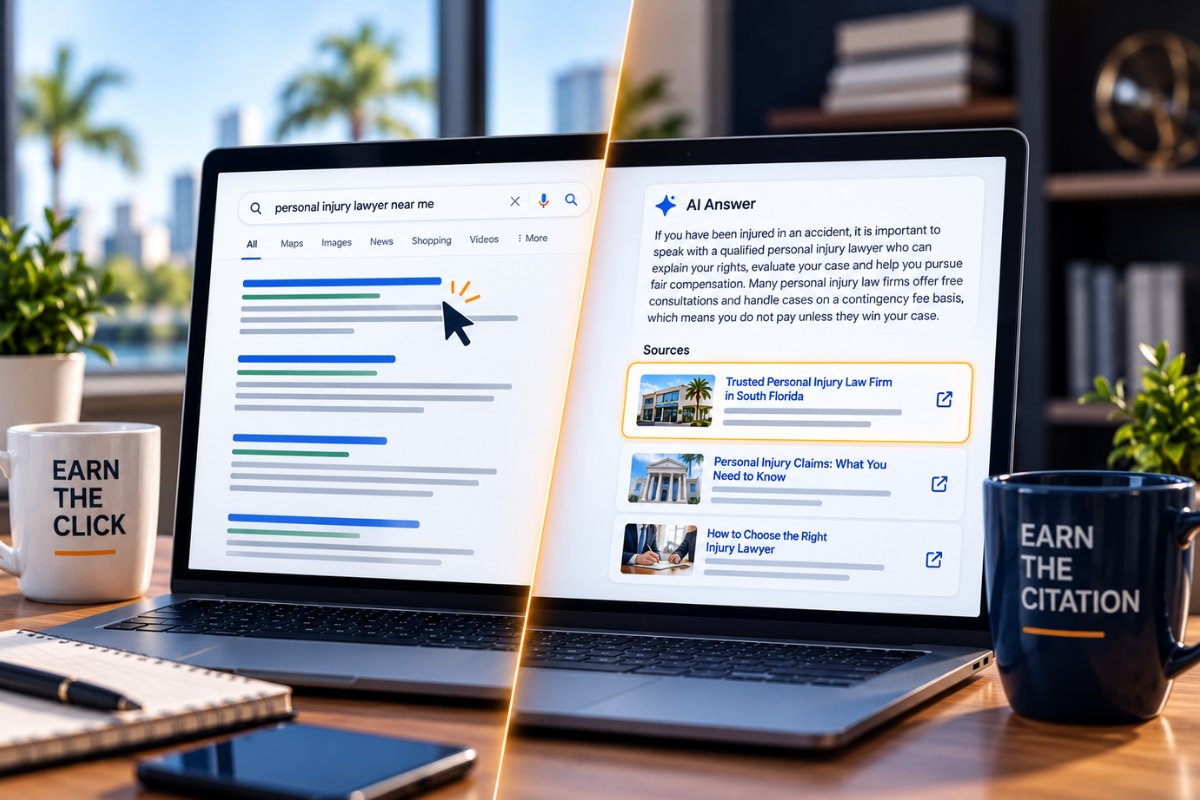
- The real shift is a goalpost change, from earning the click to earning the citation, meaning the source AI systems and search engines both trust enough to point to.
- Google’s own current guidance says there is no separate playbook for AI Overviews. The same fundamentals that always mattered, like crawlable pages and genuinely useful content, still decide what gets surfaced.
- Ranking well but seeing less traffic is a new and legitimate problem, but it is a reason to adjust strategy, not to abandon SEO in 2026 altogether.
- The businesses handling this well are not chasing every new acronym. They are investing in trustworthiness, accurate structured data, and content that actually answers the question someone asked.
Why “is SEO dead” keeps showing up in your search bar
This question did not appear out of nowhere. It shows up because something real is happening to search behavior, and most of the content trying to explain it either panics or shrugs. Neither reaction is useful if you are the one deciding where to spend your marketing budget this year.
Zero-click search isn’t new, it just found a new engine
Long before anyone said “AI Overviews,” searches were already ending without a click. Rand Fishkin, a search researcher most people in this industry trust, ran the numbers through his firm SparkToro around 2019 and found that roughly half of Google searches ended without anyone clicking through to a website. The cause back then was not artificial intelligence. It was featured snippets and knowledge panels, the boxes that answer a simple question directly on the results page.
Think about a local plumber searching “how to reset a garbage disposal” just to understand what a customer means on the phone. Google already answered that in a snippet in 2019, no AI required. That is the part people forget when they blame this entirely on generative AI: the pattern was already here.
The number worth anchoring on
If you want one figure to hold onto, hold onto this one. SparkToro and the clickstream analytics firm Datos studied real search behavior in 2024 and found that 58.5% of US Google searches ended without a click to any website. That is the most carefully sourced, most frequently cited number in this conversation, and it comes from an actual panel of real search sessions rather than a guess.
You will see other numbers thrown around. Some blog posts claim 64.82%. Others say 68%, or even 75%. Treat those with real caution. They come from inconsistent methodologies, and in a lot of cases they cannot be independently verified at all. When someone hands you a suspiciously precise statistic to prove a dramatic point, that precision should make you more skeptical, not less.
AI Overviews turn up the dial
Here is where things get less settled but still directionally clear. When an AI Overview appears at the top of a search, the zero-click rate for that particular query tends to climb even higher than the general average. Multiple sources agree on the direction. They do not agree on the size of the effect. Depending on who ran the study and how, you will see anything from roughly 60% up to more than 90% for queries where an AI Overview shows up.
That is too wide a range to treat as one confirmed fact, so this article will not pretend otherwise. What is fair to say is simpler: AI Overviews are not a rounding error on top of an existing trend. They are accelerating something that was already underway, on a growing share of search results.
Picture a bakery owner searching “best gluten free bakery West Palm Beach” to see where they rank. If an AI Overview answers that query directly, with a short summary and a few named businesses, plenty of searchers will read it and never scroll to the organic results at all. The bakery might still rank well. It just will not get credit for it in the form of a click, at least not on that particular search.
The Gartner forecast everyone quotes
One more number gets repeated constantly, so it deserves a clear-eyed look. In February 2024, the research firm Gartner published a forecast predicting that traditional search engine volume would drop 25% by 2026 as AI chatbots and virtual agents absorbed a growing share of queries.
That is a prediction, made by a named analyst firm, at a specific point in time. It is not a confirmed outcome, and nobody serious is claiming otherwise. Whether it landed exactly at 25%, higher, or lower is not something this article can verify. What the forecast does capture accurately is the shape of the shift: query share moving away from a single search box and toward AI assistants, chat interfaces, and answer engines that used to not exist at meaningful scale. A homeowner who once typed a question into Google might now just ask a voice assistant or ChatGPT directly, get an answer in conversation, and never open a browser tab at all. That is a real behavior change happening at the margins right now, even if the exact 25% figure turns out to be optimistic or conservative once someone measures it properly.
Put those pieces together and the pattern is hard to miss. Search behavior is genuinely changing, the change predates generative AI, and AI is speeding it up rather than starting it from zero.
What AEO and GEO actually are
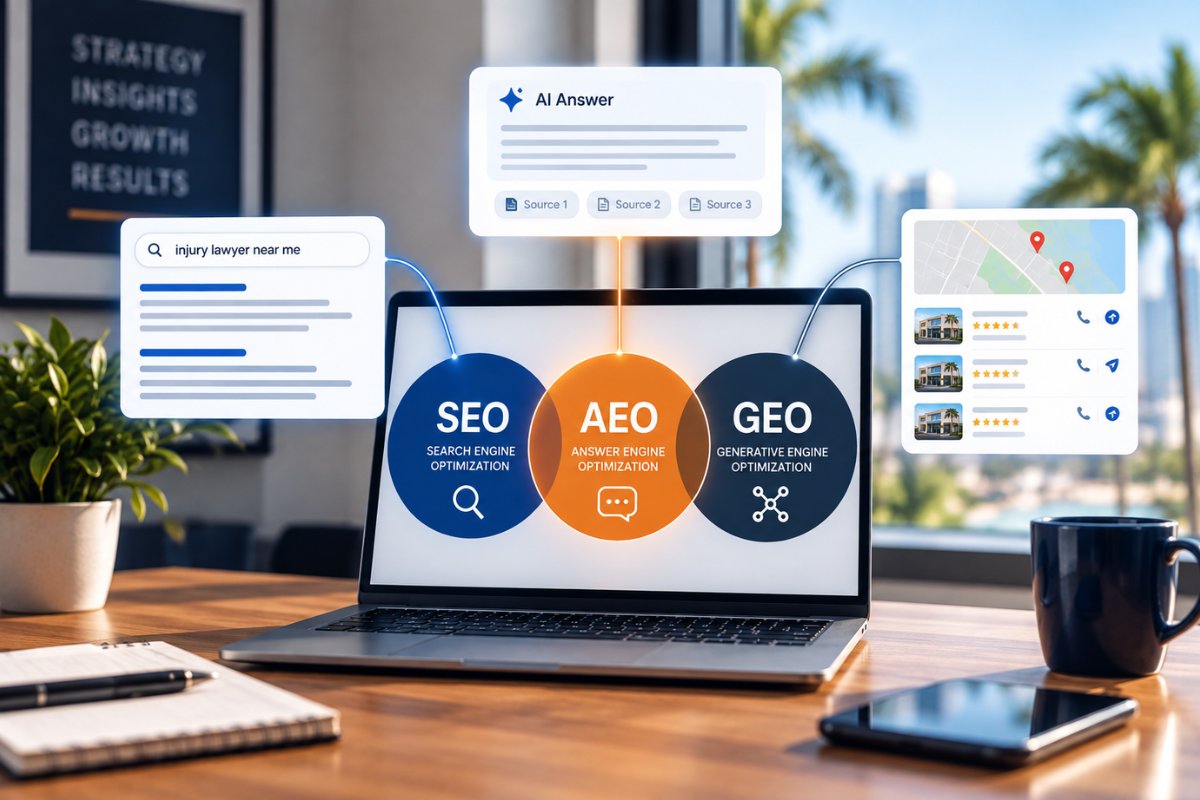
Before going further, it helps to define the two acronyms causing most of the anxiety. Neither one is as complicated as it sounds, and neither one replaces the SEO work you have already been doing.
Answer engine optimization, in plain terms
Answer engine optimization, usually shortened to AEO, means shaping content so it can be pulled out and used as a direct answer instead of just a ranked link. That covers voice search results read aloud by a smart speaker, the short answer box above traditional results, and the kind of tightly scoped question a chatbot gets asked and needs to answer in a sentence or two.
In practice, AEO looks a lot like good writing habits your English teacher probably tried to teach you: answer the question early, use a clear heading that matches how people actually ask it, and keep the response self-contained enough that it makes sense pulled out of context. A landscaping company writing “how often should St. Augustine grass be watered in Florida” and answering it in the first two sentences is doing AEO, whether or not they ever use that term.
Generative engine optimization, in plain terms
Generative engine optimization, or GEO, is the broader cousin. It is about earning a mention or citation inside an AI-generated answer, whether that answer comes from ChatGPT, Perplexity, or Google’s AI Overviews synthesizing several sources into one response. Where AEO is mostly about format, GEO is more about trust and reputation: does this AI system consider your business a reliable enough source to cite by name when someone asks a relevant question.
That distinction matters for a small business owner because it shifts the goal. You are no longer only trying to rank a page. You are trying to become the kind of source that gets referenced, quoted, or recommended when an AI system builds its answer, alongside or instead of a plain link.
Picture a dentist in West Palm Beach whose website ranks third for “emergency dentist near me.” Under old-school SEO, third place still earns clicks. Under GEO, what matters more is whether an AI search engine, when someone actually asks “which emergency dentist near me is open right now,” has enough clear, accurate, well-structured information about that practice, hours included, to name it directly in a generated answer. Ranking third and getting cited first are not the same win, but they are not opposites either.
Why the terminology is still a little unsettled
Here is an honest confession the marketing industry does not make often enough: nobody has fully agreed on where AEO ends and GEO begins. Some marketers use the two terms interchangeably. Others draw a hard line, reserving AEO for voice search and answer boxes while treating GEO strictly as optimization for generative AI systems. Both camps have reasonable arguments.
Frankly, most of the energy spent arguing about which term is “correct” is positioning, not substance. The underlying work is the same regardless of which label you use: create genuinely useful, well-organized, trustworthy content that a machine can confidently point to. This article uses both terms loosely for that reason, and if a vendor tries to sell you a completely separate strategy for each one, that is worth questioning.
What’s actually changing: earning the click vs. earning the citation
If there is one idea worth taking seriously in all the AI search noise, it is this one. The goalpost is moving. Not disappearing, not staying exactly where it was, but moving in a specific and traceable direction.
The old goalpost
Traditional SEO, the kind most small businesses have been doing for a decade, was built around a simple chain of events: rank a page on the first results page, get a click, bring that visitor onto your own website, convert them into a lead or a sale. Every metric that mattered flowed from that chain. Organic traffic, time on page, bounce rate. All of it assumed the click was the finish line.
That model still works for plenty of searches. Someone searching “roofing contractor West Palm Beach” who is ready to hire is still going to click through to a few websites, compare them, and pick up the phone. Old SEO is not obsolete for that kind of high-intent search, and it never will be.
A lot of the actual work under the old model came down to keyword targeting: figure out what phrase your customer types, build a page around it, and hope the ranking algorithm agreed the page deserved a top spot. A tile and grout cleaning company might have built an entire page around the keyword “tile grout cleaning West Palm Beach” and measured success almost entirely by where that page landed in the results and how much organic traffic it pulled in afterward.
The new goalpost
But for a large and growing share of searches, especially the informational ones, the click is no longer guaranteed even when you rank well. If an AI Overview or a chatbot answers the question directly, the person asking it may get everything they need without ever seeing your website at all. Ranking without traffic is the strange new problem this creates, and it genuinely did not exist in this form ten years ago.
Modern SEO has to account for a second, parallel goal: getting named, quoted, or referenced inside that generated answer, even when there is no click attached to it. That is what “earning the citation” means in practice. Picture that same tile and grout cleaning company showing up by name when someone asks ChatGPT “who does tile and grout cleaning near West Palm Beach,” or getting listed as a source when Perplexity answers a similar question. No click required for that to be worth something.
This kind of visibility does not always show up as a session in your analytics dashboard. It shows up instead as a rise in people searching your business name directly, a jump in phone calls that mention “I saw you online,” or more direct visits to your site with no referring search query attached at all. Those are the metrics worth watching now, alongside the traditional ones, not instead of them.
Why this is an expansion, not a replacement
Here is the part that gets lost in most “SEO is dead” content. Earning a citation from an AI system depends on almost exactly the same qualities that used to earn a ranking: accurate information, clear structure, genuine expertise, and enough trust signals that a machine is comfortable repeating what you say as fact. None of that is a new skill a small business has to learn from scratch.
The boring answer is also the true one here. This is not a pivot to some unfamiliar discipline called GEO that requires abandoning everything you know about search engine optimization. It is the same discipline, aimed at a slightly wider target, with citation added next to ranking as a second measure of success. None of this has to kill SEO for a business willing to widen its definition of a win.
A marketer who only reports on rankings and organic traffic is measuring half the picture in 2026. The other half, citations, brand mentions, and direct traffic, takes more work to track, but it is not invisible. It just requires paying attention to signals that used to be considered secondary.
What isn’t changing: the fundamentals both search engines and AI systems run on
Everything in the last section describes a real shift. This section describes what stayed exactly where it was, because both halves of the story matter for an honest answer.
Crawlability and indexability
Before anything else, a page has to be crawlable and indexed. That has been true since the earliest days of search engine optimization, and it remains true for AI-generated answers too, since AI Overviews and chatbot citations both draw from content that search engines have already found, crawled, and stored. A site with a robots.txt file blocking the wrong folder, broken internal links, or pages accidentally marked noindex will not show up in a traditional result, and it will not get cited by an AI system either. There is no separate crawl for AI. It is the same index, used two different ways.
Imagine a family-owned restaurant whose traffic vanishes overnight because a plugin update accidentally set every page to noindex. No AI Overview, no algorithm penalty, no mystery. Just a technical mistake that would make the entire site invisible to anything trying to read it, human or machine. It is a common enough failure mode that a basic technical health check catches more real problems than most AI-anxiety content ever will.
Comprehensive, genuinely useful content
This is the one that surprises people the most, because it sounds too simple to be a real answer. Content that actually, thoroughly answers a question, written by someone who understands the topic, still outperforms thin content stuffed with keywords. That was true for classic search engine optimization and it is true for GEO, arguably even more so, because an AI system synthesizing an answer needs a source confident and complete enough to lift from directly.
A landscaping company that publishes a genuinely useful guide to Florida-friendly plants, with real detail about watering schedules and soil types, builds more authority over time than a competitor pumping out short, generic posts targeting slightly different keyword variations. This is the same idea behind topical authority, the concept that one great post is rarely enough and a site needs real depth across a subject to be treated as authoritative.
Schema markup that matches the page
Structured data, the behind-the-scenes markup like schema.org and JSON-LD that tells a search engine or AI system what a page actually contains, still matters. It matters for FAQPage schema helping an AI platform recognize a clean question-and-answer format worth citing, even though Google stopped showing FAQ rich results in the standard results page back in 2023. It matters for LocalBusiness schema keeping your name, address, and phone number consistent across your website and your Google Business Profile alike. What has never mattered, and still does not, is markup that claims something the visible page does not actually say. That was bad practice five years ago and it is bad practice now, for the same reason: it breaks trust with whichever system is trying to verify it, whether that system is a Google quality rater or an AI model checking a source before citing it.
Backlinks, citations, and technical health
Other sites linking to yours, mentioning your business by name, or citing your data still functions as a trust signal, the same way it always has. A dentist quoted by a local news site, a contractor featured in a homeowner’s association newsletter, a product mentioned in an independent review roundup: all of that still counts, and increasingly it counts for AI-generated answers too, since those systems tend to weigh how often and how consistently a business gets mentioned across the web.
Underneath all of it, technical SEO has not gone anywhere either. Page speed, mobile usability, secure connections, and a site that does not throw errors when a bot tries to read it: none of that became optional just because AI entered the picture.
Local SEO deserves a specific mention here, since it is where a lot of small businesses actually compete. Consistent business information across your website, your Google Business Profile, and third-party directories still functions as a foundational trust signal, both for a traditional local pack result and for an AI system trying to confirm which business is actually open, where, and under what name. Inconsistent addresses or outdated phone numbers scattered across the web confuse machines just as easily as they confuse customers.
What Google itself says about all this
You do not have to take an agency’s word for any of this. Google addressed the question directly in its own guidance on AI search optimization, and the position is refreshingly unhyped: “the best practices for SEO continue to be relevant because our generative AI features on Google Search are rooted in our core Search ranking and quality systems.” Google also states plainly that businesses do not need special machine-readable files like llms.txt, since Google’s own systems do not use them, and there is no separate rewrite required just to appear in an AI Overview.
That is about as close to a definitive answer as this topic gets. Google and AI search are not asking for a new set of rules. They are asking for the same rules, applied consistently and taken seriously, whether the system reading your site is a classic ranking algorithm or one of the newer AI models generating a conversational answer.
So is SEO dead, or is “nothing has changed” just as dishonest?
Both extremes fail the same test: neither one survives contact with the actual data. “SEO is dead” ignores that crawlability, useful content, and trust signals are still exactly what gets rewarded, by search engines and by generative AI alike. “Nothing has changed” ignores that a real and measurable share of searches now end without a click, and that a growing number of answers get generated instead of linked.
Here is an uncomfortable pattern worth naming directly: most content declaring SEO dead is written by people selling something on one side of that claim or the other. The panic version usually leads to a course, a certification, or a “new GEO framework” being sold as the replacement for everything you already know. The dismissive version usually comes from an agency worried that admitting anything changed will spook a client into asking harder questions about results. Vendor case studies claiming a specific multiplier in AI citations or conversions after switching tools deserve the same skepticism. Impressive numbers with no methodology attached are marketing copy, not evidence.
Picture two business owners reacting to the same headline. One reads “AI is killing SEO,” cancels the blog, stops updating business listings online, and redirects the whole budget into paid ads out of panic. The other reads a “nothing has changed” post, keeps publishing exactly the same thin, keyword-stuffed pages that barely worked in 2019, and wonders a year later why traffic kept sliding anyway. Neither owner is wrong to be confused. Both got bad advice, just from opposite directions.
What actually happened is less dramatic and more useful than either sales pitch: search intent splintered across more surfaces. Some questions still send someone straight into ten blue links, ready to compare and click. Other questions get answered in a paragraph inside an AI Overview or a chatbot response, with the underlying sources credited by name rather than by link. Both of those outcomes come from the same underlying system rewarding the same underlying qualities.
So here is the direct answer, since a business owner reading this deserves one without hedging. SEO is not dead. SEO is still very much alive, and current SEO practice, done well, is arguably more valuable than it was five years ago, because the fundamentals it teaches now apply to two kinds of visibility instead of one. What is dying, and dying for good reason, is the narrow version of SEO that only ever chased a ranking for the sake of a click, with no plan for what happens once some of those clicks stop arriving. That version was already fragile. AI search just made the fragility visible faster.
Think of SEO less as a single tactic and more as a discipline that keeps re-aiming at wherever attention actually goes. It aimed at ten blue links for two decades because that is where the attention was. Now some of that attention sits inside a generated answer instead, and the discipline is adjusting accordingly. That is not a discipline dying. That is a discipline doing exactly what it is supposed to do.
What a small business should actually do about it

All of the framing above matters, but it does not pay a single bill by itself. Here is the practical version: what to prioritize, in roughly the order it should happen.
Fix the fundamentals before chasing tactics
Before touching anything trend-related, confirm the basics actually work. This is unglamorous, and it is also where the highest-leverage fixes tend to live.
- Check that your important pages are actually indexed, not accidentally blocked by robots.txt or a stray noindex tag.
- Run a mobile usability and page speed check. A slow, clunky mobile site still loses customers and credibility either way.
- Confirm your name, address, and phone number match exactly across your website, directories, and social profiles.
- Fix broken links and outdated pages before publishing anything new. A crawler cannot trust a source that contradicts itself.
None of this is exciting. All of it is foundational, and skipping it to chase the newest GEO tactic is how a business ends up optimizing a house with a cracked foundation.
A quick way to check your own foundation: search your business name directly and see what shows up. Outdated hours, an old address, a review platform you forgot existed with three-year-old complaints sitting unanswered. Fix what you find before adding anything new on top of it. It is far easier to build authority on a clean base than to build it on top of problems nobody has looked at in years.
Structure content to answer, not just to rank
Once the fundamentals hold, shift how content gets written. Lead with the direct answer in the first sentence or two, then explain the reasoning afterward, rather than building suspense toward a conclusion three paragraphs down. Use headings phrased the way a real person would actually type or ask the question. Keep each section self-contained enough that it makes sense on its own, since that self-contained quality is exactly what makes a paragraph easy for an AI Overview or a chatbot to lift and cite.
You can use AI tools like ChatGPT to brainstorm headings or outline structure faster. What you cannot outsource is the actual expertise underneath it: the specific detail a landscaper knows about Florida soil, or the specific answer a dentist can give about what a cracked filling actually feels like. That detail is what separates a source worth citing from a source that reads like everyone else’s blog.
Here is what that looks like rewritten. A weak version of a page might open with three paragraphs of scene-setting before finally answering “how much does a kitchen remodel cost in Palm Beach County.” A stronger version answers with a real number range in the first two sentences, then spends the rest of the page explaining what changes that range and why. The second version is more likely to rank, more likely to satisfy the person reading it, and more likely to get pulled into a generated answer word for word, because there is nothing to skip past to reach the substance.
Get your schema markup right, and do not over-rely on it
Implement Article schema and LocalBusiness schema so search engines and AI platforms have an accurate, structured summary of who you are and what you offer. Add FAQPage schema to genuine question-and-answer content, not as a rankings trick, since Google stopped showing FAQ rich results in the standard search results years ago. Its real value now is helping an AI platform recognize and cite a clean, well-formed answer.
Validate the JSON-LD before it goes live. A schema error is invisible to a human visitor and completely visible to whatever machine is trying to parse it, and a validation failure quietly costs you the exact benefit you added the markup to get.
Build citation and reputation signals across the web
Visibility off your own website counts more than it used to. Reviews on Google and industry-specific platforms, mentions in local press, appearances in relevant directories, and even genuine participation in community spaces like Reddit marketing conversations, when done as an actual contributor rather than a drive-by promoter, all feed into how often and how favorably your business gets mentioned across the web. AI systems synthesizing an answer tend to weigh consistency and frequency of mention, not just what is written on your own domain.
This is not a call to spam every forum with a business name. It is a call to actually show up where your customers already are, answer real questions honestly, and let the citations accumulate as a byproduct of being useful rather than as the primary goal.
A few concrete places to start: ask happy customers directly for a Google review instead of hoping one appears on its own, pitch a genuinely useful angle to a local reporter instead of a generic press release, join the industry directories your competitors are already listed in, and answer a handful of real questions a month in relevant online communities without a sales pitch attached. None of that is glamorous work. All of it compounds.
Be patient with a moving target
Results from this kind of work take months, not days, the same way they always have. Track leading indicators while you wait: branded search volume, direct traffic, phone calls that mention finding you online, and mentions of your business showing up when you or a colleague test relevant questions in a chatbot yourselves. None of those show up instantly, and none of them show up if the fundamentals from the first step were skipped.
A realistic timeline: technical fixes can show measurable improvement within a few weeks. Content and structured-data work usually needs three to six months before it shows up clearly in rankings or citations. Reputation and citation signals across the wider web tend to compound slowly over six months to a year, and then keep paying off well beyond that window. Anyone promising a dramatically faster timeline than that is either exaggerating or describing paid advertising, which is a different tool for a different job. And because the specific tactics here will keep shifting as AI search matures, it helps to hold loosely to any single tactic and hold tightly to the fundamentals underneath it.
Realistic expectations for SEO in 2026 and beyond
One more honest note before the practical advice settles in: none of this has finished changing. Google is still adjusting how AI Mode and AI Overviews behave. ChatGPT, Perplexity, and whatever comes next will keep changing how they select and credit sources. Voice search keeps quietly growing in the background as smart speakers and phone assistants get better at handling everyday questions. Specific tactics that work well this year may need adjusting again next year, the same way keyword density advice from 2012 would look laughably outdated today.
That is not a reason for anxiety. It is just how the SEO landscape has always behaved, long before generative AI entered the picture. Algorithm updates, new ranking factors, new content formats: the specifics have always been a moving target, even while the underlying goal stayed constant. Be genuinely useful, be technically sound, be a source worth trusting. Nothing about the current moment changes that goal. It only changes some of the mechanics around it.
Expect a steady stream of new tools and acronyms promising to be the future of SEO. Some will genuinely help. Plenty will be a rebranded version of something that already existed, sold with more urgency than the underlying idea deserves. The llms.txt file is a useful case study here: it got treated as a must-have by parts of the GEO industry, right up until Google confirmed its own systems do not use it at all. A healthy amount of skepticism toward the next miracle tactic is not cynicism. It is just pattern recognition.
It helps to build SEO best practices around principles you can defend to yourself in plain language, not tools or acronyms you cannot fully explain if a customer asked you about them directly. If a new platform, a new AI search engine, or a new schema type shows up next year, and it probably will, judge it by the same standard used throughout this article: does it help a real person find an honest, useful answer, and does it help a machine trust that the answer is accurate. Everything else is noise dressed up as a strategy.
A small business that keeps its SEO efforts anchored to those two questions will be fine, in 2026 and in whatever comes after it, regardless of which acronym happens to be trending at the time.
Imagine a family-run HVAC company that spends the next two years doing exactly this: cleaning up technical issues, publishing genuinely detailed guides on things like when to repair versus replace an air conditioner in South Florida humidity, and keeping its reviews and directory listings current. Nobody can promise that company a specific traffic number or a guaranteed spot in a generated answer. What is reasonable to expect is a business that shows up consistently, wherever a customer happens to be looking, while competitors leaning entirely on thin, templated service pages struggle every time the underlying systems shift. That is not a dramatic before-and-after story. It is a quiet one, and quiet, steady results are usually what good SEO actually looks like from the inside.
Get a clear SEO strategy for 2026, not just an opinion on whether it’s dead
Reading about zero-click search and AI Overviews is one thing. Knowing exactly where your business stands right now, and what to actually fix first, is another. If you have made it this far, you already care more about getting this right than most of your competitors do.
Innovative Flare is a digital marketing agency working with small and mid-sized businesses across West Palm Beach and beyond on exactly this: technical fundamentals, content that answers real questions, schema that is accurate instead of decorative, and a realistic plan for building visibility across both traditional search and generative AI platforms. No panic, no overpromising, just a strategy built around what actually works.
If you want a straight answer about where your SEO stands and what to prioritize next, without a sales pitch dressed up as a diagnosis, schedule a call with Innovative Flare and we will walk through it together.
Frequently asked questions about SEO and AI search
Is SEO dead in 2026?
No. SEO isn't dead, though the narrow version that only chased a ranking for the sake of a click is genuinely fading. SEO is evolving toward a broader goal that includes earning citations inside AI-generated answers, not just links in traditional results. The fundamentals behind both goals, useful content, technical health, and trustworthiness, are the same fundamentals that always mattered.
Is SEO still worth it for a small business?
Yes. The SEO worth pursuing today looks a little different than it did five years ago, but it has not disappeared. A strong SEO foundation still drives traditional rankings, local visibility, and increasingly, whether an AI system trusts your business enough to mention it by name. Businesses that stopped investing entirely tend to lose ground faster than ones that simply adjusted their approach, since competitors who kept publishing and fixing technical issues quietly absorb the visibility left behind.
What’s the difference between SEO, AEO, and GEO?
SEO is the broad discipline of earning visibility in search. AEO, or answer engine optimization, focuses specifically on getting content pulled into direct answers like voice search results and answer boxes. GEO, or generative engine optimization, focuses on getting cited by AI systems like ChatGPT, Perplexity, or Google AI Overviews when they generate a response. In practice, all three depend on the same underlying content quality and technical health.
Why is my traffic dropping even though my rankings look fine?
This is one of the more confusing effects of the current shift, and it has a straightforward explanation. As AI Overviews and chatbots answer more questions directly, some searchers get what they need without clicking through, even when your page ranks well. This is not a penalty or a sign anything is broken. Businesses that create content built to answer clearly, rather than just to rank, tend to see this effect less severely, since that kind of content is more likely to get cited by name even without a click.
Do I still need to rank on page one if AI Overviews answer the question first?
Yes, ranking well still matters across both traditional and AI search, because AI systems tend to draw from sources that already rank credibly. Concerns about AI Overviews dominating certain types of informational queries are legitimate, but for searches with real purchase or hiring intent, people still click through to compare options. Page-one visibility remains valuable even when it is no longer the only goal.
Does FAQ schema still matter if Google doesn’t show FAQ rich results anymore?
Yes, but for a different reason than it used to. Google phased out the FAQ rich result in the standard results page years ago, so FAQ schema no longer earns that visual space on a Google search. Its remaining value is helping AI platforms recognize clean, genuine question-and-answer content worth citing, which is exactly why well-structured SEO content built around real questions still pays off. Just make sure the markup describes content that genuinely exists on the page, since inaccurate schema can actively hurt trust with the systems trying to verify it.
How long does it take to see SEO results now that AI search is in the mix?
Timelines have not changed dramatically. Most SEO specialists still expect three to six months before content and technical improvements show up clearly in rankings or citations, with reputation signals across the wider web compounding over six months to a year. Anyone promising results within days is either describing paid advertising or exaggerating what SEO campaigns can realistically deliver.
Should I optimize for AI search engines like ChatGPT and Perplexity instead of Google?
Not instead of, alongside. More people turn to AI tools for certain kinds of questions now, but Google remains the dominant starting point for local and commercial searches. The good news is that the same content and technical work that earns traditional rankings also tends to earn visibility across AI engines, since most of them rely on similar underlying signals of trust and relevance.
Can a small business actually get cited by AI next to big, established brands?
Yes, more often than owners expect. With the rise of AI search, citation depends more on how clearly and specifically a source answers a question than on brand size alone. A local business with genuinely detailed, accurate, well-structured content about its exact specialty can get cited ahead of a national brand with generic, thinly covered pages on the same topic. Specificity tends to beat scale in this particular contest, since an AI system looking for a confident, precise answer will often prefer a smaller source that actually addresses the exact question over a large brand's generic overview page.
What’s the single most important thing to fix first?
Technical health, before anything else. A page cannot earn a ranking or a citation if it is not properly crawled and indexed in the first place, so confirming that basic layer works is the highest-leverage fix available to almost any small business. After that, prioritize rewriting your most important pages to answer clearly and directly, since that single change tends to improve both traditional rankings and the odds of getting cited in a generated answer.