

Dana runs a family-owned plumbing company outside West Palm Beach. Last year she finally sat down and wrote the blog post she’d been putting off for months: a genuinely thorough guide to fixing a running toilet, complete with photos, step-by-step instructions, and a section on when to just call a professional instead.
She did everything she’d been told to do. She picked a keyword, answered the question fully, formatted it cleanly, and mentioned her service area. Then she waited. Three months later, the post was sitting on page three of Google, getting a trickle of traffic that never turned into a phone call. She even ran a small Facebook ad to give it an initial push, hoping that would help it catch on organically. It didn’t. Meanwhile, a competitor two towns over kept showing up above her for searches she wasn’t even targeting, because that competitor’s site already had a couple dozen plumbing-related pages covering everything from water heater types to slab leak detection.
The post itself wasn’t the problem. One page, no matter how well it’s written, tells search engines and AI tools very little about whether a business actually understands plumbing as a subject, or just got lucky writing about running toilets one afternoon. That gap between “I wrote something good” and “search engines trust me on this subject” is what this article is about.
It’s worth naming the idea plainly before going further, because a lot of what gets written about it online overstates what’s actually confirmed.
Key takeaways
- Topical authority is an industry term for how comprehensively your site covers a subject. It is not a named, confirmed Google ranking factor.
- The concept is grounded in real Google guidance, specifically the Helpful Content system and E-E-A-T standards, even without an official metric behind the name.
- Domain Authority is a completely different thing. It’s a proprietary Moz metric, not something Google uses to rank your site.
- The pillar-and-cluster content model, one broad page supported by several focused pages, is the most practical way to build topical authority.
- AI search tools plausibly reward broad, connected topic coverage over single isolated pages, though no verified multiplier or percentage backs that up.
- Internal linking is what actually connects your content into a cluster. Without it, related pages just sit near each other doing nothing.
- This is a months-long content investment, not a one-post fix, and the payoff compounds rather than arriving all at once.
What Does Topical Authority Mean for Your Website?
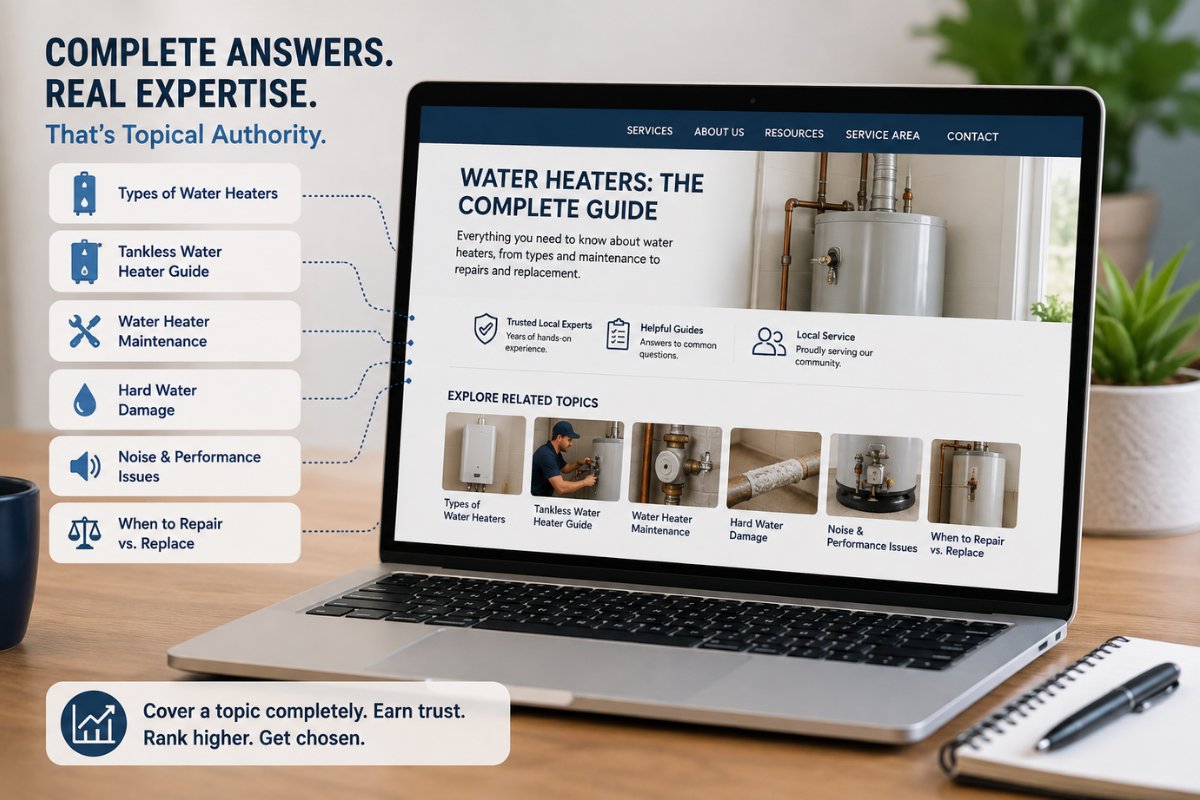
Topical authority refers to how completely and credibly your website covers a given subject across multiple connected pages, rather than how well any single page performs on its own. If someone lands on your site looking for information about water heater repair, topical authority is what determines whether they also find your pages on tankless conversions, hard water damage, and seasonal maintenance sitting right there, ready for them. It has less to do with winning one keyword and more to do with proving, page after page, that you actually know the subject.
Think about it from the searcher’s side for a moment. Someone typing “water heater making noise” into Google today might be the same person searching “tankless water heater cost” next month, or “do I need to strap my water heater before hurricane season” by fall. If your site answers the first question well and has nothing on the other two, you haven’t built topical authority on water heaters. You’ve just answered one question, one time.
Here’s the part most SEO blogs skip. Topical authority isn’t an official Google ranking factor. Google has never confirmed a specific metric, score, or signal that goes by that name, so any source claiming otherwise is not being accurate with you.
What Google has confirmed is something more useful, if less catchy. Its Helpful Content system and its quality rater guidelines both describe rewarding content that shows real depth, direct expertise, and comprehensive treatment of a topic, a standard the industry commonly shorthands as E-E-A-T (experience, expertise, authoritativeness, and trustworthiness). Google’s own documentation on creating helpful, people-first content asks whether a page provides “a substantial, complete, or comprehensive description of the topic,” which is exactly the kind of standard a single blog post, however well-researched, usually can’t meet on its own. The 2022 update that added the second E for experience to those guidelines made the expectation even more explicit: raters are trained to notice whether a site reflects hands-on, first-hand knowledge of a subject, not just competent writing about it. Topical authority is the industry’s shorthand for meeting that standard well across an entire subject area. It’s a legitimate concept resting on real, documented Google guidance, even without an official name to match it.
That distinction matters because a lot of the confusion in this space comes from treating topical authority like a hidden score you could look up, the way you’d check a page’s load time. You can’t. It behaves more like a reputation, built one relevant page at a time, and reputations don’t form from a single good conversation.
Why one great blog post isn’t enough anymore

For years, the standard SEO advice was simple: pick a keyword, write a strong page around it, and let it rank. That advice wasn’t dishonest. It was built for a version of search with far less competing content and far cruder evaluation tools than exist today. A well-written post could rank in 2015 partly because there was less standing in its way.
That headroom has mostly closed, and not only because Google got better at its job. AI writing tools made it trivial for nearly every competitor to produce a competent, well-formatted post on almost any subject. The search results that used to show a handful of thin, dated pages now show dozens of reasonably solid ones. When everyone can clear the old bar of “well-written and answers the question,” that bar stops being the thing that separates winners from everyone else. Something else has to.
It’s tempting to think Google flipped some new switch it calls topical authority and started grading websites on it. That’s not quite what happened. It’s more accurate to say Google’s ability to actually evaluate depth caught up to standards it had already claimed to reward for years through things like its quality rater guidelines. The bar didn’t move so much as the enforcement got sharper, and AI-assisted content flooding the search results gave Google every reason to sharpen it further.
Here’s what that looks like in practice. Ranking one page for one keyword answers a single question well. Demonstrating comprehensive coverage of a specific subject answers the fifteen related questions a real customer actually has, in roughly the order they tend to ask them. Dana’s toilet-repair post answered “how do I fix a running toilet.” It said nothing about water pressure problems, pipe insulation before a cold snap, or how to tell if a leak needs a professional instead of a wrench. Each of those is a separate, searchable need, and each one left unaddressed is a page her competitor got to claim instead.
Semrush’s own overview of the concept describes topical authority as a website’s credibility on a given subject, built through consistent, high-quality content rather than any single standout asset. That framing is useful, and it lines up with what Google’s own documentation says elsewhere about rewarding sites that go deep. Where a lot of content on this exact topic goes wrong is in the specific numbers attached to it, the traffic-increase percentages and case studies presented as if they apply equally to every business, every time. Individual results vary too much for that kind of claim to mean much on its own. The underlying logic, that broader coverage signals real expertise, holds up fine without the inflated math bolted onto it.
Topical authority vs. Domain Authority
This is where a lot of business owners get tangled up, understandably. Domain Authority, usually shortened to DA, is a score created by Moz, the SEO software company, to estimate how likely a website is to rank well based largely on the strength of its backlink profile. It runs from 1 to 100, and it’s genuinely useful as a rough, external benchmark for comparing sites at a glance.
What DA is not is a Google metric. Google does not calculate, publish, or reference anything by that name. It’s a third-party score built by one SEO vendor, and treating it as if Google itself hands it out is a common, understandable mistake. Part of the confusion comes from how many client-facing SEO tool dashboards display a DA-style score right next to real Google Search data, which makes it feel official even when it isn’t.
Topical authority and DA measure two different things entirely. That single Moz score reflects the overall strength of a site’s backlink profile, compressed into one number meant to work as a shorthand comparison. Topical authority, on the other hand, isn’t a number you can look up anywhere. It’s a description of how thoroughly your content covers a specific subject, assessed page by page and link by link rather than counted in one score.
You can carry a strong DA in Moz’s system and still have thin coverage in the one niche that actually matters to your business. Picture a national furniture retailer with a healthy score built from years of press mentions and backlinks, but almost nothing published about, say, caring for outdoor teak furniture. That specific niche sits wide open for a smaller site willing to cover it in real depth, regardless of what its own DA happens to read.
If you want the fuller picture of how metrics like this fit into SEO generally, Moz publishes a beginner’s guide to SEO that’s worth bookmarking if you’re building this knowledge from the ground up. The practical takeaway here is simpler than the terminology suggests: don’t let a healthy DA score talk you out of the content work. One is a disclosed, third-party number. The other is an industry concept without an official score behind it. They answer different questions, and a sound SEO strategy needs an honest answer to both, not just the one that’s easier to check.
The pillar-and-cluster content model, explained
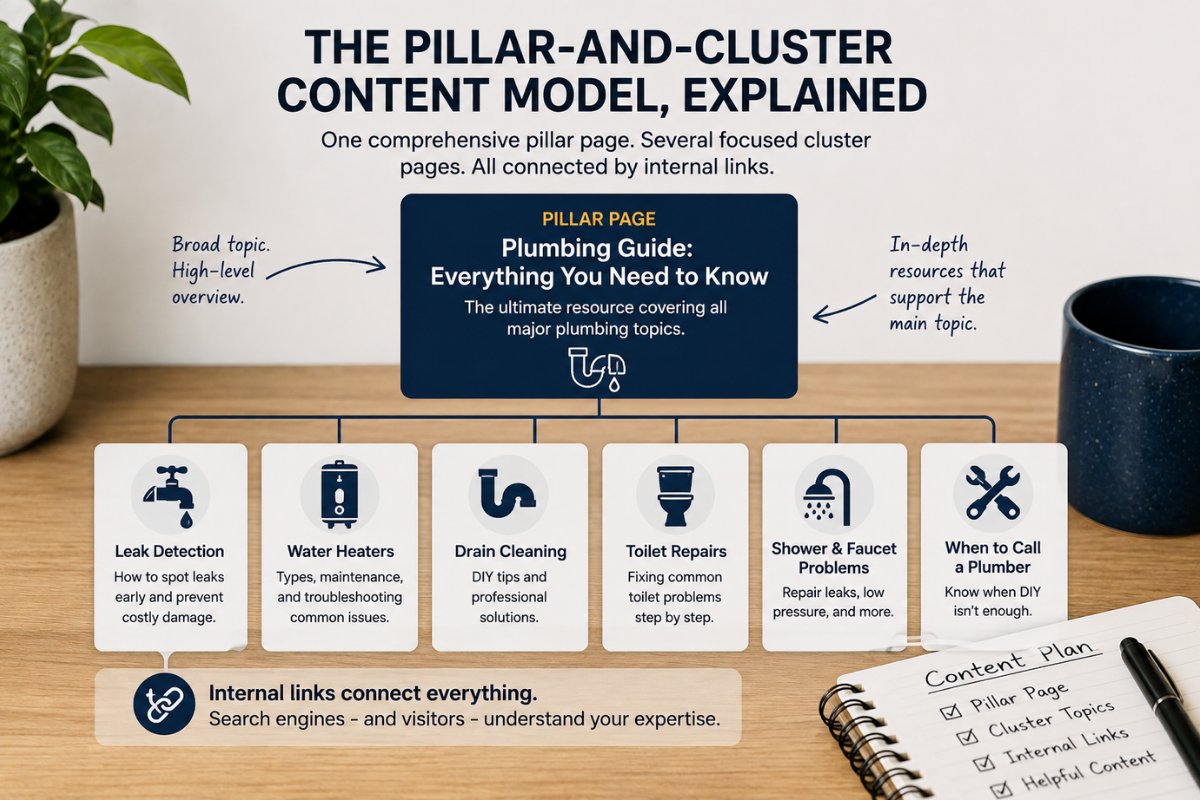
Once you accept that one post isn’t enough, the next question is practical: what actually is enough, and how do you organize it so it doesn’t turn into a pile of disconnected blog posts? The most established answer is the pillar-and-cluster model, sometimes called hub and spoke. It isn’t new, and it isn’t an AI-era invention dressed up in new language. HubSpot’s own content marketing team popularized this exact structure back around 2017, years before generative AI search existed, because it solved a real organizational problem long before anyone was worried about being cited by a chatbot.
A pillar page is a broad, comprehensive page that covers a subject at a high level and links out to the more specific pages that go deeper. Think of it as the front door and the table of contents in one. A cluster page, sometimes just called a subpage, goes narrow on one piece of that subject, the kind of specific question someone types into Google at 11 p.m. when something in their house just broke. The pillar introduces the topic; the cluster pages do the heavy lifting on each individual piece of it.
Here’s how that would have looked for Dana’s plumbing company instead of one isolated post. Her pillar page might be a broad guide to residential plumbing repair in West Palm Beach, covering the major categories of problems homeowners in the area actually run into. Her cluster pages would each take one of those categories and go deep: the running toilet post she already wrote, a guide to water heater troubleshooting, a page on slab leak detection, one on drain clogs, and one on prepping plumbing before hurricane season, since that’s a real, recurring, local search need. There’s no fixed number of clusters that guarantees anything. Some services genuinely need five supporting pages, others need fifteen, depending on how many distinct subtopics real customers actually search for.
The part that makes this a system instead of just a folder of related posts is the linking between the pieces. Every cluster page needs internal links back up to the pillar, and the pillar needs internal links down to every cluster page, not one buried mention in a sidebar widget nobody clicks. Closely related cluster pages link sideways to each other where it’s genuinely useful too, the hurricane prep page pointing to the water heater page for strapping instructions, for instance. That structure does two things at once. It helps users and search engines both understand how the pages relate, and it distributes relevance across the group instead of trapping it inside one page nobody else points to. Sites built this way tend to develop what’s sometimes described as semantic SEO, where related concepts reinforce each other instead of sitting in isolation.
Picture Dana’s toilet-repair post rebuilt inside that structure. A reader lands on it from a search for “toilet running after flush,” gets the fix they came for, and then sees a line at the bottom pointing them to the water heater troubleshooting page or the hurricane prep guide, because those internal links are actually there instead of assumed. Some of those readers weren’t looking for a second answer. A few will click anyway, because now they know the site covers plumbing broadly, not just one repair. That’s the entire mechanism in miniature.
Done consistently, this is how a business actually starts to establish topical authority in its space rather than just hoping one good post gets noticed. It’s unglamorous work: mapping out subtopics, writing them one at a time, linking them together, and repeating. But it’s also the version of the advice that holds up, which puts it ahead of most shortcuts being sold on this exact topic right now.
Why this matters for AI search, not just Google
If you’ve read our earlier piece on generative engine optimization, the practice of shaping content so AI platforms actually surface and cite it, this next part will sound familiar. The same logic that applies to traditional rankings applies here, arguably even more so.
AI search tools and chat-based answer engines have to decide, in the moment someone asks a question, which sources to trust enough to summarize or cite. A site with one relevant page and nothing else around it gives an AI system very little to work with. Most of these tools work by retrieving several relevant pages and passages first, then generating an answer from whichever sources look credible and consistent enough to cite. A site with a pillar page and a cluster of connected, cross-linked pages on the same subject gives that retrieval step a lot more to find, more context to draw on, and more evidence that the site actually knows the subject rather than having gotten lucky once with a single page.
Ahrefs has published a useful illustration of this using its own site-analysis data. One well-established Healthline article on magnesium glycinate reportedly surfaces for around 2,500 keywords on Google alone, alongside hundreds of related queries in Google’s AI Overviews and a meaningful number of prompts across ChatGPT, Perplexity, and other assistants. That’s Ahrefs’ own tool data on a single, unusually strong example, not an independently verified study, and it shouldn’t be read as a formula. What it illustrates well is the general direction: broad, deeply covered subjects show up in more places, across more systems, than isolated pages do.
Here’s the honest limit of what can be said with confidence. Nobody has an independently verifiable number for exactly how many more citations you get from building out a topic cluster instead of publishing one page, whatever specific multiplier you might see quoted elsewhere. What’s better supported is the underlying reasoning: AI systems are described, in the documentation of the companies building them, as weighing trustworthiness and depth in ways that echo what search engines have always claimed to reward. Betting on comprehensive, well-linked coverage is a reasonable bet on that basis alone, even without a flashy number attached to it.
How to Build Topical Authority and Actually Rank Higher
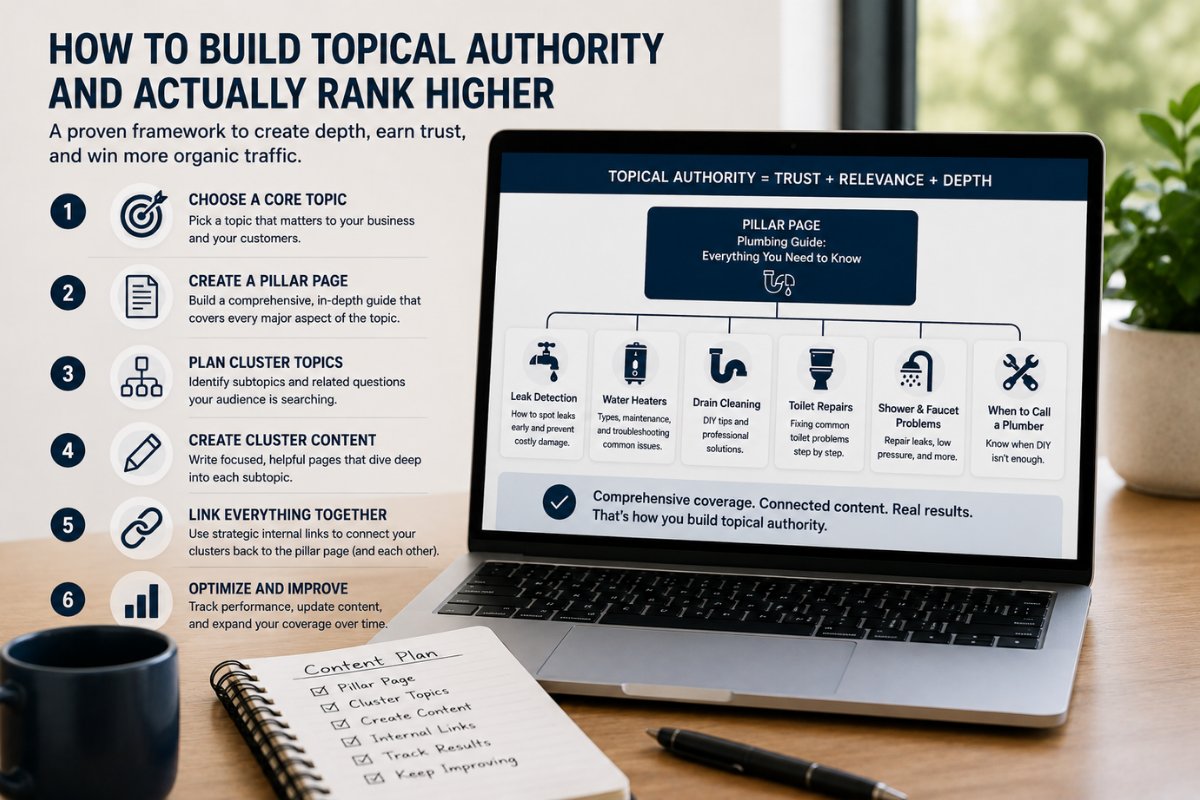
Building topical authority requires patience and an actual plan, not a trick. The plan itself, at least, isn’t complicated. It breaks into five practical steps, and none of them require guessing.
Map your subtopics first
Before writing anything, list out the real questions your customers ask about the subject you want to own, not the questions you assume they ask. Pull from actual emails, phone calls, and reviews if you have them. Group similar phrasings by search intent rather than by exact wording, since “toilet won’t stop running” and “why does my toilet keep filling” are the same question asked two ways. A basic keyword research tool can help confirm approximate search volume for each one, which is useful for judging whether a subtopic deserves its own page or just a paragraph inside another one. Google’s autocomplete and the “people also ask” boxes on an actual search results page are free, and they’ll often surface real questions faster than any paid tool will.
Choose your first pillar
You probably can’t build five pillar topics at once, and trying to usually means finishing none of them. Start with the subject where you most want to be seen as the obvious authority in your niche, typically your highest-value service or the one with the most search demand behind it. That choice becomes the anchor of your entire topical authority strategy. Everything else branches out from it.
Plan the cluster content around it
Once the pillar is chosen, list every subtopic from your earlier mapping that belongs under it. A reasonable starting point for a typical local service business is somewhere in the range of five to twelve supporting pages, though the real number should follow how many distinct subtopics customers actually search for, not a figure picked in advance to hit a quota. Build out the topic cluster in order of demand, publishing the highest-value cluster pages first so the structure starts working sooner rather than later. If you’d rather see this planning process explained visually, this video walkthrough on building topical authority covers similar ground.
Implement internal links as you go
Add internal links from every new cluster page back to the pillar the moment it’s published, not months later during some cleanup project that never happens. Link the pillar down to each cluster page too, and update it every time a new one goes live. This step gets skipped constantly, usually because it feels like housekeeping rather than real work. A simple linked list of cluster pages in the footer or body of the pillar takes an afternoon to build in WordPress and keeps paying off long after that afternoon is over. It’s one of the highest-leverage parts of the entire process, since it’s what turns a folder of related posts into a connected structure a search engine or an AI system can actually read.
Measure progress over time
There’s no single dashboard that will measure topical authority directly, since, as covered earlier, it isn’t a disclosed metric you can check. What you can track are the things that actually indicate whether it’s working: rankings for your target pages, impressions and clicks in Google Search Console for the broader set of terms related to your subject, and organic traffic trends across the whole cluster rather than any one page in isolation. Watch whether pages besides your original pillar start pulling in search traffic on their own. That’s usually the clearest sign the structure is doing its job, well before any single ranking moves dramatically. Give it at least two full publishing cycles, realistically three to six months of consistent output, before drawing firm conclusions from what you see.
None of this happens in a week, and no single blog post will let you achieve topical authority on its own, which is exactly the problem this article opened with. But each step here is concrete, and each one compounds on the last.
Common mistakes that undermine topical authority
Isolated pages send weak authority signals, no matter how well they’re written. A page sitting alone, with no internal links pointing to it and none pointing out from it, looks to a crawler roughly the way a business card looks to a stranger: a claim, not proof. In the eyes of search engines, that page is an island, disconnected from anything that would back it up.
Thin or outdated supporting pages cause a quieter version of the same problem. A subtopic page written two years ago, before a price changed or a regulation updated, doesn’t just fail to help. It actively damages topical relevance across the group, since it signals that the site’s coverage of the subject isn’t being maintained. Even solid on-page SEO can’t rescue a page like that. Good title tags and clean headings don’t compensate for content that’s simply gone stale. Publishing something new just to hit a schedule, without keeping the existing pages high-quality and current, ends up costing more credibility than not publishing at all.
The mistake that undoes the most work, though, is treating every topic as its own separate silo. A landscaping company might publish a page on lawn care and, months later, a completely unrelated page on holiday lighting installation, with nothing connecting the two even though the same homeowners searching for one often need the other eventually. A business publishes a page about one service, then an unrelated page about another, with no attempt to build topical authority around either one before moving on. Nothing links together. Nothing reinforces anything else. Five disconnected posts a year won’t establish a site as an authority on anything in particular, even if each post individually happens to be good.
Fix the linking and the fragmentation, and that alone helps search engines recognize the difference surprisingly fast, because cross-linked, well-maintained coverage is exactly what topic authority is supposed to look like from the outside. Consistent cross-linking sends clear signals to search engines about the shape of your topical coverage, something no amount of individual page polish can fake on its own. A handful of well-connected pages can carry strong authority in a niche that ten disconnected posts never will. It’s rarely one dramatic error causing underperformance. It’s usually these three small, fixable habits, repeated for months without anyone noticing.
Realistic expectations
Topical authority is one of those SEO ideas that sounds abstract right up until you watch it play out in your own analytics, usually as a slow, steady climb across a dozen pages rather than one page spiking overnight.
Set expectations accordingly. This is a medium-to-long-term content investment, not something you install once and forget. Authority building here looks like consistent publishing over months, not a single sprint squeezed in before a deadline.
If someone promises you strong topical authority in thirty days from a handful of new posts, that claim deserves real skepticism. Not because the underlying strategy is wrong, but because SEO and content marketing results simply don’t move on a sales timeline, no matter how badly a vendor wants them to.
Authority isn’t built from one piece of content, no matter how good it is. It’s built from a pattern that search engines and real readers both notice over time, one page reinforcing the last. Done well, topical authority helps both traditional search engine rankings and how often AI platforms cite you, though never through any single confirmed mechanism. Topical authority improves gradually rather than in one visible jump, which is exactly why it gets underestimated by business owners hoping for a faster payoff.
A realistic timeline for a small local business is usually measured in a handful of months before search visibility starts shifting in a way anyone would actually notice, not days and not weeks. That’s a hard sell compared to the promise of instant results, but it’s the version of the timeline that tends to hold up.
Long-term SEO success looks less like a viral post and more like a small, well-organized library that keeps growing, the kind of thing search engines evaluate as a whole rather than one page at a time. Businesses that build out topical clusters instead of isolated posts tend to see steadier movement across many pages at once, showing up more often across search engine results and AI-generated answers alike. A single strong post might get a business seen as helpful. It takes months of connected coverage to get seen as an authority, and that’s the honest, if less exciting, version of this advice.
Start building topical authority with a strategy call
Everything above is easy enough to explain and genuinely hard to execute consistently while you’re also running the rest of a business. That’s the part Innovative Flare handles: mapping your real subtopics and keyword targets, choosing the right pillar to build first, planning and writing the supporting pages around it, and putting the internal links and technical schema in place so both search engines and AI platforms can actually find your coverage.
If you’re ready to stop guessing and start building a real content structure instead of another isolated post, schedule a strategy call and we’ll map exactly what full coverage of your specific topic actually requires, and what it would take to build authority in your niche instead of hoping one more post gets lucky.
Frequently asked questions about topical authority in SEO
The questions below come up constantly with business owners trying to learn how to build topical authority for their own site, and why topical authority matters enough to justify the work described above. Others just want to learn what topical authority actually changes for a website their size.
What is topical authority in SEO?
Topical authority means how completely and credibly a website covers a given subject across many connected pages, rather than how well any single page ranks on its own. It’s an industry term, not an official Google ranking factor, though it’s grounded in real Google guidance about rewarding depth and expertise. Topical authority refers to a reputation for a subject built page by page, and sites with strong topical authority tend to see steadier seo rankings across many related searches, not just one.
Is topical authority the same as Domain Authority?
No, and mixing them up causes real confusion. DA is Moz’s own proprietary metric, based mainly on a site’s backlink profile, and Google doesn’t calculate or use it at all. Some tools even label this same idea “website authority,” but it’s still Moz’s metric, not Google’s, whatever name a dashboard gives it. Topical authority is an industry concept describing how thoroughly your content covers a specific subject, judged page by page rather than compressed into one third-party score.
How many blog posts do I need to build topical authority?
There’s no fixed number that guarantees results, and any source giving you an exact count is guessing. A more honest approach: map the real subtopics your customers search for, then build supporting pages for the ones with genuine demand, often landing somewhere between five and fifteen pages for a focused local subject. Building out your website’s topical authority is less about hitting a number and more about closing real gaps in coverage.
What is a pillar page in content marketing?
A pillar page is a broad, comprehensive page that introduces a subject and links out to narrower pages that go deeper on each piece of it. It works like a table of contents for the entire topic, giving readers and search engines a map of everything else you’ve covered.
How do cluster pages work with a pillar page?
Each cluster page links back up to the pillar, and the pillar links back down to every cluster page beneath it, creating a hub-and-spoke structure that’s easy for both people and search engines to follow. Closely related cluster pages often link sideways to each other too. Without those internal links, the pages might as well be unrelated, even if they technically sit on the same site.
Does topical authority help you get cited by ChatGPT and Google AI Overviews?
It plausibly does, though there’s no independently verified statistic showing exactly by how much. Large language models and AI answer engines are described, in their own documentation, as weighing depth and trustworthiness in ways that resemble what search engines have always claimed to reward, and comprehensive, well-linked coverage is a reasonable way to demonstrate both.
How long does it take to build topical authority?
There’s no universal timeline, but for most small businesses, a realistic range is somewhere between four and twelve months of consistent publishing before rankings and organic traffic shift in a way that’s clearly noticeable. Businesses with high topical authority in their space usually got there through unglamorous, consistent SEO strategies executed for months, not a shortcut, and businesses that publish sporadically typically take longer to see any movement at all.
Can a small business realistically compete for topical authority in its niche?
Yes, and niche focus is actually an advantage here. A small business covering one local subject in real depth, with pages that reference each other and stay current, can out-cover a much larger competitor that only touches the subject in passing. Authority on a topic isn’t about company size. It’s about which site actually bothered to cover the subject completely, and it’s honestly a more direct way to earn topical authority than trying to outspend a competitor on backlinks alone.
Why is topical authority important for a small business?
Because most small businesses operate inside a genuinely narrow niche, where deep, connected coverage is achievable in a way it usually isn’t for a national brand spread thin across hundreds of subjects. The importance of topical authority for a small business comes from that leverage: thorough coverage of one local, specific subject can outperform a much bigger competitor’s thin coverage of that same thing.