seolounge
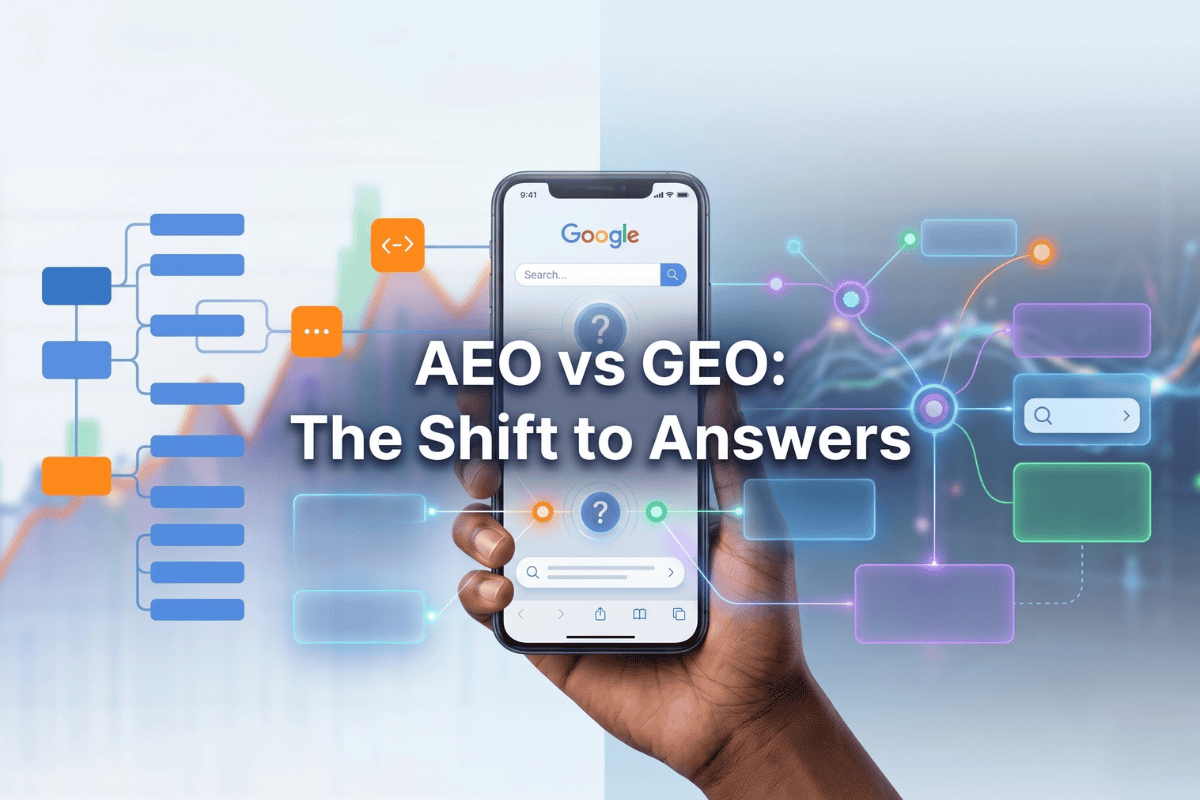
Say a small business owner books three vendor calls in the same week. The first one pitches SEO. The second one pitches GEO. The third one pitches AEO, and by the end of that call, she’s fairly sure she just paid to hear the same idea explained three different ways with three different price tags attached.
She’s not wrong to be confused. The terminology in this space is genuinely messy right now, and anyone who tells you otherwise is probably trying to sell you something. But underneath the acronym soup, there’s a real shift happening in how people find businesses online, and understanding it doesn’t require picking a side in a branding argument. It requires understanding what answer engine optimization actually means, where it overlaps with generative engine optimization (GEO) and traditional search engine optimization (SEO), and what to do about it regardless of which term eventually wins.
Key takeaways
- Answer engine optimization (AEO) means optimizing content to be pulled directly into an answer, whether that answer comes from a featured snippet, a voice assistant, or a chatbot.
- AEO predates generative AI. It started with Google’s featured snippets and knowledge panels years before ChatGPT existed.
- Industry experts genuinely disagree on whether AEO and GEO are the same thing or whether AEO is the broader umbrella term. Neither camp has “won” yet.
- What matters practically is the same regardless of terminology: structure your content so it can be lifted out and cited as a direct, self-contained answer.
- Google has stated there’s no special technical requirement for showing up in AI Overviews beyond strong SEO fundamentals.
- Small businesses have a real opportunity here, since answer engines often cite fewer sources than a traditional results page shows links, which means being one of three cited answers instead of one of ten blue links.
What answer engine optimization actually means
Answer engine optimization is the practice of structuring content so a search system can lift it out, whole, and hand it to a user as a direct answer, rather than making that user click through to your page to find the answer themselves. That’s the core idea, and it holds whether the “answer engine” in question is a Google featured snippet, a voice assistant reading a result out loud, or a large language model like ChatGPT synthesizing a response from several sources.
The shift that matters here is the shift from ranking to citation. Traditional SEO asks a simple question: did your page show up high enough on the results page that someone clicked it? AEO asks a different one: did the system trust your content enough to quote it, summarize it, or attribute an answer to it directly? Those two goals overlap a lot in practice. Good, clear, well-organized content tends to do well at both. But they’re not identical goals, and conflating them is part of why the AEO/GEO terminology debate gets so tangled.
A few terms are worth defining before going further, since this space loves acronyms. A large language model (LLM) is the technology behind tools like ChatGPT, Claude, and Gemini, a system trained to generate humanlike text by predicting what comes next based on patterns in enormous amounts of data. A SERP is a search engine results page, the list of links Google shows after a query. A featured snippet is the highlighted answer box that sometimes appears above the regular results, pulling a short answer directly from a webpage. Keep those three in your pocket. They’ll come up again.
Here’s a concrete example. Say someone asks a voice assistant, “What’s the difference between SEO and AEO?” The assistant isn’t going to read out a list of ten website links. It’s going to pull a short, clear answer from somewhere, probably a source that phrased the answer plainly enough to lift out whole. That’s answer engine optimization in action, and it’s been happening in some form since long before generative AI entered the picture.
Consider a more everyday case too. A home services business, say a Palm Beach County air conditioning company, publishes a page that opens with “An AC unit typically lasts 12 to 15 years with regular maintenance.” That single sentence is written to work as a standalone answer. It doesn’t depend on the paragraph before it or after it. A featured snippet algorithm can grab it. So can an AI model summarizing several sources into one answer about AC lifespan. That’s the practical target: write sentences and short passages that would still make complete sense if someone copied just that piece and nothing else.
Where the term “answer engine optimization” came from
AEO isn’t new. It’s just newly relevant.
Long before ChatGPT existed, Google was already reshaping search around direct answers. Featured snippets started appearing regularly around 2014, pulling short passages out of webpages and displaying them above the standard blue links. Knowledge panels followed, showing facts about people, places, and businesses directly on the results page. Voice assistants like Siri and Alexa added another layer: when someone asks a question out loud, there’s no scrolling through ten results. There’s one answer, spoken once.
Marketers and SEO practitioners started optimizing for these formats years ago, structuring content specifically to win the featured snippet or get pulled into a knowledge panel. That practice already had a name: answer engine optimization. It meant writing clear, self-contained answers to specific questions, using structured data to help search engines understand what a page was about, and organizing content so a short passage could stand on its own if it got lifted out and displayed separately.
So when generative AI tools arrived and started summarizing the web into conversational answers, a lot of the underlying skill set didn’t need to be invented from scratch. It needed to be extended. Think of it like a business that already had strong customer service phone scripts long before it opened a live chat widget on its website. The channel changed. Plenty of the underlying discipline, answering clearly and completely on the first try, carried right over. That’s a meaningfully different story than “AEO was invented because of ChatGPT,” and it’s worth knowing, because it explains a lot of the confusion that shows up next.
Is AEO the same as GEO? The honest terminology problem

Here’s where things get genuinely unsettled, and where a lot of content on this topic pretends otherwise. There isn’t a single agreed-upon answer to whether AEO and GEO are the same discipline, two overlapping disciplines, or one discipline with two competing brand names. Credible people in the industry land in different places, and both sides have reasonable arguments.
Framing one, and probably the more common view, treats AEO as the broader umbrella term. Under this framing, AEO covers every kind of direct-answer optimization: featured snippets, knowledge panels, voice assistants, “People Also Ask” boxes, the whole pre-generative-AI answer ecosystem. Generative engine optimization, in this view, is a specific subset of AEO, the part that’s about getting cited inside AI-generated responses from tools like ChatGPT, Perplexity, and Google’s AI Overviews specifically.
Framing two pushes back on that. Some practitioners argue AEO and GEO describe essentially the same underlying work, and that AEO simply has an advantage as a brand term because it’s clearer and easier to search for. GEO, in this view, gets criticized as a vaguer term that’s harder for a business owner to type into Google and immediately understand. There’s a real point buried in that criticism: “generative engine optimization” is a mouthful, and plenty of small business owners have never heard the word “generative” outside of an AI headline.
The history explains why this fight exists at all. “Generative Engine Optimization” is the newer term, and it traces to a specific source: a 2024 academic paper out of Princeton, titled GEO: Generative Engine Optimization and presented at the ACM SIGKDD conference, which formally proposed and tested the concept using a large benchmark of real user queries. The term picked up broader momentum the following year when venture capital firm Andreessen Horowitz published a widely shared piece on GEO overtaking SEO, which put the acronym in front of a much larger audience of marketers and founders almost overnight. “Answer Engine Optimization,” by contrast, had already been circulating in SEO circles for years by that point, tied to the earlier featured-snippet era, with none of the sudden venture-capital spotlight.
There’s a third camp worth mentioning briefly too, even though it’s smaller: a handful of practitioners have started using “AI SEO” or “LLM optimization” as catch-all replacements for both terms, arguing that neither AEO nor GEO has fully caught on with mainstream business owners yet. That hasn’t gained the traction the other two framings have, but it’s a reminder that this naming fight is still genuinely in motion, not a settled matter with two neat sides.
So which one is right? Honestly, it doesn’t matter as much as the debate makes it seem. Whichever term eventually wins the naming war, the underlying goal is the same: become the source that gets quoted, cited, or extracted from, rather than just the link that gets ranked. That’s the part worth actually paying attention to, and it’s where the rest of this article is going to spend its time.
AEO vs. SEO: what’s shared and what’s genuinely different
It helps to think of AEO less as a replacement for SEO and more as an additional lens on top of it. The two share a foundation. Both depend on crawlable pages, clean site structure, genuinely useful content, and technical basics like fast load times and mobile-friendly design. If your traditional SEO foundation is weak, no amount of AEO-specific tactics is going to fix that. This is worth repeating because a lot of vendors sell AEO as if it’s a wholly separate discipline requiring an entirely new toolkit. It isn’t. It’s SEO with a sharper focus on a particular outcome.
Where the two genuinely diverge is the target. SEO optimizes for ranking: getting your page to appear as high as possible on a results page so a user clicks through. AEO optimizes for the answer itself, getting your content extracted, quoted, or referenced directly, sometimes without the user ever visiting your site at all. That last part matters. A featured snippet win or an AI Overview citation can generate visibility and trust without generating a click, which changes how you should think about measuring success. Traffic numbers alone won’t tell the whole story anymore.
There’s also a structural difference in how content gets written for each goal. Good SEO content can afford to build up to a point, easing a reader in with context before delivering the payoff. Good AEO content front-loads the answer. A featured snippet, a voice assistant response, or an AI-generated citation typically needs the useful information in the first two or three sentences of a section, phrased so it could stand alone if pulled out of context entirely. That’s a real writing skill, and it’s one most business blogs haven’t been built around.
Picture two versions of the same page for a family law firm. One opens with three paragraphs about the emotional weight of divorce before finally stating that Florida requires a mandatory waiting period. The other opens with, “Florida law requires a mandatory 20-day waiting period between filing for divorce and finalizing it.” Both pages might rank fine in traditional search, where a reader is willing to scroll. Only the second one is written to survive being lifted out and handed to someone as a direct answer. That’s the difference AEO asks you to design around.
AEO vs. GEO in practice: what actually matters for a small business

Set the terminology debate aside for a moment. Here’s the version that’s actually useful if you’re running a landscaping company, a dental practice, or a boutique law firm and don’t have time to referee an industry naming dispute.
Think of it as two overlapping surfaces rather than two competing disciplines. Answer engines, in the older, broader sense, include featured snippets, “People Also Ask” boxes, knowledge panels, and voice assistants like Siri or Alexa. These have existed for years and tend to reward short, structured, directly-worded content. Generative engines are the newer surface: ChatGPT, Perplexity, Claude, and Google’s AI Overviews and AI Mode. These synthesize answers from multiple sources at once, often citing two or three of them by name, rather than pulling one clean snippet from a single page.
The tactics overlap substantially. Clear headings, direct answers to specific questions, FAQ-style content, and structured data all help across both surfaces. But there are some differences worth knowing. Traditional answer engines tend to favor the single best, most concise passage. Generative engines tend to synthesize across several sources, which means depth and topical authority carry more weight; a page that thoroughly covers a subject from multiple angles has a better shot at being one of the two or three sources an AI system decides to cite.
A dentist’s office FAQ page answering “how often should I replace my toothbrush” might win a featured snippet with one crisp sentence. That same practice’s full guide to pediatric dental care, covering a dozen related questions in depth, is more likely to get cited by an AI system pulling together a broader answer about children’s oral health. The snippet rewards brevity. The citation rewards depth. Both are worth building toward, and they don’t actually compete with each other on the same page; a well-built FAQ section can win the snippet on one question while the surrounding article wins the citation on the broader topic.
There’s a third, smaller distinction worth knowing about too: query length and phrasing. Someone typing into a traditional search box tends to use short, clipped phrases, three or four words. Someone talking to ChatGPT or Perplexity tends to ask a fuller, more conversational question, sometimes with follow-up context baked right in. A landscaping company optimizing purely for the short-phrase habits of classic Google search might miss the longer, more specific questions people are now asking AI tools directly, things like “what native Florida plants need the least watering in a drought-prone yard.” Writing content that answers both the short version and the fuller, conversational version of a question covers more ground across both surfaces at once.
Retail and service businesses see this play out a little differently again. A boutique furniture store might win a featured snippet for “how do I know if a couch will fit through my door” with one clean measurement-based answer. But when a customer asks an AI shopping assistant something broader, like “what should I look for when buying a sofa for a small apartment,” the AI is more likely to synthesize an answer from several sources covering dimensions, materials, and delivery logistics together. A store that has published thorough, separate guides on each of those subtopics gives itself more chances to be one of the sources woven into that broader answer, rather than hoping a single page happens to cover everything at once.
Here’s the practical takeaway, and it’s worth sitting with: you don’t need to pick a camp in the AEO-versus-GEO argument to act on this. You need content that answers real questions clearly, in a structure that works whether it’s a snippet, a voice assistant, or an AI-generated citation doing the pulling. Chase the terminology fight if it interests you. Chase the actual practice regardless.
Why this matters now for small businesses specifically
The stakes here are shifting in a way that’s easy to miss if you’re only watching your own analytics dashboard. According to Wix’s AI Search Lab, which tracks traffic using SimilarWeb data, visits to AI search platforms grew 42.8% year over year in Q1 2026, compared to just 2.4% growth for Google search over the same period. Separately, Semrush’s own research found the average AI search visitor converts at a rate 4.4 times that of the average traditional organic search visitor.
Whatever the exact numbers turn out to be, the direction is clear enough. More people are asking AI tools questions they used to type into Google. And when they do, they’re often getting a synthesized answer that names two or three sources by name, not ten blue links to sort through themselves.
That’s actually good news for a small business, not bad news, and this is one of the places worth being direct rather than hedging. A results page with ten links means competing against ten competitors, some of them much bigger. An AI-generated answer that names three sources means the field just got a lot smaller. If your business shows up in that shortlist, you’re not fighting for position four on page one anymore. You’re one of the three names a potential customer actually hears.
Think about what that looks like for a family-owned HVAC company competing against a national franchise with a much bigger marketing budget. On a traditional Google results page, the franchise probably outranks the local shop most of the time; more backlinks, more domain history, more ad spend. But if a homeowner asks ChatGPT “who’s a reliable AC repair company near West Palm Beach,” the AI system isn’t ranking by domain authority the same way. It’s looking for clear, trustworthy, well-structured local content that actually answers the question. A smaller business with genuinely good, specific local content has a real shot at getting named in that answer, right alongside or even instead of the bigger competitor. The shift from click to citation isn’t a loss of opportunity. For a business willing to structure its content well, it’s a chance to leapfrog competitors who are still writing purely for search engine rankings and ignoring how AI systems actually pull and cite information.
This does mean rethinking how you measure success, at least a little. A page that gets cited by an AI Overview without generating a click still did its job; it built awareness and trust with someone who may search your business name directly later, call the number they saw next to the answer, or simply remember you when the actual need comes up. That’s a harder thing to track in a standard analytics dashboard than a click-through, but it’s not a reason to dismiss the value. Some businesses have started manually checking how they appear when they ask ChatGPT or Perplexity questions relevant to their own services, treating it the way they’d once treat checking their Google ranking by hand.
Practical AEO best practices worth implementing

Structure comes first. Every major section of your content should be built to answer a specific question, and the answer should show up early, ideally in the first sentence or two, phrased so it could be lifted out and still make sense on its own. That’s the single highest-leverage habit here. A vague opening paragraph that “sets the scene” before getting to the point works fine for a magazine feature. It works badly for AEO, because there’s no guarantee the system pulling your content will read past sentence three.
FAQ-style content deserves special attention, and not just because it’s easy to write. Questions phrased the way real people actually ask them, “how much does a website redesign cost,” “do I need business insurance in Florida,” “what’s the difference between a logo and a brand,” map directly onto how people type into search bars and how they talk to voice assistants and chatbots. A locksmith’s FAQ page answering “what do I do if I’m locked out of my car” in two clear sentences has a real shot at getting pulled into a voice assistant’s response. A vague “About Our Services” page describing the same thing in marketing language doesn’t.
FAQ schema, the structured markup that tells search engines “this block of text is a question and this is its answer,” still matters here, even though its role has shifted. Google phased out FAQ rich results from its own search pages by 2026, so the visual snippet you might remember from a few years back mostly doesn’t show up in Google’s results anymore. But the schema itself hasn’t become useless. It still helps AI platforms parse your content’s question-and-answer structure clearly, which supports citation even without the old visual payoff in Google’s SERP. There’s more detail on exactly how that shift works and what to do about it here, if you want the fuller picture.
Conversational language matters more than it used to. People don’t type “cheap plumber West Palm Beach” into ChatGPT the way they might into Google. They ask something closer to “who’s a reliable, affordable plumber near West Palm Beach who can come out same-day.” Writing content that answers that kind of natural, fuller question, rather than content stuffed with clipped keyword phrases, tends to perform better across both search and AI surfaces.
Topical authority is the slower-building piece, and it’s worth being honest that there’s no shortcut here. A single well-optimized page rarely earns citation on its own. A body of content that thoroughly covers a subject area from multiple angles, an accounting firm that’s written clearly about quarterly taxes, deductions, payroll setup, and bookkeeping software, all internally linked and all well-structured, builds the kind of depth that makes an AI system more confident citing that business as a source. This is one place where solid, ongoing SEO work and AEO genuinely converge into the same long-term investment.
One more habit worth naming: being an explicitly trusted source means being specific rather than generic. “We offer quality service at competitive prices” tells an AI system nothing it can cite. “Our licensed electricians respond to emergency calls in Palm Beach County within two hours, seven days a week” is specific enough to be quoted directly, and specific enough that a reader, human or machine, can tell it’s a real claim rather than filler.
Internal linking plays a role here too, and it’s an easy one to overlook. When related pages on a site link to each other clearly, an “AC maintenance checklist” page linking to a “signs your AC is failing” page and a “how often to replace your air filter” page, it signals topical depth in a way a single isolated page never can. That structure helps human readers navigate, and it helps AI systems understand that a business has genuine, connected expertise on a subject rather than one lucky page that happens to rank. Keeping that content current matters too. A page stating outdated pricing, an old warranty term, or a since-changed local regulation is a liability either way, but it’s a particular liability for AEO, since an AI system citing stale information as current makes the mistake visible to a potential customer in a way an old page buried on page three of Google search results rarely does.
What Google itself has said about optimizing for AI Overviews
It’s worth cutting through some of the noise here, because plenty of vendors imply there’s a secret technical checklist for showing up in Google’s AI Overviews or AI Mode, something separate from regular SEO that only they know how to do. Google’s own position doesn’t support that.
Google has stated directly that there are no special optimizations or extra technical requirements for appearing in AI Overviews or AI Mode beyond the standard fundamentals that have always mattered: crawlability, indexability, genuinely useful content, and structured data that accurately matches what’s actually visible on the page. Google’s own guide on optimizing for generative AI features lays this out clearly, and it’s a useful thing to have on hand the next time someone tries to sell you a proprietary “AI SEO” package that claims otherwise.
That doesn’t mean nothing has changed. It means the foundation hasn’t changed. The strategies covered above, structuring content around direct answers, building genuine topical depth, using accurate schema, still sit on top of the same base that’s always mattered for search: a fast, clean, genuinely useful site that a search engine can crawl and understand without friction. If your site’s technical fundamentals are shaky, no amount of FAQ schema is going to compensate for that.
Realistic expectations for AEO going forward
This space is still moving, and anyone promising a fixed set of rules that will hold steady for years is overselling what’s actually knowable right now. The AEO/GEO terminology may well settle into a single dominant term over the next couple of years, or it may not. AI platforms are changing how they cite sources on a rolling basis, sometimes without much public announcement. What counts as a strong citation signal today could shift meaningfully within a year.
There’s a version of this article, written a year from now, that might use entirely different terminology, or might reference an AI platform that barely exists yet. That’s fine. It’s also exactly why chasing the latest naming trend is less useful than building the underlying habit: answer real questions clearly, structure content so it can stand on its own, and keep the technical foundation solid. A business that does those three things consistently will likely still be well positioned no matter what the industry decides to call this practice next.
It’s also worth resisting the temptation to chase shortcuts as this space matures. Stuffing content with statistics that aren’t verified, fabricating expert quotes, or gaming schema markup to claim a business does something it doesn’t might produce a short-term citation, but it erodes the one thing that actually earns trust with both human readers and AI systems over time: accuracy. An AI system that cites a business and gets called out for a wrong fact isn’t likely to keep citing that source. Neither is a customer who calls a business expecting a service the website oversold.
What’s unlikely to change is the underlying principle: clear, well-structured, genuinely useful content that directly answers real questions tends to perform well across search formats, present and future. That’s not a hedge. It’s the actual throughline connecting featured snippets in 2015, voice search in 2019, and AI Overviews in 2026. Build toward that, and the terminology fight becomes mostly academic.
Ready to make your content the answer, not just a result?
Understanding the difference between AEO, GEO, and SEO is useful. Acting on it is what actually moves the needle. If your website is still built around old-style keyword pages instead of clear, direct answers to the questions your customers are actually asking, you’re leaving visibility on the table, both in traditional search and in the growing number of conversations happening on ChatGPT, Perplexity, and Google’s AI Overviews.
Innovative Flare works with small and mid-sized businesses across South Florida and beyond to build content, schema, and site structure that performs across both worlds, whether that means winning a featured snippet, showing up in a voice assistant’s answer, or becoming one of the sources an AI system actually cites by name. Schedule a free strategy call with Innovative Flare to find out where your content stands today and what it would take to close the gap.
Answer engine optimization: frequently asked questions
What is answer engine optimization?
Answer engine optimization (AEO) is the practice of structuring content so a search system, whether that's a featured snippet, a voice assistant, or an AI chatbot, can extract it directly and present it as a complete answer. The goal is citation and direct use, not just a high ranking on a results page.
Is AEO the same as GEO?
It depends who you ask. Some practitioners treat AEO as the broader umbrella term covering all direct-answer formats, with generative engine optimization (GEO) as the AI-specific subset focused on tools like ChatGPT and Google's AI Overviews. Others treat AEO and GEO as functionally the same practice with two competing brand names. The industry hasn't settled this, and honestly, it matters less than picking a side would suggest.
Do I need AEO if I already do SEO?
Strong SEO fundamentals, crawlability, useful content, clean site structure, are the foundation AEO builds on top of, not a replacement for it. Adding AEO-specific practices like direct-answer formatting and FAQ schema extends what good SEO already does; it doesn't require starting over.
What is the difference between AEO and traditional SEO?
Traditional SEO optimizes for ranking: getting a page high enough on a results page that someone clicks through to it. AEO optimizes for the answer itself, aiming to get content quoted, extracted, or cited directly, sometimes without a click happening at all.
How do I optimize my content for AI Overviews?
Google has stated there's no special technical checklist for AI Overviews beyond standard SEO fundamentals: crawlable, indexable pages with genuinely useful content and accurate structured data. Beyond that foundation, structuring content around clear, direct answers to real questions helps across both traditional and AI-driven search.
Does FAQ schema still help with Google search results?
Google phased out the visual FAQ rich result from its own search pages by 2026, so FAQ schema no longer produces the expandable snippet many site owners remember. It still helps AI platforms parse question-and-answer content clearly, though, which supports citation in AI-generated responses even without that older visual payoff.
What is generative engine optimization?
Generative engine optimization (GEO) is the practice of optimizing content specifically for AI systems like ChatGPT, Perplexity, and Google's AI Overviews, which synthesize answers from multiple sources rather than pulling a single passage the way an older-style featured snippet does. The term traces to a 2024 Princeton research paper and gained wider attention after a 2025 piece from venture capital firm Andreessen Horowitz.
How do I get cited by ChatGPT or Perplexity?
Building topical depth across several related pieces of content, rather than relying on a single optimized page, tends to increase the odds an AI system considers a source authoritative enough to cite. Clear, direct, well-structured answers to specific questions, backed by genuine expertise, matter more here than keyword density ever did.
Will AEO replace SEO?
No. AEO sits on top of strong SEO fundamentals rather than replacing them. A site with weak technical SEO, slow load times, poor crawlability, thin content, won't succeed at AEO either, since the same foundation supports both.
How long does it take to see results from AEO?
There's no fixed timeline, and this space is genuinely still evolving, but topical authority and citation trust tend to build gradually rather than overnight, similar to how traditional SEO authority builds over months rather than days. Businesses that start restructuring content around direct answers now are positioning themselves ahead of competitors still writing purely for keyword rankings.